

Key takeaways
- The 1099 vs W-2 choice is not a preference; it is a legal test based on how much control you have over the worker.
- In a Florida med spa, your core providers, injectors, estheticians, and front desk are almost always W-2 employees.
- A contracted physician medical director is one of the few roles that can legitimately be a 1099 independent contractor.
- Misclassifying employees as 1099 to save on taxes is a common and expensive mistake, with back taxes and penalties.
- This is general information, not legal or tax advice; confirm every classification with an employment attorney and a CPA.
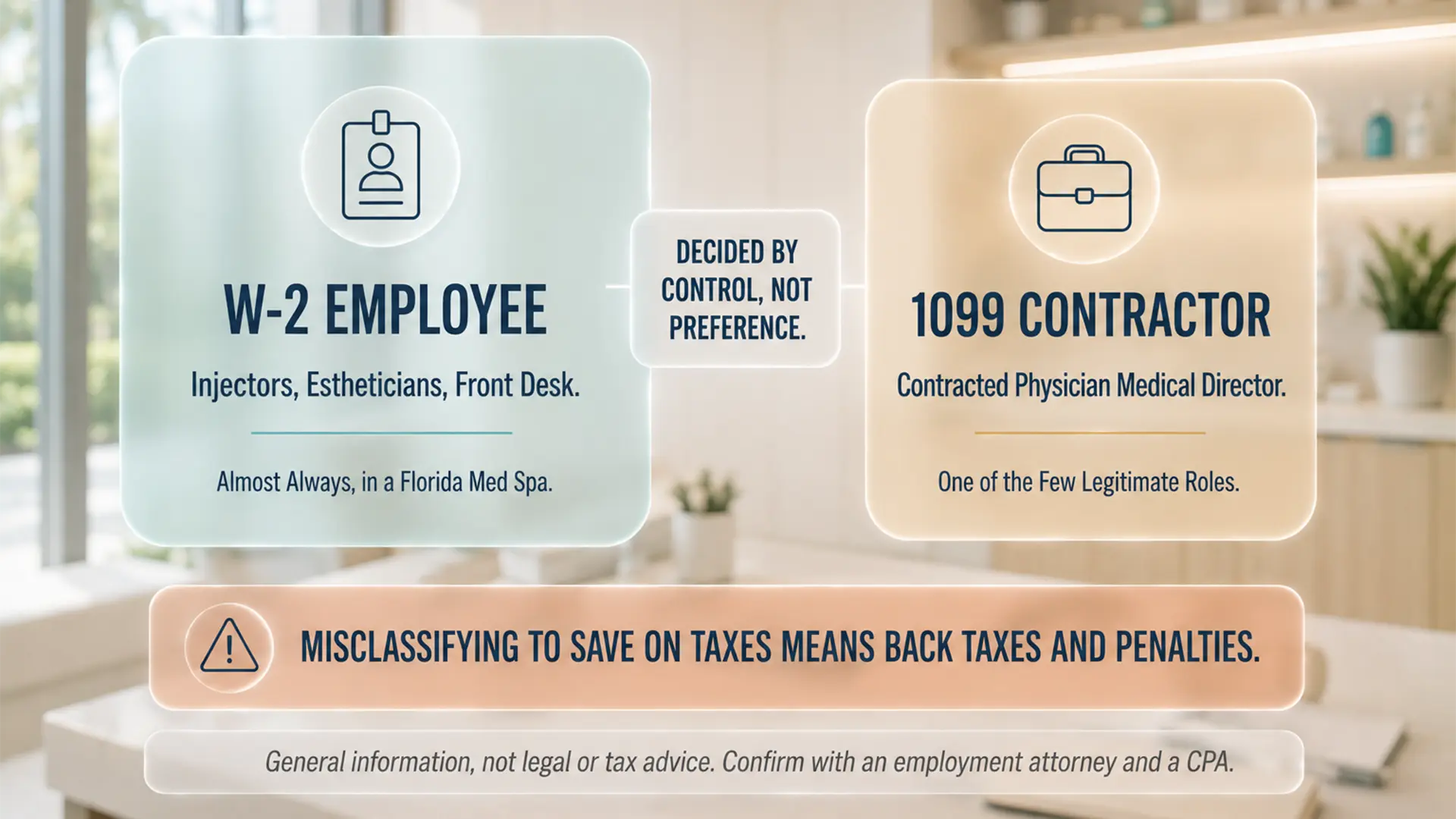
Getting 1099 vs W-2 right for your med spa staff is a legal test, not a preference.
For almost every med spa role in Florida the answer is W-2. Injectors, estheticians, laser technicians and front desk staff work your schedule, on your equipment, under your protocols, and that control is what the IRS and the Department of Labor test. The one role that is routinely and legitimately 1099 is the contracted medical director. Get it wrong and you owe back payroll taxes and penalties, and in Florida a reemployment tax assessment on top.
→ what a Florida med spa employee handbook must include to protect both the clinic and the team completes the staffing stack.
Every Florida med spa owner faces the 1099 vs W-2 question the moment they hire, and getting it wrong is one of the quietest ways to rack up back taxes and penalties. The appeal of 1099 is obvious: no payroll taxes, no benefits, less paperwork. The problem is that classification is not your choice to make freely; it is a legal test. Here is how it actually works for a med spa in Florida.
Classification is only half of the payroll question. The other half is the structure sitting on top of it, and designing a med spa commission structure by role decides whether the overtime exemption you are relying on actually applies.
1099 vs W-2 for med spa staff: what is the difference?
A W-2 employee works under your control and gets payroll taxes withheld; a 1099 independent contractor runs their own business and is responsible for their own taxes. The core of the 1099 vs W-2 distinction is control: the more you direct how, when, and where someone works, the more the law treats them as a W-2 employee, no matter what your contract calls them.
Florida does not have its own separate classification test; it follows the federal standards set by the IRS and the Department of Labor. So a med spa in Miami answers the same 1099 vs W-2 question as a business in any other state.
Can med spa staff be 1099 in Florida?
For most roles, no. The question of whether med spa staff can be 1099 comes down to control, and a med spa exercises a lot of it: you set the schedule, provide the room and devices, supervise the treatments, and require the work be done your way. That level of control makes your injectors, estheticians, and front desk W-2 employees in almost every case. Trying to classify them as 1099 is where clinics get into trouble.
Which med spa roles are W-2, and which can be 1099?
Here is how the common med spa roles usually break down. Treat this as a starting point to review with your own advisors, not a ruling:
| Role | Usual classification | Why |
|---|---|---|
| Nurse injector, NP, or PA provider | W-2 employee | You control schedule, tools, and supervision |
| Esthetician or laser technician on staff | W-2 employee | Same day-to-day control |
| Front desk and manager | W-2 employee | Core to running the business |
| Contracted physician medical director | Often 1099 | Independent, oversees rather than is managed |
| Outside vendor (IT, marketing) | 1099 | Own business, serves many clients |
| NP or PA hired per diem for good faith exams | Usually W-2; 1099 only if genuinely multi-client and self-directed | The control test decides, not the title |
| Physician injector working set clinic hours | W-2 employee | Same control as any other provider |
The medical director is the classic legitimate 1099 in this industry, because they provide oversight rather than being managed like staff. For what that role actually involves, see our guide to the Florida med spa medical director, the one role that is often legitimately an independent contractor rather than an employee.
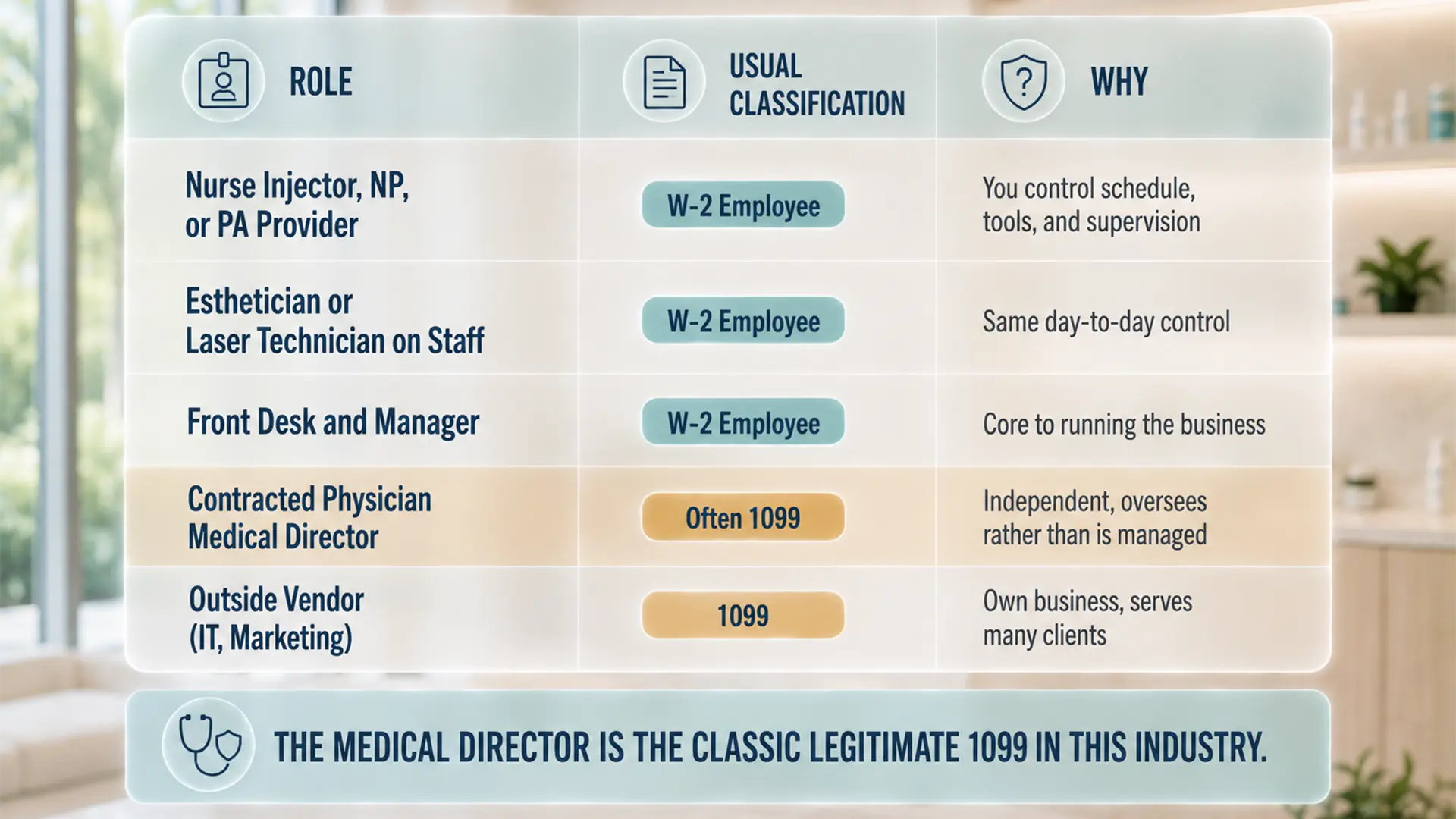
The 1099 vs W-2 decision shows up in payroll, taxes, and the penalties that follow a wrong call.
Classification also changes your margin, not just your legal exposure, because it moves payroll between a fixed and a variable line. See how clinical payroll sits inside a med spa P and L and why what you pay people decides owner take-home more than patient volume does for the financial side of the same decision.
The misclassification risk: what it costs a med spa
Misclassifying a W-2 employee as a 1099 contractor is the expensive mistake. If the IRS or the Department of Labor reclassifies your workers, the clinic can owe back payroll taxes, unpaid overtime, interest, and penalties, sometimes going back years. Add a disgruntled former worker filing a complaint, and a small tax saving turns into a large liability. Worker classification also ties directly into your broader compliance picture; our complete Florida med spa compliance guide puts worker classification alongside the rest of your legal and clinical stack.
The control test: how the IRS decides
When you are unsure, run the role through the control test. The more boxes fall on the left, the more clearly the worker is a W-2 employee:
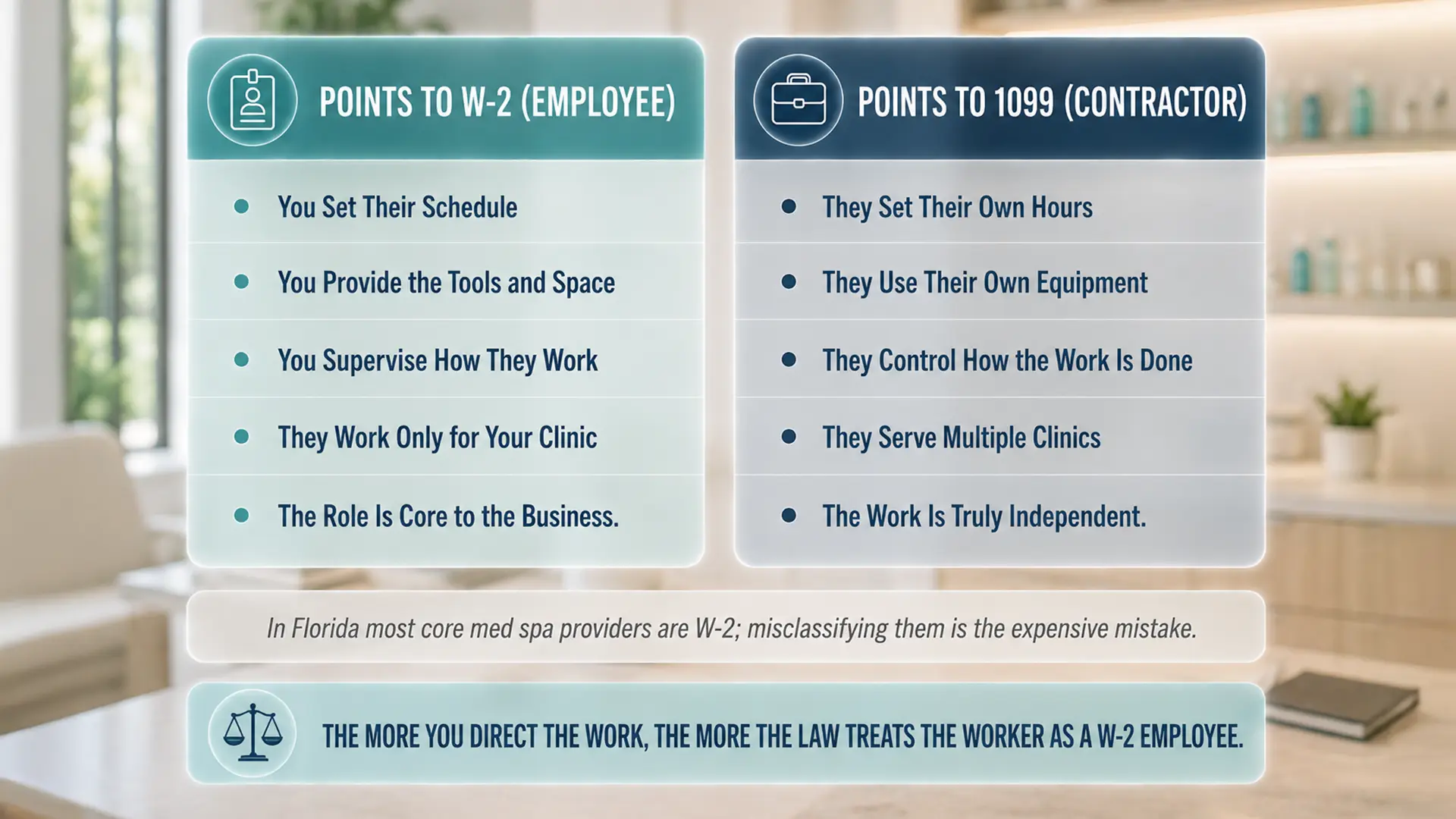
The control test: the more you direct the work, the more the law treats the worker as a W-2 employee.
For the official standards behind this test, review the IRS guidance on independent contractor versus employee classification, the federal standard every clinic must follow, and the U.S. Department of Labor rules on employee versus independent contractor status under the Fair Labor Standards Act.
1099 vs W-2 for a nurse injector specifically
The nurse injector is where owners are most tempted to use 1099, and where the risk is highest. An injector who works your schedule, in your rooms, with your product, under your medical direction is a textbook W-2 employee. The 1099 vs W-2 nurse injector question almost always lands on W-2, and the injector is too central a role to get wrong. Structure their pay as a W-2 base plus commission instead of reaching for a 1099 shortcut.
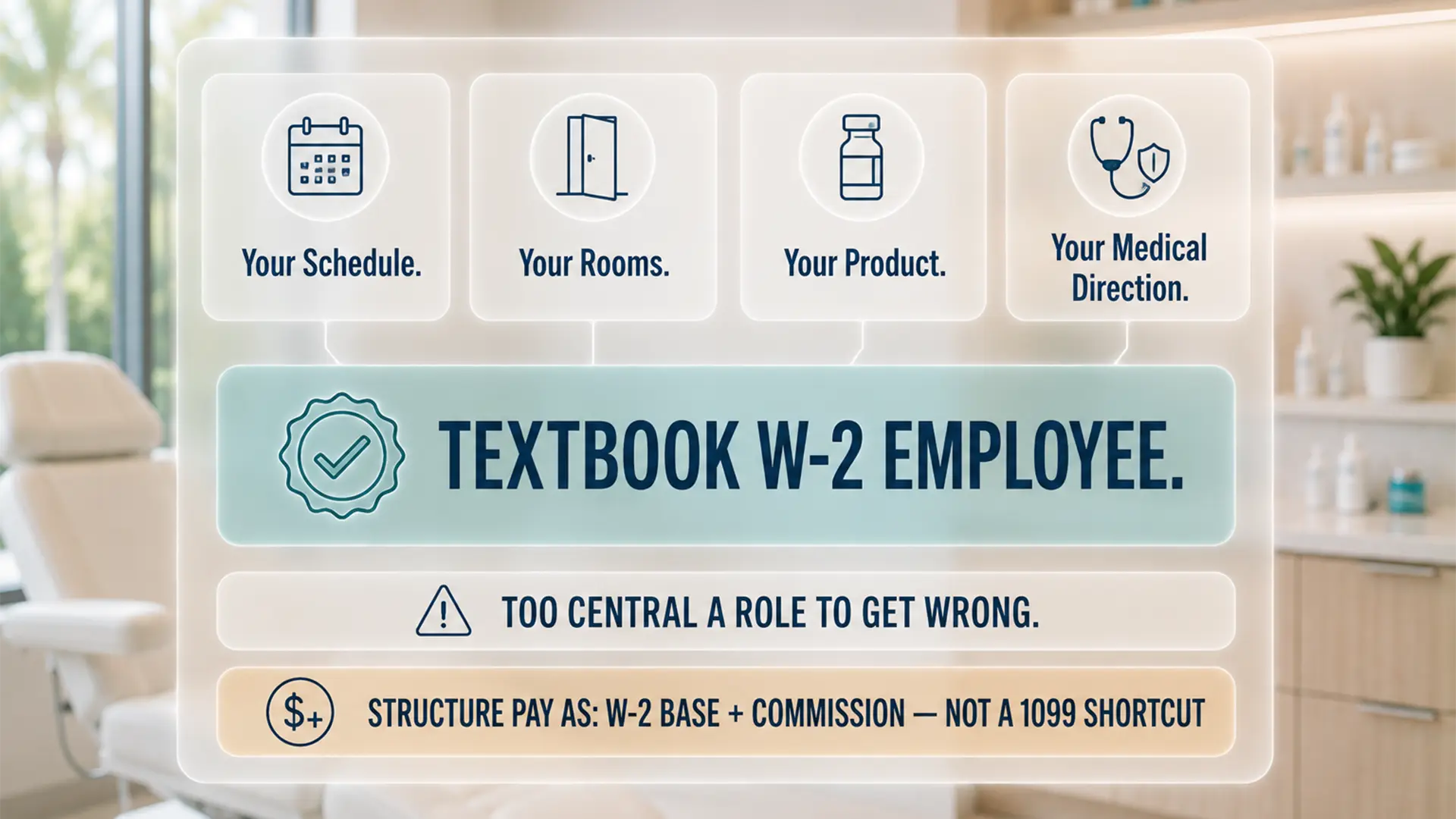
Your core med spa team, the people who run treatments day to day, are almost always W-2 employees.
Classification is decided before the offer, in the posting itself, because the duties list is the first evidence of how much control you intend to exercise. Our four copy-paste esthetician job description templates broken out by license level, with real South Florida pay bands and the scope Florida law does not permit in a duties list keep that record straight from day one.
How to classify your med spa staff correctly
Build classification into how you hire, not something you fix after an audit:
Price the W-2 version properly with our guide to what each aesthetic hire actually costs once payroll taxes and the ramp are counted, and keep the classification file with the rest of your records, as set out in our Florida med spa compliance guide.
- Default your core providers and staff to W-2 unless an advisor tells you otherwise.
- Reserve 1099 for genuinely independent roles like a contracted medical director or an outside vendor.
- Put every relationship in a written agreement that matches how the person actually works.
- Structure injector pay as a W-2 base plus commission, not a 1099 workaround.
- Review your classifications with an employment attorney and a CPA before you scale.
If you are still building the clinic, fold this into the setup: our step-by-step guide on how to open a med spa in Florida sequences payroll setup alongside the rest of the launch, and our Florida med spa business plan guide builds payroll and classification costs into your financial projections. Classification is also a staffing decision, and our guide to med spa staffing in Florida covers building the team these classification rules apply to.
Physicians weighing the role should read how to become a medical director for a med spa in Florida, including the physician requirements, liability exposure, and compensation models clinics use to structure the position.
→ the recurring training requirements a Florida med spa must provide and document for its clinical staff maps the recurring obligations by role.
The IRS 20 factor test, in med spa terms
The IRS now groups its questions under behavioral control, financial control and the relationship between the parties, but the twenty factors from Revenue Ruling 87-41 are still the checklist auditors and attorneys reach for. Here they are, translated for a treatment room. Each yes pushes the worker toward W-2.
Behavioral control
- Do you give instructions on how, when and where the work is done?
- Do you train them on your protocols and devices?
- Is their work part of your core service? Injecting is; IT support is not.
- Must they perform the work personally?
- Do you hire, supervise and pay any assistants they use?
- Is the relationship continuing rather than project based?
- Do you set the hours?
- Is it effectively full time for you?
- Is the work done on your premises?
- Do you set the order or sequence of tasks?
- Do you require reports?
Financial control
- Do you pay by the hour, week or month rather than by the job?
- Do you reimburse business expenses?
- Do you supply the tools, product and devices?
- Has the worker made no significant investment of their own?
- Is the worker unable to realise a profit or a loss?
- Do they work for you alone rather than for several clinics?
- Are their services unavailable to the general public?
Relationship
- Can you discharge them at will?
- Can they quit at will without liability?
Score an injector on that list and the result is rarely in doubt. The official texts are short: IRS Tax Topic 762 explains the independent contractor versus employee distinction and the three categories of evidence, and IRS Publication 15-A, the Employer's Supplemental Tax Guide, sets out the common law rules in full with examples. Florida applies its own version for reemployment tax: Florida Statute 443.1216 defines employment for reemployment assistance using the same common law control test.
If you are the injector being offered a 1099
Read this section as the candidate, because a good share of the people searching this question are. A 1099 offer at the same hourly rate as a W-2 job is a pay cut. You take on the employer's 7.65 percent share of Social Security and Medicare, you lose unemployment coverage and workers' compensation, and you buy your own malpractice policy. A set schedule, clinic prices, clinic product and a manager over you add up to an employee, whatever the contract says.
- Ask why the role is 1099. "Everyone does it" is not a reason; a multi-client per diem provider is.
- Ask who carries malpractice and what happens after an adverse event.
- Ask for the rate in both forms. If the 1099 rate is not materially higher, you are subsidising the clinic's payroll tax.
- Read the non-compete before you sign; our guide to med spa non-compete agreements in Florida explains what is enforceable and for how long.
How Florida med spas actually pay injectors, with base, hourly and commission models side by side, is covered in our pay guide, and the commission structures clinics use, and the ones that quietly shift risk to the provider, are in our commission guide. Compare offers with the classification written into each one before you decide; browse the South Florida clinics hiring injectors on Enhance.work and ask the classification question first.
Frequently asked questions
What is the difference between 1099 and W-2 for med spa staff?
A W-2 employee works under your control with payroll taxes withheld; a 1099 independent contractor runs their own business and pays their own taxes. The deciding factor is how much control you have over how the work is done.
Can med spa staff be 1099 in Florida?
For most roles, no. Injectors, estheticians, and front desk staff work under enough clinic control that the law treats them as W-2 employees. Florida follows the federal IRS and Department of Labor standards.
Should a nurse injector be 1099 or W-2?
Almost always W-2. An injector who works your schedule, in your rooms, with your product and medical direction is a classic employee. Structure their pay as a W-2 base plus commission rather than a 1099 arrangement.
Can a med spa medical director be 1099?
Often yes. A contracted physician medical director who provides oversight rather than being managed like staff is one of the few roles that can legitimately be an independent contractor. Confirm the structure with your advisors.
What happens if a med spa misclassifies employees?
The clinic can owe back payroll taxes, unpaid overtime, interest, and penalties if the IRS or Department of Labor reclassifies the workers, sometimes for multiple prior years. It is a large liability for a small short-term saving.
Does Florida have its own worker classification rules?
Florida largely follows the federal standards set by the IRS and the Department of Labor. A Florida med spa applies the same control-based test as businesses in other states; confirm specifics with a Florida employment attorney.
Is it better to be paid 1099 or W-2?
For a med spa injector, W-2 almost always. You keep unemployment and workers' compensation coverage, the clinic pays half your payroll tax and carries malpractice, and the classification is the legally correct one for a role the clinic controls. 1099 only wins when you genuinely run your own practice across several clinics and price your own work.
Does W-2 pay more than 1099?
Not on the face of the offer, but usually in total. The same $60 an hour is worth more as W-2 because the employer pays 7.65 percent in FICA on top, plus reemployment tax and workers' compensation. A 1099 rate has to be materially higher to match, and it rarely is.
What are the disadvantages of being a 1099 worker?
Self-employment tax on the full 15.3 percent, no unemployment benefits, no workers' compensation, your own malpractice premium, quarterly estimated taxes, and no protection under most employment laws. For the clinic, the disadvantage is the misclassification liability if the arrangement does not survive the control test.
Which med spa roles can legitimately be 1099?
A contracted medical director who oversees rather than is managed, a genuinely independent per diem NP or PA who serves several clinics on their own terms, and outside vendors. Our guide to the med spa medical director in Florida covers how that contract should be structured and priced. Everyone who works your schedule on your devices is W-2.
Classify it right, and sleep at night
The 1099 vs W-2 decision is not where a med spa should try to save money. Default your core team to W-2, reserve 1099 for genuinely independent roles like your medical director, document everything, and have an attorney and CPA confirm it. Get classification right and one of the biggest hidden liabilities in the business simply goes away.
This article is general information, not legal or tax advice. Worker classification rules and enforcement change; confirm every classification with a Florida employment attorney and a licensed CPA.