
Key takeaways
- A med spa non compete in Florida is enforceable when it is reasonable, because Florida is one of the more employer-friendly states on restrictive covenants.
- A non-compete must be in writing, limited in time and area, and protect a legitimate business interest.
- The FTC's 2024 rule to ban most non-competes was blocked in court, so Florida state law governs.
- A non-solicitation agreement is often the more practical tool for protecting your patient base.
- The most durable protection is a team that wants to stay, not just a restrictive covenant.
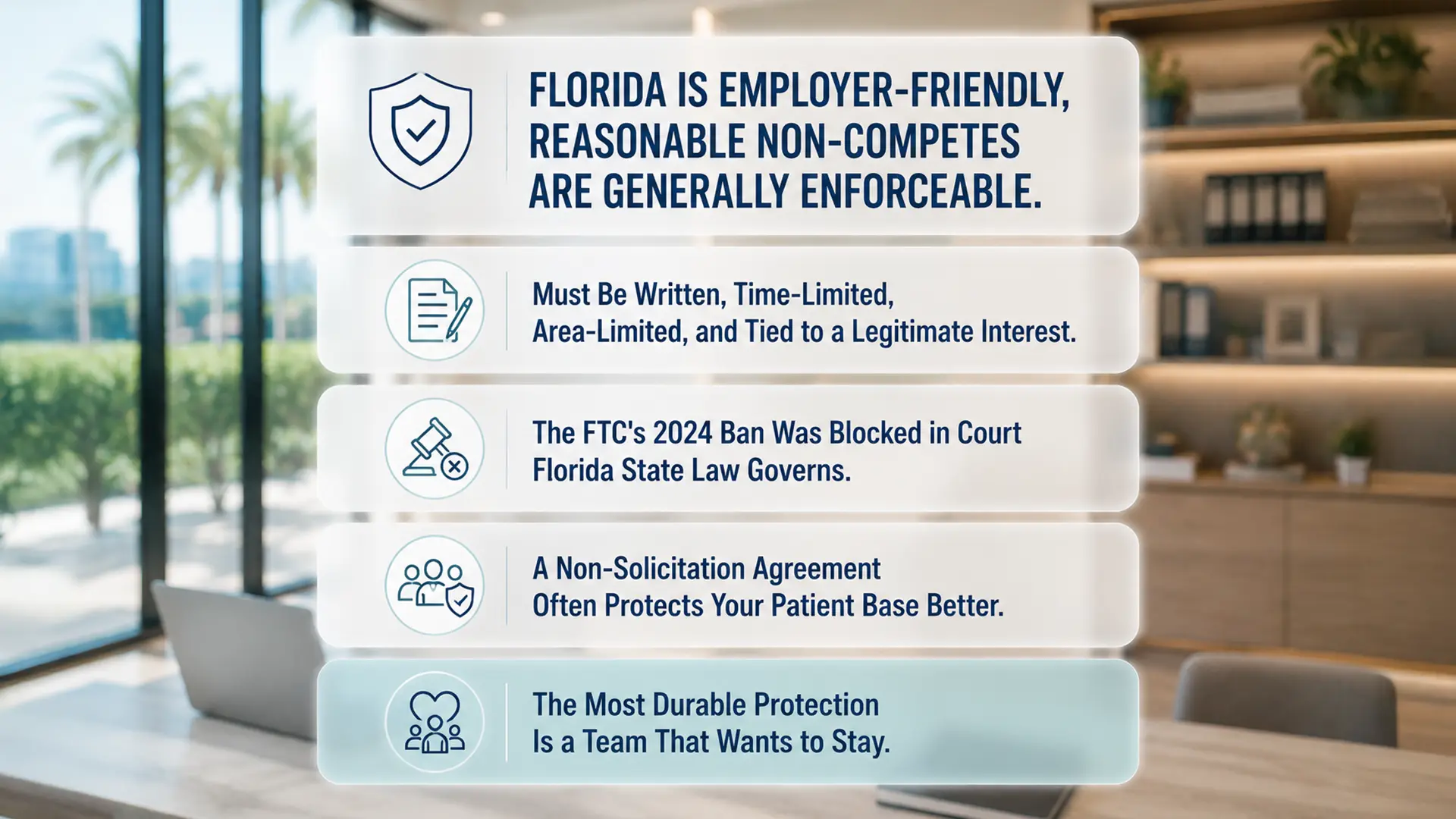
Reasonable non-compete agreements are generally enforceable for Florida med spa owners.
A med spa non compete in Florida is enforceable, but only within limits the statute sets in advance. Florida law presumes any restraint of 6 months or less is reasonable and presumes anything longer than 2 years is not, and the clinic has to prove a legitimate business interest before a court will enforce anything at all. The federal ban that was going to void these agreements never took effect.
When you invest in training an injector or building a patient base, losing that provider to the clinic down the street stings. Non-compete agreements are one way Florida med spa owners protect the practice, and this guide explains what you can and cannot enforce. This is general information for owners, not legal advice, so confirm the specifics with a Florida employment attorney before you rely on any agreement.
Are non-competes enforceable in Florida?
Yes. Florida is one of the more employer-friendly states, and courts generally enforce non-compete agreements that are reasonable in time and geographic area and that protect a legitimate business interest. A 2025 update to Florida law made the state even more favorable to employers for higher-earning staff. For how these rules sit alongside the rest of your obligations, our Florida med spa compliance guide covers medical direction, good faith exams, and the ownership and supervision rules every clinic has to follow.
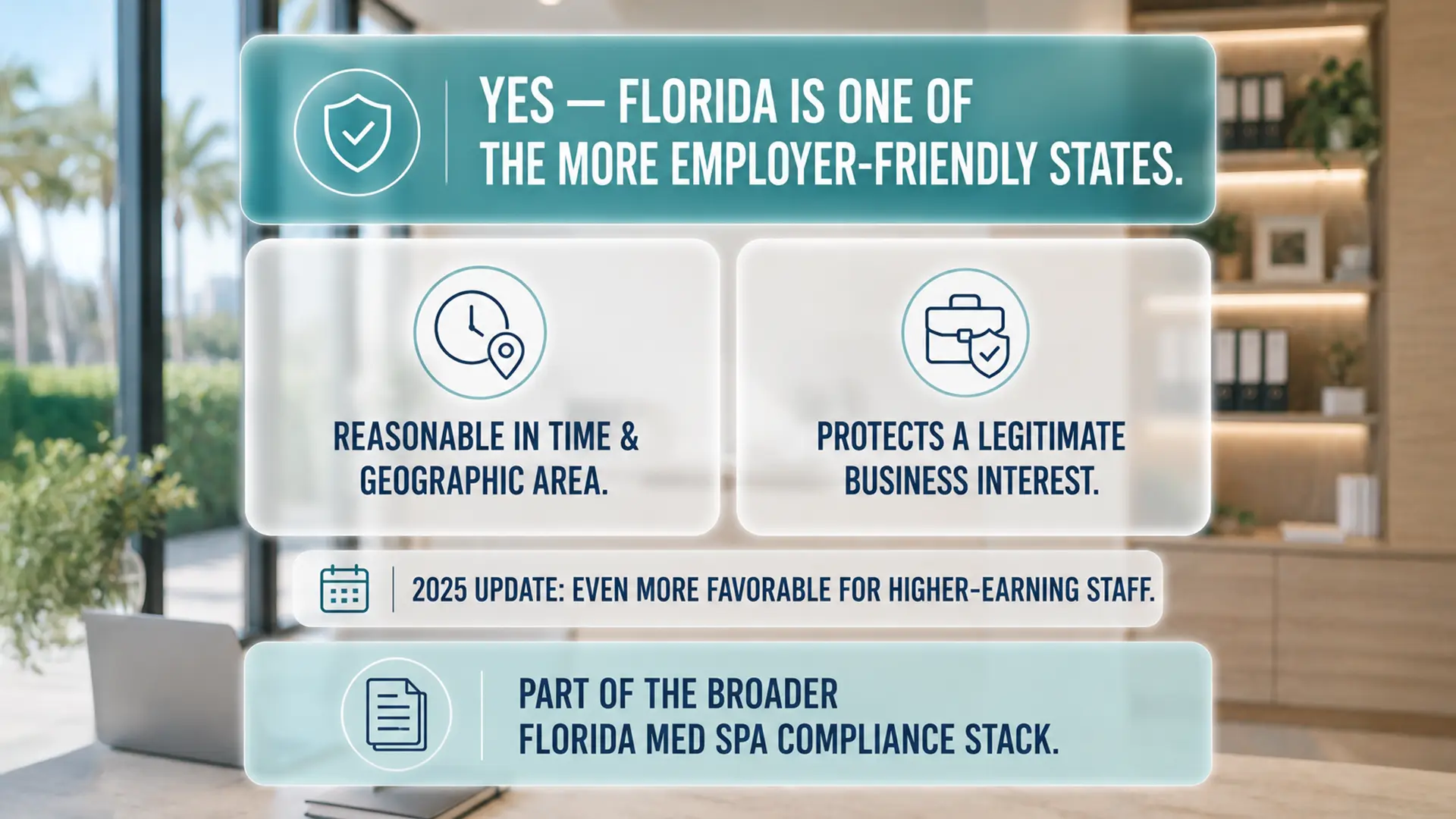
What makes a med spa non-compete enforceable in Florida: reasonable time, area, and a legitimate business interest.
What makes a med spa non-compete enforceable?
Florida courts look at whether the agreement is reasonable and protects something real. In practice, that means it should be in writing and signed, limited to a reasonable duration rather than indefinite, restricted to a defined geographic area rather than the whole state, and tied to a legitimate business interest such as patient relationships, goodwill, or confidential information. Overly broad terms are the most common reason a court narrows or refuses to enforce a covenant, so tighter and more specific usually holds up better than sweeping and vague.
Non-compete vs non-solicitation: which protects your patients?
These are different tools. A non-compete restricts where a provider can work after leaving; a non-solicitation restricts them from taking your patients or recruiting your staff. For most med spas, the real worry is a departing injector calling their patient list, and a well-drafted non-solicitation is often the more practical and defensible way to protect that. The American Med Spa Association goes deeper here: the American Med Spa Association covers how non-competes, non-solicitations, and confidentiality terms work together to protect a medical spa.
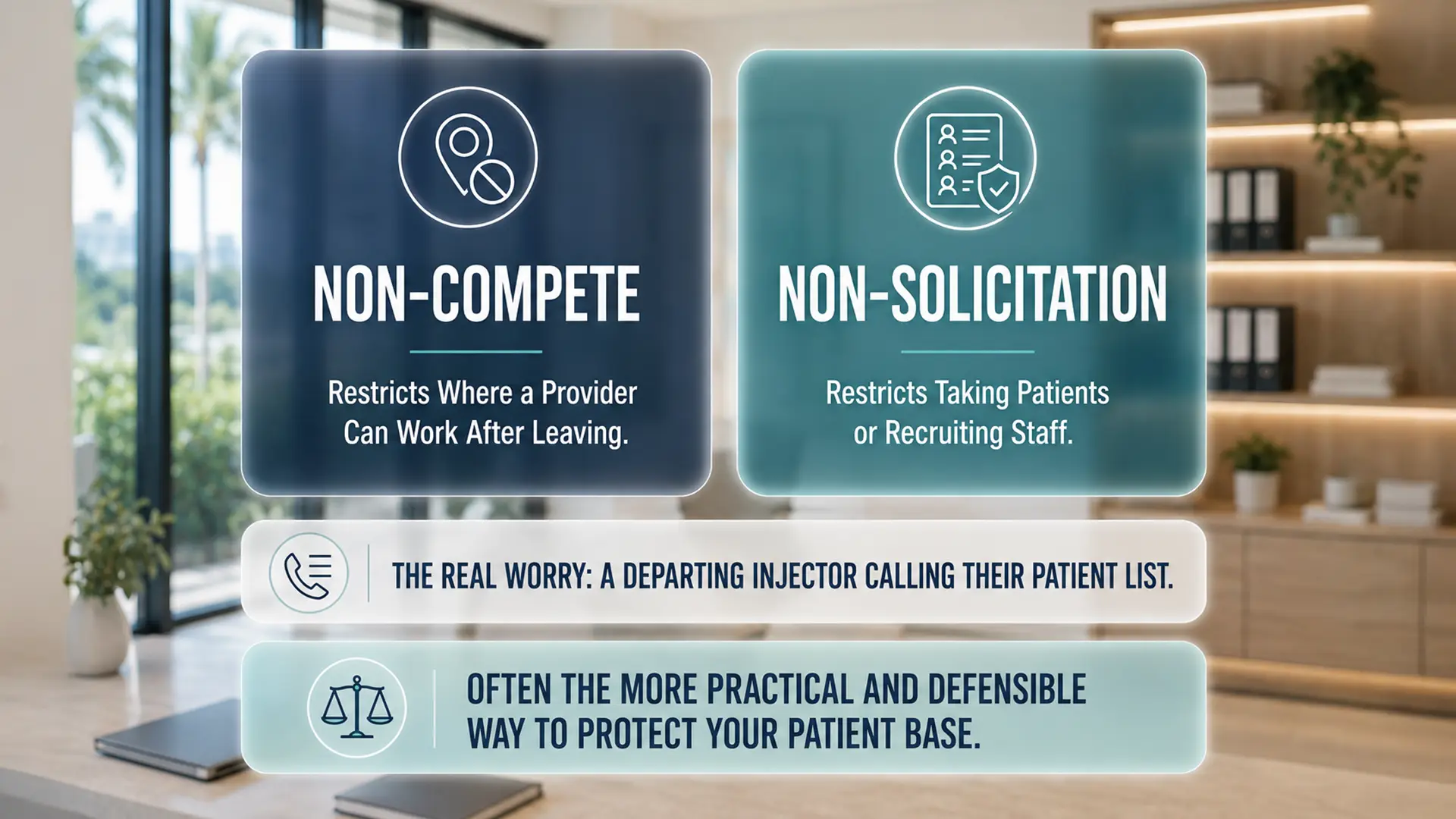
Owners should have restrictive covenants drafted or reviewed by a Florida employment attorney.
Is the FTC non-compete ban still coming?
You may have seen headlines about non-competes being banned. In 2024 the Federal Trade Commission finalized a rule to ban most non-competes nationwide, but a federal court blocked it, so it is not in effect. That means non-competes are still governed by state law, and Florida remains employer-friendly. Because federal and state rules can change, confirm the current status before you draft or enforce anything: the Federal Trade Commission maintains the official status of its non-compete rulemaking and any updates to the federal position.
How to protect your med spa when a provider leaves
Restrictive covenants are only one layer. The strongest protection is a mix of legal and practical steps:
- Use a reasonable, narrowly written non-compete and non-solicitation, reviewed by a Florida attorney.
- Protect patient data and processes with clear confidentiality terms.
- Own the patient relationship as a practice, not just through one provider.
- Hire for fit and retention so people want to stay, which no clause can replace.
- Onboard and document consistently so agreements are signed and enforceable.
Hiring well is the part most owners underrate. A stable, well-matched team reduces turnover in the first place, and our guide to med spa staffing in Florida walks through building a team through agencies, in-house hiring, or specialized recruiting covers the options. When you do hire an injector, our guide on how to hire a nurse injector in Florida explains what to screen for and how to structure the role from the start. And if you are still setting up, our breakdown of who can own a medical spa in Florida covers the ownership and medical-oversight rules that frame every employment agreement.
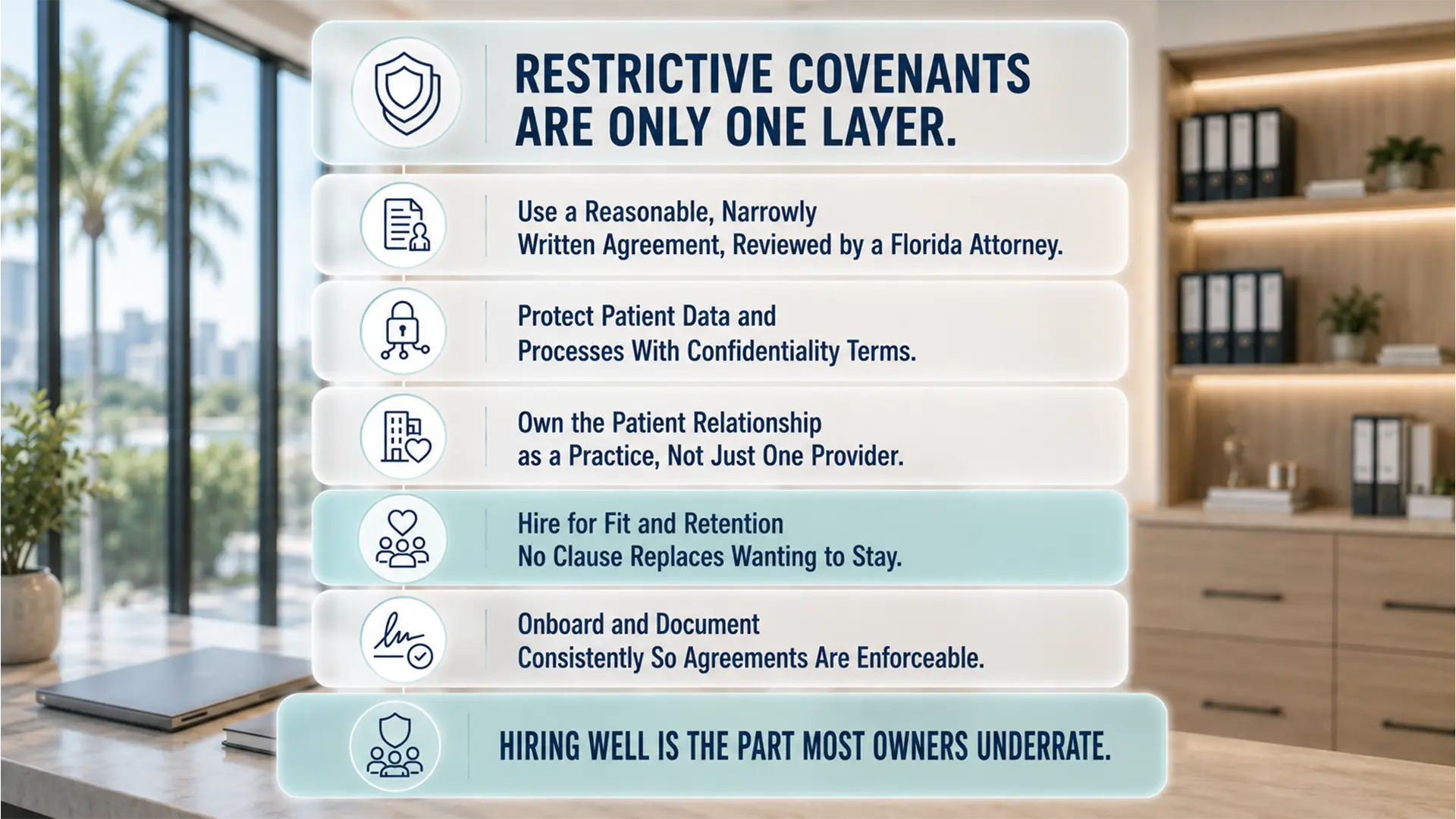
A clear, reasonable agreement plus a team that wants to stay is the most durable protection.
Sources: Florida Board of Medicine.
What does Florida Statute 542.335 actually require?
Three things, in order, and a clinic that skips any of them loses. Florida Statute 542.335 permits contracts that restrict competition so long as they are reasonable in time, area and line of business. First, the restraint has to be in writing and signed by the person you want to enforce it against. Second, the clinic must plead and prove a legitimate business interest that justifies it. Third, it must show the specific restraint is reasonably necessary to protect that interest. The statute is blunt about what happens if the second step fails: any restrictive covenant not supported by a legitimate business interest is unlawful, void and unenforceable.
The statute lists what counts as a legitimate business interest, and the list is what decides most med spa disputes. It includes trade secrets as defined in Florida Statute 688.002(4), the Uniform Trade Secrets Act definition, valuable confidential business information that is not a trade secret, substantial relationships with specific prospective or existing patients, goodwill associated with a trade name or a specific geographic location, and extraordinary or specialized training. Note what is not on the list: the general fear that a good injector will compete with you.
| What the clinic wants to protect | Is it a legitimate business interest? | What the clinic has to show |
|---|---|---|
| The patient list and booking history | Yes, as a substantial relationship with specific existing patients | That the departing provider actually treated those patients and had access to the list |
| Pricing, protocols and vendor terms | Yes, as valuable confidential business information | That the information is not public and the clinic took steps to keep it that way |
| The clinic brand in a defined area | Yes, as goodwill tied to a trade name or geographic location | That the goodwill exists in the area the clause covers, not a whole county by default |
| Advanced injectable training you paid for | Yes, as extraordinary or specialized training | That the training went beyond ordinary onboarding and that the clinic funded it |
| The provider's own skill and reputation | No | Nothing. This is the interest courts refuse to protect |
| Avoiding competition in general | No | Nothing. The statute makes the covenant void without an interest |
How long can a med spa non-compete last in Florida?
The statute answers this with rebuttable presumptions rather than a hard cap, which is why the same 12 month clause can be enforced in one case and cut down in another. Statute 542.335(1)(d)1 tells a court to presume reasonable any restraint of 6 months or less and to presume unreasonable any restraint longer than 2 years, when the covenant is against a former employee, agent or independent contractor and is not tied to the sale of the practice. Between 6 and 24 months there is no presumption either way and the clinic carries the burden. Covenants that come with the sale of a practice get a longer runway.
One more provision decides how these cases end in practice. If a court finds the restraint overbroad or overlong, the statute directs it to modify the restraint and grant only the relief reasonably necessary. A Florida judge does not throw out an aggressive clause; the judge rewrites it. That is why an unrealistic 24 month, county wide clause usually converts into something much smaller rather than protecting anything.
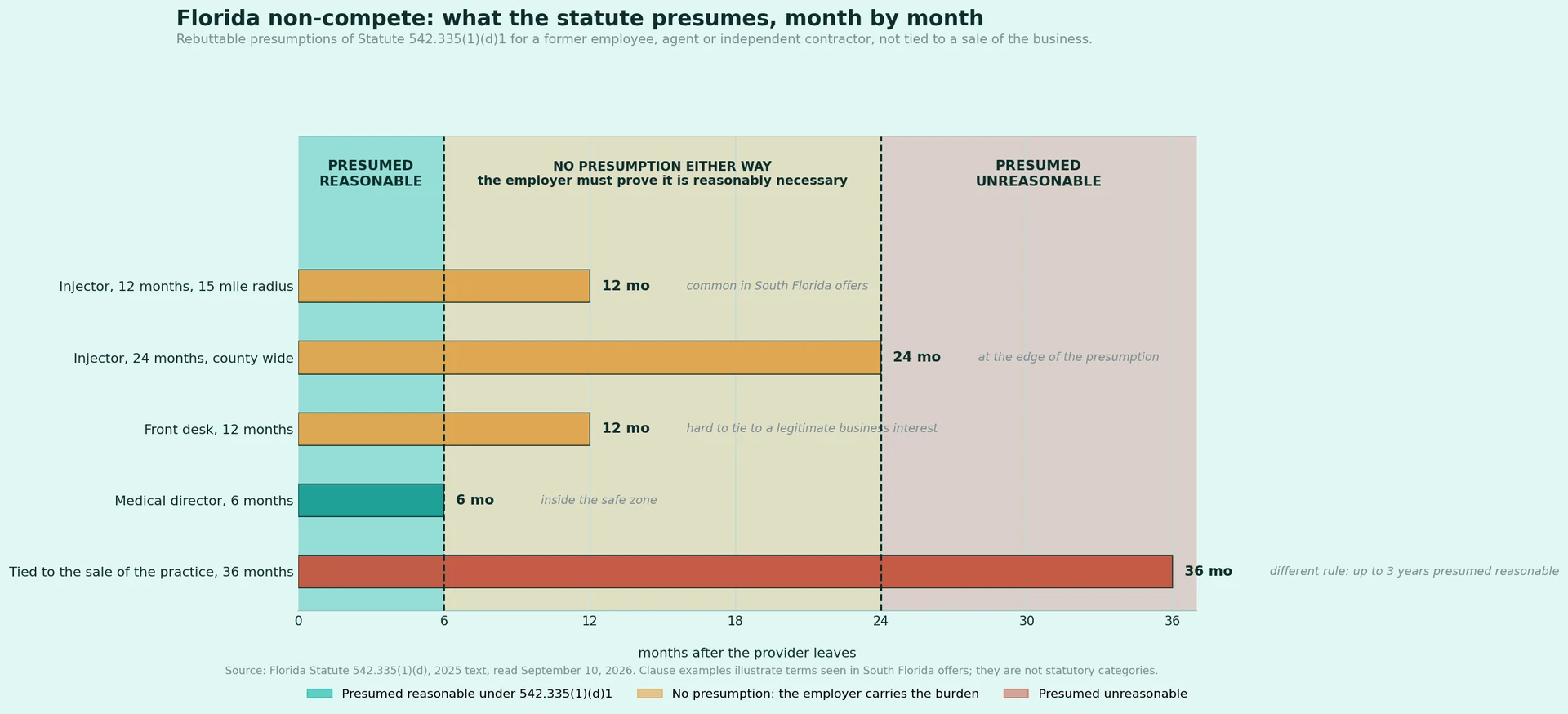
Where common med spa clause lengths fall against the statutory presumptions of Florida Statute 542.335(1)(d)1. The 6 month and 2 year lines are the statute; the clause examples are terms seen in South Florida offers.
Read the chart from the employer side and the conclusion is uncomfortable: the clause most clinics write, 12 months with a radius, sits in the zone where the clinic has to prove its case. The clause that is safest is the one most clinics think is too short.
What can you actually enforce against a departing injector?
Less than the contract says, and more than most owners assume, depending on which promise you are enforcing. Separating the clauses matters because courts treat them differently.
| Clause | What it stops | How it usually holds up in Florida |
|---|---|---|
| Non-compete | Working for a competitor inside a time and area | Enforceable with a legitimate interest; cut down if the time or radius is not justified |
| Non-solicitation of patients | Contacting patients the provider treated at your clinic | The strongest of the three, because it maps directly onto the substantial relationship interest |
| Non-solicitation of staff | Recruiting your team on the way out | Usually enforceable and rarely litigated, because the harm is easy to show |
| Confidentiality | Taking protocols, pricing and patient data | Enforceable independently of any non-compete, and survives even if the non-compete fails |
| Liquidated damages | Setting a price on breach in advance | Enforceable only if the amount is a genuine pre-estimate of loss rather than a penalty |
The practical order for an owner is the reverse of how most contracts are drafted. Confidentiality and patient non-solicitation do the real work. The non-compete is the clause that gets litigated and modified. Our guide to the Florida med spa employee handbook covers where these obligations belong in your documents and which ones a signed acknowledgment page has to cover, and our breakdown of how Florida med spas pay injectors explains why a compensation model that keeps a provider is worth more than a clause that punishes them for leaving.
Sources and how we checked them
Every figure on this page traces to one of the following. Where a number is our own observation rather than a published source, the text says so.
- The 6 month and 2 year presumptions, and the requirement to prove a legitimate business interest: Florida Statute 542.335, subsections (1)(b) and (1)(d)1, 2025 text, read 10 September 2026.
- The trade secret definition the statute borrows: Florida Statute 688.002(4), the Uniform Trade Secrets Act definition, read 10 September 2026.
- The status of the federal ban, which never took effect and whose appeals the Commission dropped in September 2025: the Federal Trade Commission rule page for the Non-Compete Rule, read 10 September 2026.
- The instruction to a court to rewrite rather than void an overbroad restraint, in 542.335(1)(c): the same statute, subsection (1)(c) on modification of an overbroad restraint.
- Clause durations of 6, 12, 24 and 36 months in the chart are terms seen in South Florida offers, not statutory categories, and are labelled as such on the chart itself.
Frequently asked questions
Are non-competes enforceable in Florida?
Yes. Florida is one of the more employer-friendly states, and courts generally enforce non-competes that are reasonable in time and geography and protect a legitimate business interest. A 2025 update made the state even more favorable to employers. This is general information, not legal advice.
Are non-competes banned in Florida?
No. The FTC's 2024 rule to ban most non-competes nationwide was blocked in court and is not in effect, so state law applies. In Florida, reasonable non-competes remain enforceable.
What makes a non-compete enforceable in a med spa?
It must be in writing and signed, limited to a reasonable time and geographic area, and protect a legitimate business interest such as patient relationships, goodwill, or confidential information. Overly broad terms are the most common reason a court trims or refuses to enforce one.
What is the difference between a non-compete and a non-solicitation agreement?
A non-compete restricts where a provider can work after leaving; a non-solicitation restricts them from taking your patients or staff. For protecting a patient base, a well-drafted non-solicitation is often the more practical and defensible tool.
Can an injector work for a competing med spa after signing a non-compete?
It depends on whether the agreement is reasonable and enforceable under Florida law. Because outcomes turn on the specific terms, both owners and providers should have the agreement reviewed by a Florida employment attorney.
How long can a med spa non-compete last in Florida?
There is no single number, but shorter, clearly reasonable durations are the most enforceable. Florida courts weigh the time period against the legitimate business interest being protected, so an attorney can advise what is reasonable for your situation.
How long can a non-compete last in Florida?
Six months or less is presumed reasonable and more than two years is presumed unreasonable for a former employee, agent or independent contractor under Statute 542.335(1)(d)1. In between, the clinic has to prove the length is reasonably necessary. Covenants tied to the sale of a practice get a longer presumption.
Did the FTC ban non-competes?
No. The FTC rule was set aside by a federal court in Texas before its effective date and never took effect. In September 2025 the Commission dropped its appeals. Florida non-competes are governed by Statute 542.335, as they were before.
Can a med spa stop a nurse injector from working nearby?
Only if it can prove a legitimate business interest and that the time and area are reasonably necessary to protect it. A radius that covers a whole county because the clinic is worried about competition, with no patient relationship or confidential information behind it, is the kind of clause a Florida court rewrites.
What is the difference between a non-compete and a non-solicitation?
A non-compete stops the provider from working; a non-solicitation stops them from contacting your patients or staff. The non-solicitation is usually easier to enforce because it maps directly onto the substantial relationship interest the statute names.
The bottom line: reasonable agreements, and a team that stays
In Florida, a reasonable, well-drafted non-compete is generally enforceable, and pairing it with a non-solicitation and confidentiality terms gives most med spas solid protection. But no clause replaces hiring people who want to stay. Get the agreements reviewed by a Florida employment attorney, and build a team strong enough that you rarely need to enforce them.