

Key Takeaways
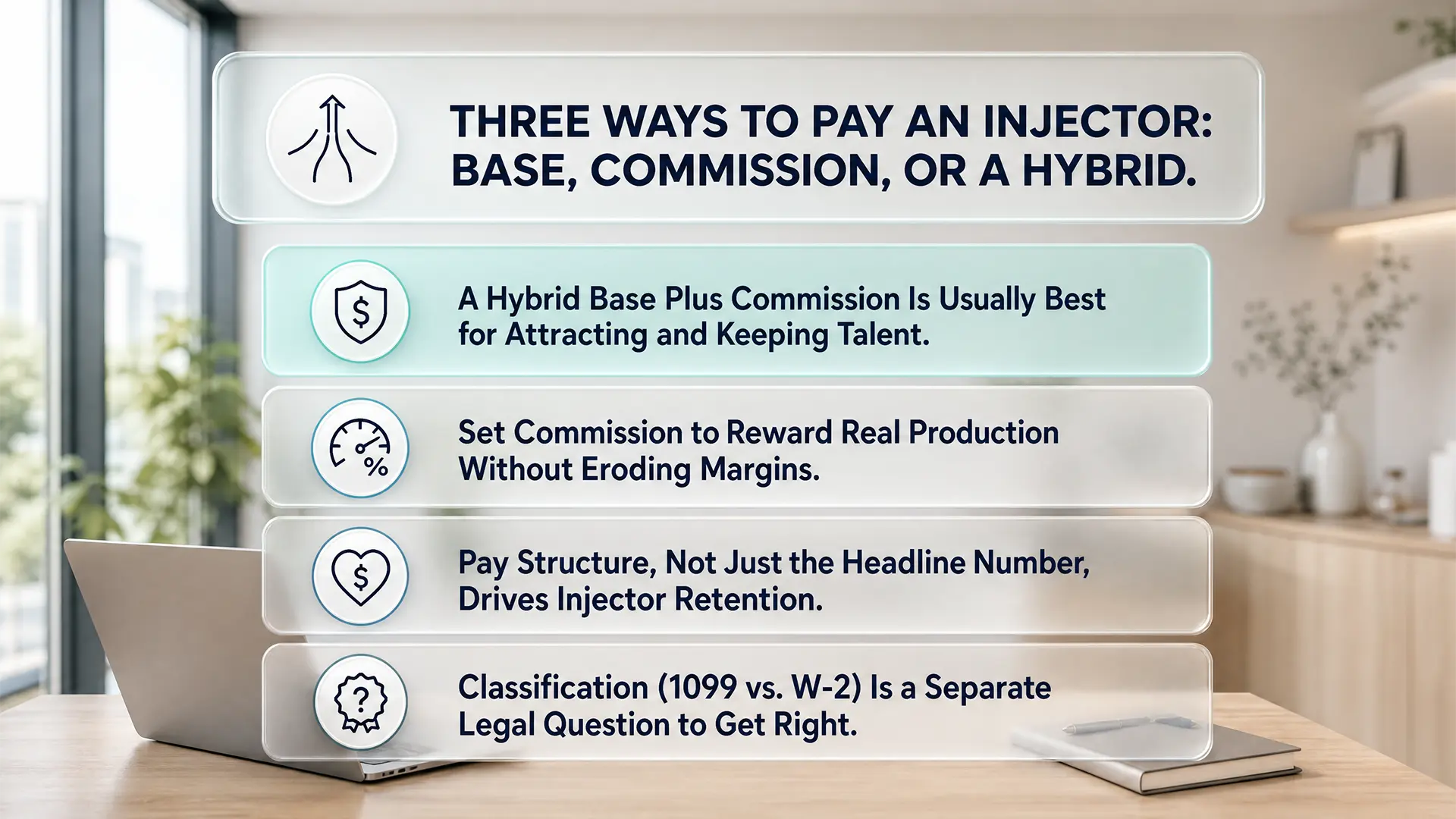
- How to pay a med spa injector comes down to three models: base or hourly, commission, or a hybrid of both.
- A hybrid base plus commission is the most common model and usually the best for attracting and keeping talent.
- Set commission so it rewards real production without pushing over-treatment or eroding your margins.
- Pay structure, not just the headline number, is one of the biggest drivers of injector retention.
- Classification, 1099 versus W-2, is a separate legal question you also have to get right.
How you structure injector pay is one of the strongest levers a Florida med spa owner has for retention.
How to pay a med spa injector in Florida is a choice between three models, and the right one depends entirely on where the provider is in their ramp. Straight commission pays below a living wage until the book is built, a flat base costs you margin once it is, and the hybrid exists to cover both.
The classification question sits underneath all three and decides more than the rate does.
How you pay your injectors decides who you can attract and, just as important, who stays. Get it wrong and your best injector leaves for the clinic down the street; get it right and you build a loyal, productive team. This owner's guide covers the three ways to pay a med spa injector, how to set commission without hurting margins, and why pay structure is a retention tool. It is general information for owners, not legal or financial advice, so confirm specifics with a Florida employment or tax advisor.
How do you pay a med spa injector?
There are three core ways to pay a med spa injector: a base or hourly wage, a commission on what they produce, or a hybrid that combines a stable base with commission. Most successful clinics land on the hybrid, because it gives the injector security while still rewarding production. The right structure depends on your volume, your services, and how you want to balance stability against incentive.
→ how to reduce med spa turnover in Florida, the retention levers that keep injectors and estheticians from leaving, and what turnover really costs an owner ties comp to retention.

The three injector compensation models: base or hourly, commission, and the hybrid most clinics choose.
The three ways to pay an injector
Base or hourly
A straight wage is predictable for the injector and simple for you to run, and it works for newer injectors still building a book. The downside is limited incentive: a salaried injector has no direct reason to grow production.
Commission
Paying a percentage of what the injector produces rewards output and can attract high performers. The risks are income volatility for the injector and, if it is not managed well, pressure to over-treat or over-discount. Commission alone suits experienced injectors with a following.
Hybrid: base plus commission
The most common model pairs a stable base with commission above a threshold. It gives security and upside, which is why it tends to attract and keep the strongest injectors. The exact split is where owners should spend their design time.

The pay model that keeps strong injectors is usually a stable base plus commission on production.
Which pay model attracts and keeps the best injectors?
For experienced, in-demand injectors, a hybrid almost always wins: they want the security of a base and the upside of commission. A pure hourly offer often loses top talent to clinics that share the upside, while pure commission can feel risky and transactional. Before you set your numbers, know the market; our detailed look at aesthetic injector salaries in Florida shows the market rates your offer has to compete with.
Commission only makes sense against the wider picture of where your revenue goes, which is why it helps to see how clinical payroll sits in a med spa P&L and why your compensation model moves owner take-home more than patient volume does before you set a percentage.
How to set commission without hurting margins
Commission should reward production the clinic actually profits from. Tie it to the right base (service revenue net of product cost is cleaner than gross), avoid rewarding heavy discounting, and model the plan against your real margins before you promise anything. A plan that pays out more than the treatment earns is worse than no commission at all. Keep it simple enough that an injector can understand exactly how a strong month pays off.
Model any commission plan against real margins before you promise it, so pay rewards profitable production.
Classification: 1099 or W-2?
How you structure pay is separate from how you classify the worker, and getting classification wrong is a costly mistake. Most clinical injectors are W-2 employees, not 1099 contractors, but it depends on the real working relationship. Do not decide this casually; our breakdown of 1099 versus W-2 for med spa staff in Florida explains how to classify and pay your team legally.
Pay is a retention tool, not just a cost
Owners who treat pay as a pure cost lose people; owners who treat it as a retention investment keep them. A fair, transparent, well-designed plan is one of the cheapest ways to hold onto an injector you spent months hiring. It works best alongside hiring the right person in the first place, so pair it with our guide on how to hire a nurse injector in Florida, which walks the full process from sourcing to a signed offer and our guide to med spa staffing in Florida, which covers building and keeping the team your pay plan is meant to retain.
Sources: Florida Board of Nursing.
What does each model actually pay at different production levels?
Model the three side by side before you offer one. The parameters below are the ones South Florida clinics use most often, and the crossover points are where the conversation with a candidate actually happens.
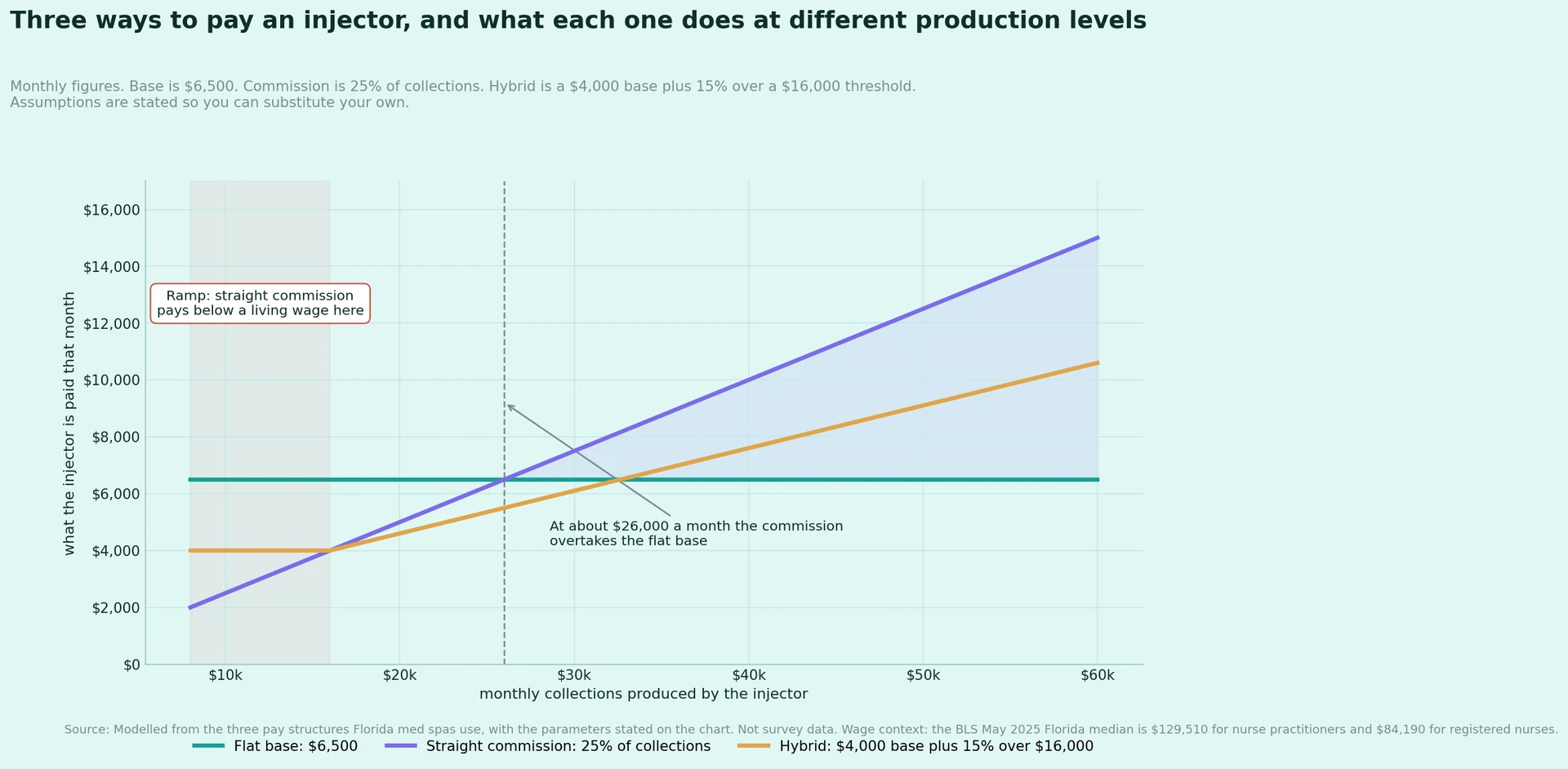
What the injector takes home under each model as monthly collections rise, with the crossover marked. Parameters are stated on the chart so you can substitute your own; this is a model, not survey data.
Three things fall out of the crossover. Below about $16,000 a month in collections, straight commission pays a provider less than they can live on in this market, which is why it loses candidates during the ramp. At about $26,000 a month the commission overtakes a $6,500 base, so a productive injector on a flat base is being underpaid and knows it. And the hybrid tracks between the two, which is why it is the model that survives contact with both a new hire and a senior one.
Set the threshold from the loaded cost of the seat rather than from a round number. Our breakdown of what each aesthetic hire actually costs once payroll taxes and the ramp are counted gives you the figure the threshold has to clear.
Does the pay model change the classification question?
No, and that is the mistake. Paying an injector on commission does not make them a contractor. The control test does: who sets the schedule, whose devices and product are used, whose protocols govern the treatment and whose prices apply. An injector working your hours on your equipment under your medical director is an employee whatever the pay structure says. Our guide to 1099 versus W-2 for Florida med spa staff walks through the IRS control test in clinic terms and what misclassification costs. Get this wrong and the pay model is the least of it: you owe back payroll taxes, and the workers' compensation policy will not respond for a misclassified worker.
Sources and how we checked them
The wage and scope references below are federal or statutory and dated. The pay parameters are a stated model, not a survey.
- Wage context for the models: the Florida median is $129,510 for nurse practitioners and $84,190 for registered nurses, from BLS Occupational Employment and Wage Statistics, Florida state estimates, May 2025, pulled 10 September 2026.
- The scope boundary that decides who can hold an injecting role at all: Chapter 464 of the Florida Statutes and Florida Statute 458.331(1)(q), which makes prescribing outside the course of the physician's professional practice a ground for discipline, together with 458.331(1)(t) on the standard of care and, where the evaluation happens by telehealth, Florida Statute 456.47(2). Older articles cite Rule 64B8-9.014 for this duty; that rule governed telemedicine prescribing and was repealed with effect from 26 October 2014.
- The written protocol under which a delegated injector works: Florida Statute 458.348.
- The pay parameters in the chart, a $6,500 base, a 25 percent commission and a $4,000 base with 15 percent over a $16,000 threshold, are a model built from the structures we see in live South Florida offers. They are stated on the chart so you can substitute your own; they are not survey data.
Frequently asked questions
How do you pay a med spa injector?
Three core ways: a base or hourly wage, a commission on what they produce, or a hybrid that combines a base with commission. Most clinics use the hybrid because it balances security and incentive.
Should med spa injectors be paid commission?
Often yes, but usually as part of a hybrid rather than pure commission. Commission rewards production, while a base gives the injector stability and reduces pressure to over-treat.
What is a typical injector commission structure?
A common structure is a base wage plus commission on production above a threshold, tied to revenue net of product cost. The exact split varies by clinic, volume, and services, so model it against your margins.
Is it better to pay an injector hourly or commission?
For newer injectors, hourly is simpler; for experienced ones with a following, a hybrid usually wins because it offers both security and upside. Pure hourly often loses top talent.
Should a med spa injector be 1099 or W-2?
Most clinical injectors are W-2 employees, but it depends on the actual working relationship. Misclassification is costly, so confirm with a tax or employment advisor before deciding.
How does pay affect injector retention?
Strongly. Pay structure and fairness are among the top reasons injectors stay or leave, so a transparent, well-designed plan is one of the most cost-effective retention tools you have.
Design pay to keep the injectors you hire
The best injector pay plan is not the cheapest; it is the one that attracts strong people, rewards profitable production, and makes them want to stay. Pick a hybrid that fits your margins, get classification right, and treat pay as the retention investment it is. For how the wider industry structures this, the American Med Spa Association tracks how clinics structure injector pay and broader compensation trends, and the Society for Human Resource Management publishes best practices on designing fair, competitive compensation plans.