Key Takeaways
- Becoming a med spa medical director in Florida starts with the licence: the law requires the medical director of any med spa offering medical procedures to be a Florida-licensed MD or DO in good standing, with the medical director responsible for delegation, protocols, and chart oversight.
- There are two completely different versions of the role: administrative (mostly oversight, $2,000 to $5,000 a month in South Florida) and practicing (actually performing or running clinical work, with salary or commission like any other medical job).
- Administrative medical director time commitment is modest: weekly check-ins, periodic chart reviews, and being reachable by phone if something goes wrong. It is not a full-time job.
- The real barrier to landing the role in South Florida is not malpractice coverage. It is finding a med spa that operates legitimately, because attaching your license to a poorly run practice puts your license and personal liability on the line.
- Most South Florida medical director placements happen through physician referrals or direct industry networking. Applying online or through job boards is rarely how the role is filled.
To become a med spa medical director in Florida you need an active Florida MD or DO license in good standing and a willingness to sign the practice's protocols and answer for delegation. The role comes in two versions: administrative oversight, which pays about $2,000 to $5,000 a month in South Florida, and practicing clinical work.
A medical director's day-to-day work in a South Florida med spa is closer to chart review and protocol oversight than hands-on clinical practice.
Most physicians who get approached to become the medical director of a med spa in Florida walk into the conversation thinking it is one role. It is actually two, and the version a clinic is offering you completely changes the pay, the time commitment, and the risk you take on. A board-certified family physician in Coral Gables can get offered a $3,000 monthly retainer for what amounts to weekly check-ins and being on call, and a dermatologist in Aventura can get offered a full clinical schedule that pays like any other practicing role. Both are real. They just live on opposite ends of the spectrum, and the literature for prospective medical directors almost never distinguishes between them.
This guide on the medical director florida med spa market explains what each version actually involves, what South Florida med spas pay for both, what Florida law expects of you as the named medical director, and what to look at before signing. It is written for the MD or DO considering the role, not for the owner trying to hire one.
Med Spa Medical Director in Florida: The Two Roles Nobody Separates
When a Florida med spa medical director search begins, the call usually comes from a salon owner or aesthetic-business operator calls a physician about being their medical director, the underlying question they are asking depends on what the clinic actually plans to do.
If the practice offers injectables, lasers, microneedling, IV therapy, weight-loss pharmacology, or anything else that falls under the practice of medicine in Florida, they need a named medical director by law. In a lot of those cases, the role is what we call administrative. The physician sets up the standing orders, signs off on the protocols, reviews charts on a defined cadence, and stays reachable by phone in case a complication develops. The actual patient-facing work is done by APRNs, RNs, or licensed aestheticians depending on the procedure. The medical director does not necessarily inject, laser, or consult patients themselves.
If the practice expects the physician to actually see patients, run consultations, perform procedures, or build out the medical side of the business, that is the practicing role. In practice it looks like any other physician job. The doctor commits real clinical hours, gets paid as an employee or independent contractor, and is compensated either through a salary or a commission structure tied to the services they personally provide.
Florida law does not use different terms for these two arrangements. The med spa still has a named medical director either way. But the day-to-day reality, the malpractice exposure, the time commitment, and the compensation are dramatically different, and a doctor who agrees to one and then gets pulled into the other is in a much riskier position than they realize.
What does Florida law require of a med spa medical director?
Florida is one of the stricter states on med spa oversight. Any practice performing services that fall within the practice of medicine must have a Florida-licensed MD or DO in good standing as the medical director. According to the Florida Board of Medicine's framework for delegation and supervision of medical procedures, which specifies that licensed physicians are responsible for the acts of unlicensed individuals to whom they delegate medical tasks within their practice, the named medical director carries direct accountability for the clinical care delivered under their oversight, regardless of whether they personally performed the procedure.
In practical terms, that means a Florida medical director is responsible for a defined set of obligations. The supervision of procedures performed by APRNs, RNs, and other personnel falls on them. They write or approve the standing orders the clinic uses. They review patient charts and the consents on file. They make sure each candidate is properly screened for contraindications before treatment. They are on the hook if a treatment is performed outside the scope of someone's license or training. And they are the named point of contact if the Florida Department of Health or the Agency for Health Care Administration comes asking questions.
Florida does not require the medical director to be a specific specialty for an administrative role, but it does require that they be qualified to supervise the services being delivered. A general internist can be the medical director of a med spa that offers neurotoxin and dermal filler procedures, provided they can demonstrate appropriate familiarity with the protocols, complications, and rescue procedures. A physician who has never managed a vascular occlusion or anaphylaxis from filler cannot meaningfully supervise that work, regardless of what their license says they are allowed to do.
How much does a med spa medical director make in Florida?
The number that gets thrown around online for medical director compensation is wildly inconsistent. National sources cite $2,000 to $10,000 per month. Career platforms cite $66,000 to $250,000 annually. Both are true, and both are misleading, because they fold the administrative and practicing versions of the role into one bucket.
In South Florida, for a purely administrative medical director role at a typical med spa, the going retainer is $2,000 to $5,000 per month. The variation depends on the size of the med spa, the volume of procedures performed each week, the perceived complexity of the procedure menu, and the level of risk the medical director is being asked to absorb. A small med spa offering only Botox and basic facials at low volume tends to pay near the bottom of that range. A higher-volume operation with injectables, lasers, IV therapy, and weight-loss pharmacology tends to pay closer to the top of it, sometimes higher if the clinic is large or the protocols are complex.
The practicing version of the role is compensated like any other clinical job. Either a salary, an hourly rate for the time committed, or a commission on the services the physician personally delivers. Annualized, a practicing medical director who is doing real clinical hours can earn anywhere from $120,000 to $250,000 depending on volume and revenue split, which is in line with industry surveys of the role.

South Florida administrative retainers cluster between $2,000 and $5,000 per month. Practicing roles are paid like any other clinical job.
How much time does the medical director role actually take?
The most common question physicians ask before signing on as an administrative medical director is how much time it actually takes once the systems are set up. The honest answer: not much.
For an administrative role at a med spa that is already running smoothly, the time commitment is typically a weekly thirty-minute check-in with the clinical staff, a batch of chart reviews on a defined schedule (some clinics do these weekly, some monthly), and being reachable by phone if something happens. The on-call piece is the most important. If a patient reacts badly to a filler injection, or an APRN is unsure how to manage a post-procedure complication, the medical director needs to pick up the phone. That obligation is what the retainer is paying for as much as anything else. For context on what an RN is and is not allowed to do under your supervision in Florida, see the practical reality of aesthetic RN scope of practice in this state, which directly shapes how a medical director structures protocols and standing orders.
The setup phase is heavier. Writing the initial standing orders, reviewing and approving the protocols, vetting the clinical staff, and making sure the consent forms and intake screens are appropriate to the procedures being offered all take real time at the front end. Most physicians underestimate this phase. A reasonable estimate is twenty to forty hours of work in the first month or two, then a steady cadence of two to five hours per week thereafter.
The practicing version is whatever the clinic and the physician agree on. It is a job. If the doctor wants to work three days a week seeing patients, that is the schedule. If they want to do one day a month and consult on complicated cases, that is the schedule. The compensation scales with the hours, exactly like every other clinical position.
Which specialties get placed most easily in Florida?
Med spa owners hiring a medical director who is expected to participate clinically tend to gravitate toward a small set of specialties. Dermatology and plastic surgery are the natural fits because the procedure menu overlaps with their training. OB-GYN comes up surprisingly often, particularly for med spas that offer hormone therapy, weight loss, or wellness services alongside aesthetics. Endocrinology has the same advantage for hormone-focused operations.
For the administrative role, specialty matters much less. Family medicine, internal medicine, emergency medicine, and even anesthesia have all placed easily as medical directors in South Florida. The reasoning is straightforward: every physician completed training in how to recognize and manage complications, how to screen for contraindications, and how to handle adverse reactions. That foundation is what the administrative oversight role actually needs. The specialty-specific training matters more when you are personally performing the procedures, which an administrative medical director is not.
The one rule that Florida enforces is that the supervision should be within the physician's competence. A dermatologist supervising neurotoxin and laser work is a clean fit. A retired ENT supervising a multi-modality med spa with injectables, lasers, body contouring, and IV therapy can also work, provided the physician has familiarized themselves with each modality, the protocols, and the rescue procedures.
The Real Barrier to Entry for a Med Spa Medical Director in Florida (It Is Not Insurance)
The biggest misconception physicians have when considering a med spa medical director role is that the limiting factor is going to be malpractice insurance. In reality, malpractice coverage for med spa work is broadly available in Florida. Most major carriers will write a policy or extend an existing one to cover the medical director role, sometimes with a small premium adjustment depending on the procedure menu.

The contract review is where most physicians underestimate the work. The real risk lives in the operational reality of the med spa, not in the legal language.
The real barrier is finding a med spa that operates legitimately. South Florida has a wide range of aesthetic operations, and some of them pose real liability risk to whoever attaches their license to the practice. A shady med spa is one where unqualified staff are performing procedures, where charting is inconsistent, where adverse events get hidden instead of documented, where the owner pressures the medical director to look the other way on scope issues, or where the operation is using the medical director's name as cover for non-compliant practice. None of those situations are uncommon enough to ignore.
If your license is attached to a med spa where these things are happening, you carry the regulatory and civil liability when something goes wrong. The Florida Department of Health and the Board of Medicine have investigated and sanctioned medical directors for the conduct of clinics they supervised in name only. A Stevens and Lee health law analysis of medical director arrangements warns that physicians who accept oversight roles for a flat monthly fee and infrequent site visits take on risks that rest on their own medical license. Vetting the operation matters more than vetting the contract.
Practical things to look at before signing: ask to see a sample chart, ask how complications have been handled historically, ask to review the standing orders and consents already in use, ask to spend a half-day on site observing the workflow, and ask to speak with the APRN or RN who would be operating under your oversight. If any of those requests get pushback, you have your answer.
How Florida MDs Actually Land the Medical Director Florida Med Spa Role
The path most physicians assume they need to take to land a medical director role is the path that almost never works. Posting profiles on job boards, applying through online medical director marketplaces, and waiting for med spa owners to come find you produces very little. The volume of qualified physicians applying through those channels exceeds the volume of legitimate roles being filled through them.
The way physicians actually land the role in South Florida is through one of two routes. The casual route is referrals: another physician already serving as a medical director who is stepping back, retiring, or moving out of state and is asked to recommend a replacement. The professional route is direct networking inside the aesthetic industry. Going to local med spa events, getting introduced to APRNs and RNs who already work in the space, building visibility within the South Florida aesthetic community alongside the broader hiring patterns at South Florida med spas, where roles get filled through quiet network signals well before they ever appear on a public job board.
The third path, which is increasingly common, is for a physician to be approached by someone in their existing network who is opening a med spa and wants a name they trust attached to it. A friend, a former colleague, a relative. This is how a real portion of the South Florida medical director market gets filled. The same pattern shows up across most aesthetic roles, including how nurse injector compensation gets set in Miami practices, where the offered rate often hinges more on referrals and reputation than on what is advertised. It is also why the role tends to land with physicians who already have some connection to the aesthetic or cosmetic side of medicine.
Becoming a Medical Director in Florida Is a Business Decision as Much as a Clinical One
The path to becoming a medical director for a med spa in Florida is clear for any Florida-licensed MD or DO who understands what the role actually requires. The administrative version is accessible, pays $2,000 to $5,000 per month in South Florida, and requires genuine protocol oversight and chart review. The practicing version is more demanding, more lucrative, and more complex to structure correctly.
The practices that work best with their medical directors are those where both parties understand the arrangement clearly before signing. Fee structures, protocol authority, liability exposure, and the distinction between delegating and supervising are all negotiable and all worth getting right at the start. Enhance.work connects medical directors and aesthetic practices across South Florida.
The platforms that aesthetic professionals already use to find work in South Florida are a faster route to that visibility than the generic medical job boards. A profile on Enhance.work that signals your interest in medical director roles puts you in the same network where APRNs, injectors, and med spa operators are already actively looking for the right physician partner.
For context on what practices in South Florida are actively hiring for and what compensation looks like across all clinical roles, this overview of medical spa jobs in South Florida covers every role from injector to practice manager, with realistic salary ranges and hiring criteria for each.
The Contract Clause That Will Hurt You as a Medical Director in a Florida Med Spa
Most medical director agreements in Florida are simple documents. A few pages outlining the scope of oversight, the payment structure, the term, and the termination conditions. Most of the language is standard. There is one clause, however, that quietly does more damage than any other, and it is the non-compete.

A clean treatment room in a South Florida med spa. Vetting the operation, not just the contract, is what protects the physician's license.
A poorly drafted non-compete can prevent the medical director from opening their own med spa later, from serving as medical director at another practice in the same neighborhood, or from joining an aesthetic operation anywhere within a specified radius and time window. For a physician who only ever wanted a passive retainer, that may not matter. For a physician who is using the medical director role as a stepping stone into their own aesthetic practice, or who plans to direct multiple med spas at once across South Florida, the non-compete is the entire game.
Two practical screens to run before signing. First, look at the geographic radius. A non-compete that covers the neighborhood where you live, or where you might realistically want to open a future practice, is a serious limitation. Five miles is usually negotiable. Twenty-five miles often is not. Second, if you plan to direct more than one med spa, make sure the non-compete language does not create conflicts between agreements. A non-compete radius of fifteen miles attached to one med spa in Aventura can functionally block you from taking a second medical director role in Hallandale or Sunny Isles, even if the businesses do not compete with each other in any meaningful way.
The other terms worth scrutinizing live in a smaller circle of risk, but they still matter. Indemnification clauses that make the medical director liable for the clinic's general business conduct are a red flag. Auto-renewal language that locks you into multi-year terms with no review window is worth pushing back on. Ownership of patient records should remain with the practice, not the medical director, but the physician should retain access in case of investigation or audit. Tail coverage on malpractice should be addressed explicitly. And the right to terminate with cause if the clinic engages in unlawful or unethical conduct should be reserved without qualification.
Why does the Florida market need directors who show up?
South Florida has more med spas opening in a given year than the regional supply of legitimate medical directors can comfortably cover. For a Florida-licensed MD or DO, that imbalance is an opportunity, but only if the physician treats the role with the seriousness it actually demands. The retainer is reasonable. The time commitment for an administrative role is genuinely modest. The work is professional. And the path to a second or third directorship, or to opening one's own aesthetic practice, often starts with the first well-chosen oversight role.
The physicians who do well in this market are the ones who treat the decision like any other clinical commitment. They vet the operation before they sign. They negotiate the non-compete carefully. They build relationships with the APRNs and RNs who will be operating under their oversight. And they stay reachable when the phone rings. That is what the South Florida aesthetic market is asking the medical community for, and it is exactly the kind of physician partnership the platforms that aesthetic professionals already use are built to facilitate.
What a med spa medical director is paid in Florida and how the role works
A med spa medical director in Florida is the supervising physician responsible for medical oversight, protocols, and good faith exams. Directors are usually paid a monthly retainer, and the amount scales with the clinic's size and how hands on the role is.
How much should you pay a medical director for a med spa?
Medical director pay is typically a monthly retainer that reflects oversight scope, clinic volume, and liability, not a flat national number. Owners weighing how much to pay a medical director for a med spa should price the actual supervision and exam duties, not just the title.
How do you find and get a medical director for a med spa?
Owners recruit through physician networks, staffing partners, and referrals, then formalize duties in a written agreement. Some search how to become a medical director for a med spa online, but Florida oversight has to be real and documented, not remote box checking.
Sources: American Med Spa Association.
What does the role pay, and which fee structures are safe?
The fee tracks how much of the role the physician actually performs, and one structure is off the table regardless of the amount. A director of record who writes protocols, reviews charts on a schedule and stays reachable is a different product from a practising director who is on site and performs the examinations, and the market prices them differently.
Two federal and state anchors bound the negotiation. Statute 458.320(1)(b) requires the physician to carry at least $100,000 per claim and $300,000 in annual aggregate, which is a real cost the fee has to cover. And Rule 64B8-56.002 caps the physician at 4 laser electrologists supervised at once, which caps how many clinics one director can serve. At $2,000 to $5,000 a month, four clinics is $96,000 to $240,000 a year. That is the ceiling the rule creates.
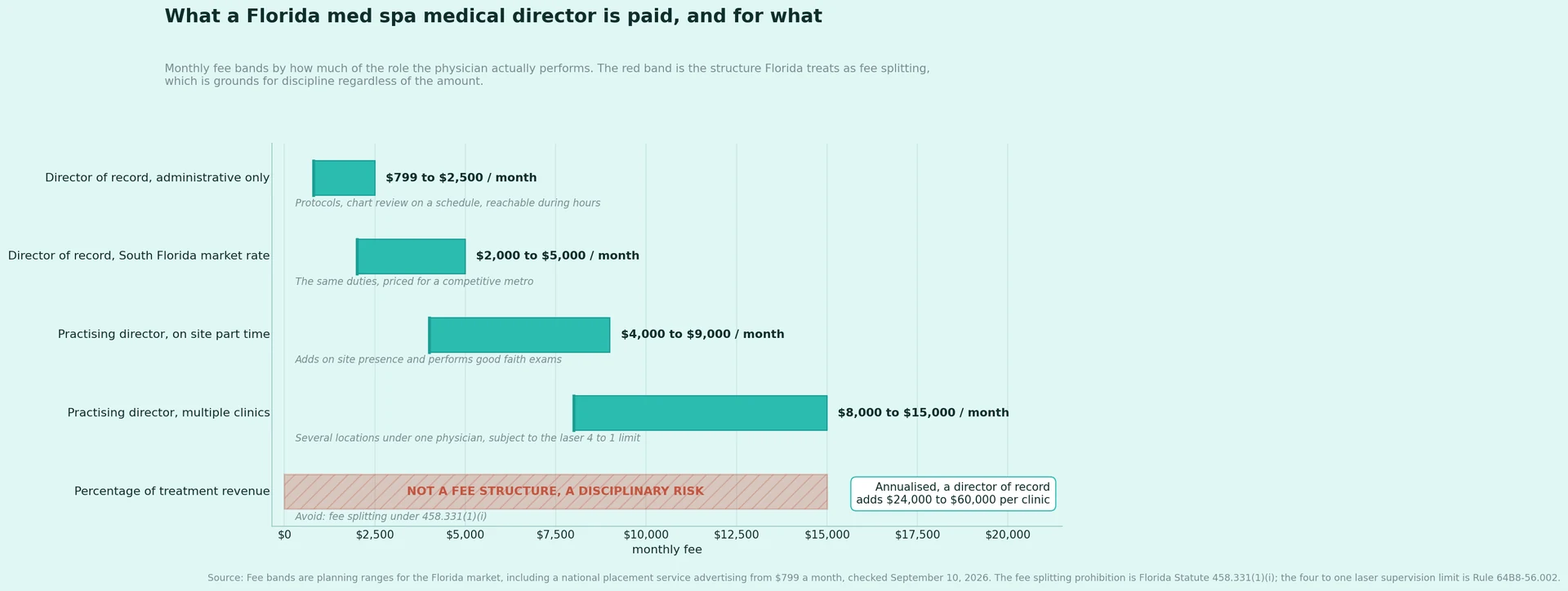
Monthly fee bands by how much of the role the physician performs. The hatched band is the structure Florida treats as fee splitting under Statute 458.331(1)(i), which is grounds for discipline whatever the amount.
Annualise the middle of that range and a director of record adds $24,000 to $60,000 a year per clinic. Physicians who direct several clinics stack those fees, which is why the four to one laser supervision limit matters commercially and not only clinically.
What does the job actually oblige you to do?
Four duties carry legal weight and everything else is negotiable. Statute 458.348 requires a written protocol with each practitioner the physician supervises, so the protocols are yours to write and sign rather than to inherit. a prescription drug must be ordered in the course of a genuine professional relationship with the patient, and the chart has to show it. Florida Statute 458.331(1)(q) makes prescribing outside the course of the physician's professional practice a ground for discipline, which means the examination workflow is your exposure even when someone else performs it. Note that older articles cite Rule 64B8-9.014 for this duty; that rule governed telemedicine prescribing and was repealed with effect from 26 October 2014. Rule 64B8-56.002 caps you at four laser electrologists supervised at any one time and requires direct supervision for laser hair removal. And Statute 458.331 lists delegating to unqualified staff and inadequate supervision among the grounds for discipline, which is the clause that turns a paper directorship into a licence problem.
Sources and how we checked them
Every legal duty on this page traces to the statute or rule named below. The fee figures are market observation except the advertised floor, which is dated.
- The written protocol requirement with each supervised practitioner: Florida Statute 458.348, read 10 September 2026.
- The fee splitting prohibition and the discipline grounds for inadequate supervision: Florida Statute 458.331(1)(i) and the surrounding subsections.
- The duty to prescribe within a genuine professional relationship: Florida Statute 458.331(1)(q), read 10 September 2026.
- The four to one laser supervision limit and the direct supervision requirement: Rule 64B8-56.002.
- The $799 a month floor is a national placement service advertised rate checked on 10 September 2026. The $2,000 to $15,000 bands are our observation of the Florida market, not a published survey. The cost floor under any fee is the $100,000 per claim and $300,000 aggregate coverage required by Statute 458.320(1)(b), which every practising Florida physician has to satisfy, and the 4 clinic ceiling comes from the four to one laser supervision limit in Rule 64B8-56.002.
Frequently Asked Questions
1. What does a medical director get paid in a Florida med spa?
In South Florida, an administrative medical director typically earns a monthly retainer of $2,000 to $5,000, depending on the size of the med spa and the risk profile of the procedure menu. A practicing medical director who works real clinical hours is paid like any other physician role, with annualized compensation typically falling between $120,000 and $250,000 based on hours, salary, or commission structure.
2. Can a family medicine physician be a medical director for a med spa in Florida?
Yes, for an administrative role. Florida law requires the medical director to be a Florida-licensed MD or DO in good standing, with the competence to supervise the procedures being delivered. Family medicine, internal medicine, emergency medicine, and most other specialties all qualify for administrative oversight, provided the physician is familiar with the protocols and complications relevant to the med spa's menu. For a practicing role that involves performing procedures personally, specialties like dermatology, plastic surgery, OB-GYN, and endocrinology fit more naturally.
3. How many hours per week does a medical director actually work at a med spa?
For an administrative role at a steady-state med spa, two to five hours per week is typical, made up of a weekly check-in, scheduled chart reviews, and being on call for complications. The setup phase is heavier, often twenty to forty hours over the first month or two. A practicing medical director works whatever clinical schedule has been agreed on, which can range from one day a month to full-time.
4. Does my existing malpractice policy cover med spa medical director work in Florida?
Often yes, with adjustments. Most major malpractice carriers in Florida will either cover med spa medical director duties under an existing policy or write a rider to extend coverage. The premium adjustment depends on the procedure menu and whether the physician is performing procedures personally or supervising only. Before signing as medical director, the physician should confirm coverage in writing with their carrier, including for any specific high-risk procedures the med spa offers.
5. Can a physician be the medical director of more than one med spa in Florida?
Yes. There is no Florida statutory limit on the number of med spas a single physician can serve as medical director for, provided they can meaningfully supervise each operation. The practical limits are time and oversight quality. Two to four well-run med spas with strong APRN and RN staff is workable for a physician dedicating modest weekly hours. Beyond that, the chart review and on-call burden grows quickly. Non-compete clauses between agreements are the most common reason this arrangement breaks down legally, not the statute.
6. What is the biggest legal risk for a Florida medical director?
The biggest risk is being named medical director of a med spa that operates outside the standard of care, performs procedures beyond the scope of its staff licenses, or hides adverse events. The Florida Department of Health and the Board of Medicine hold the named medical director accountable for the clinical conduct of the operation, even when the physician is not personally on site. Vetting the operation before signing matters more than any contract language.
7. How do most Florida physicians find their first medical director role?
Almost always through referrals or direct industry networking. Another physician stepping back from a role and recommending a replacement, or a personal connection opening a med spa and asking for a trusted name, accounts for the vast majority of South Florida placements. Generic medical job boards and online marketplaces produce very little compared to either of those routes. Profiles on aesthetic-specific platforms where med spa operators and aesthetic clinicians already concentrate are a faster path to the right introductions than waiting to be found through general healthcare channels.