Most states make estheticians complete continuing education to renew their license, and Florida is one of them. A Florida facial specialist has to finish exactly 10 hours every two years across eight mandatory subjects, and the registration expires on October 31. Which October depends on your renewal group: Group 1 renews in odd years, Group 2 in even years, which means the 2026 deadline falls on Monday, November 2, because the 31st is a Saturday.
Key Takeaways
- Florida caps esthetician continuing education at 10 hours per biennium by statute, and the Board fills all 10 with mandatory subjects: HIV/AIDS, sanitation, OSHA, workers' compensation, laws and rules, chemical makeup, environmental issues and one elective.
- Your renewal year is not a choice. DBPR splits facial specialists into Group 1 (October 31, odd years) and Group 2 (October 31, even years). Group 2 licenses are due November 2, 2026.
- Since July 1, 2024 Florida exempts licensees who have held an active license continuously for 10 years with no disciplinary action from the CE requirement for that renewal (Statute 455.2124). Newer licensees get no exemption.
- Requirements vary widely by state: Texas asks for 4 hours, Georgia 5, Iowa and Maryland 6, North Carolina 8, and California requires none at all.
- An approved 10-hour Florida course costs about $20 online. Missing the date is what gets expensive: an unrenewed license goes delinquent and, after a full cycle, void.
- Renewal CE keeps you legal. It does not change what a med spa will let you do; device training and medical delegation do that, and employers know the difference.
Do estheticians need continuing education?
In most of the country, yes, and the amount is set by your state board rather than by any national body. There is no federal esthetician license and no national continuing education standard. What exists is a patchwork of state rules that range from nothing at all to ten hours every two years. The table below shows the eight states we verified directly on the board or department website on September 10, 2026. If your state is not listed, the rule lives on your board's renewal page, and it is worth reading the rule itself rather than a course vendor's summary of it.
| State | Hours required | Cycle | Mandatory topics | Source |
|---|---|---|---|---|
| Florida | 10 | Every 2 years, expires Oct 31 (Group 1 odd years, Group 2 even years) | HIV/AIDS 1h, sanitation 3h, OSHA 0.5h, workers' comp 0.5h, laws and rules 2h, chemical makeup 1h, environmental 1h, elective 1h | Rule 61G5-32.001 |
| Texas | 4 (2 if licensed 15+ years) | Every 2 years | Sanitation 1h, human trafficking awareness 1h, 2h elective | TDLR continuing education |
| Georgia | 5 | Every 2 years | 3h health and safety, 2h business (per the Secretary of State board page) | Georgia State Board of Cosmetology and Barbers |
| South Carolina | 4 | Every 2 years, odd years by March 10; first renewal exempt | Board laws and regulations, client safety, infection control | SC LLR Board of Cosmetology |
| North Carolina | 8 per renewal | Annual license | Board publishes a free 8-hour esthetician class | NC Board of Cosmetic Art Examiners |
| Iowa | 6 | Per renewal; first renewal exempt | At least 4h specific to the license discipline | Iowa DIAL renewal page |
| Maryland | 6 | Per renewal term, from January 1, 2026 (HB 1600) | Board-approved courses | Maryland Board of Cosmetologists |
| California | 0 | Every 2 years | None. The Board does not require CE to maintain a license | California Board of Barbering and Cosmetology FAQ |
Two things stand out. The first is how low the bar is almost everywhere: the heaviest state on the list asks for five hours a year. The second is that the mandatory subjects are about public safety, not skill. Sanitation, infection control, human trafficking awareness, state law. No state on the list requires a single hour of advanced technique to keep an esthetics license. That gap is the reason the second half of this article exists.
What are Florida's esthetician continuing education requirements?
Florida's rule is unusually specific. Florida Statute 477.019(7) lets the Board of Cosmetology require continuing education as a condition of renewal, but caps it at 10 hours every two years, and the Board uses every one of those hours. Rule 61G5-32.001 of the Florida Administrative Code sets the minimum of ten hours and lists the subjects each licensee and registered specialist must cover. The rule applies equally to cosmetologists, facial specialists, nail specialists and full specialists. Here is the breakdown, subject by subject.
| Subject | Minimum hours | What the rule requires it to cover |
|---|---|---|
| HIV/AIDS and communicable diseases | 1 | Modes of transmission, infection control, clinical management, prevention, and attitudes toward people who may have the virus |
| Sanitation and sterilization | 3 | Standard cleaning and disinfecting precautions, disinfectants versus antiseptics, hand and tool hygiene, bloodborne pathogens and parasites |
| OSHA regulations | 0.5 | Occupational Safety and Health Administration rules as they apply to the practice |
| Workers' compensation | 0.5 | Florida workers' compensation issues as they pertain to the practice |
| State and federal laws and rules | 2 | Chapter 477, the Board's rules, where and when you may legally practice, prohibited conduct and penalties, salon inspections, renewal dates and fees |
| Chemical makeup | 1 | Chemistry as it pertains to hair, skin and nails |
| Environmental issues | 1 | Environmental issues related to the practice |
| Elective | 1 | Any approved subject related to the practice that you have not taken this licensure period |
| Total | 10 | All subjects must be in a Board-approved course; home study, video and conference courses count if approved before they are taught |
Notice what is missing. There is no hour of chemical peel technique, no hour of device safety, no hour on skin analysis. The 10 hours exist to keep the public safe from infection and from unlicensed practice. They are the price of keeping the registration, and nothing more. What the Florida facial specialist registration actually lets you do, and why the state does not issue a licensed esthetician license at all, is covered in our guide to the licensed esthetician credential.
Who is exempt from continuing education in Florida?
Two groups, and only two. Statute 455.2124(2) requires every DBPR board to exempt a licensee from continuing education for a renewal period if the license is active, has been held continuously for at least 10 years, and carries no disciplinary action. That rule took effect on July 1, 2024 through Senate Bill 382 of the 2024 session, chapter 2024-189, which also made distance learning an accepted format for every board. Cosmetology is not on the list of professions carved out of the exemption, so a facial specialist licensed for a decade with a clean record renews without the 10 hours. The second group is anyone who cannot practice and chooses inactive status at renewal. Everyone else, including every licensee in their first ten years, completes the full 10 hours.
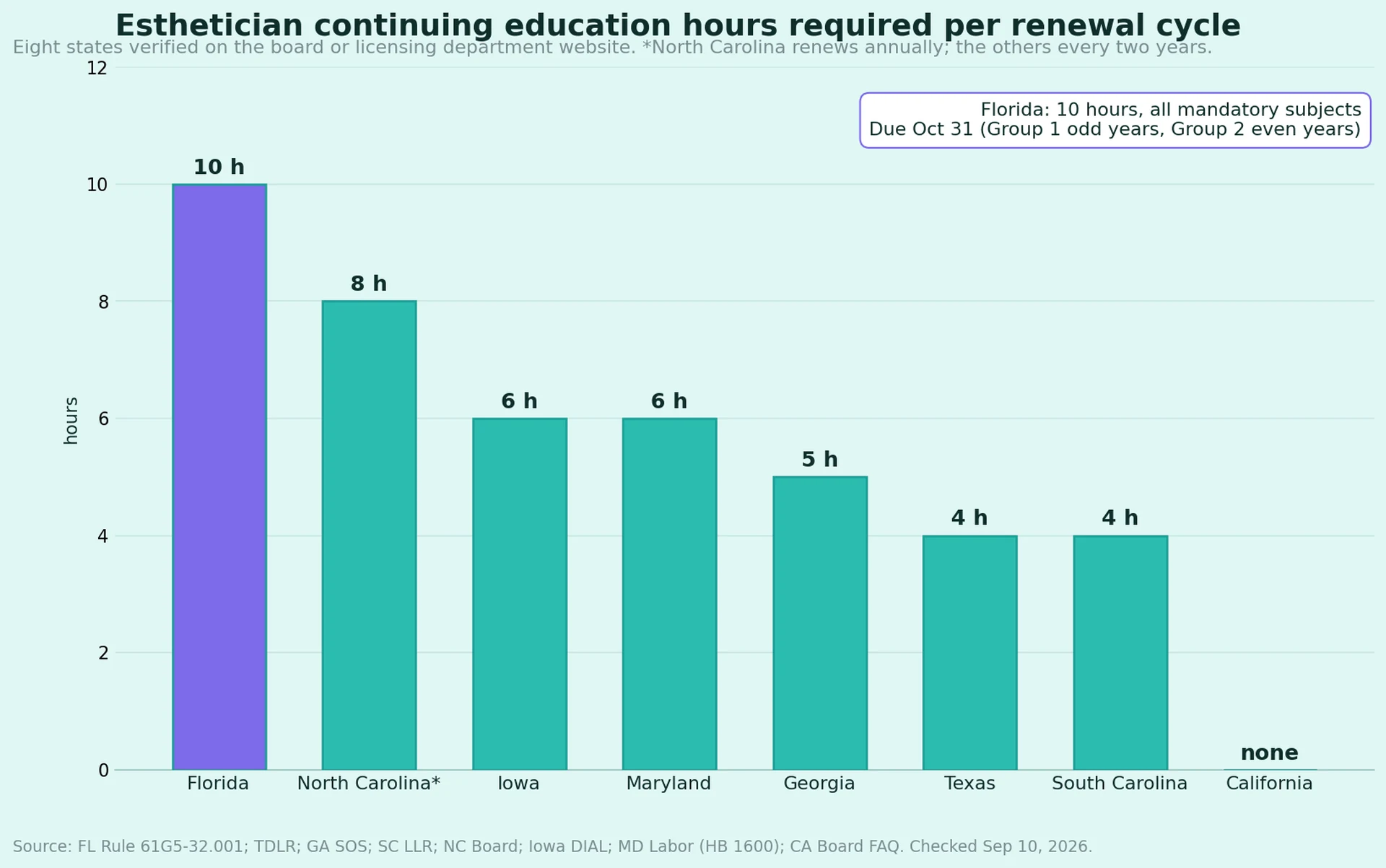
Continuing education hours per renewal cycle in eight states, from board and licensing department pages checked on September 10, 2026. Florida sits at the top at 10 hours; California requires none.
When is the Florida esthetician renewal deadline?
October 31, every two years, but not the same October for everyone. The Department of Business and Professional Regulation divides cosmetologists, nail specialists, facial specialists and full specialists into two renewal groups. Group 1 licenses expire on October 31 of every odd year. Group 2 licenses expire on October 31 of every even year. In 2026 the 31st falls on a Saturday, so DBPR has extended the Group 2 deadline to Monday, November 2, 2026. The renewal fee is $45.
Your group is fixed to your license, so the first thing to do is confirm which one you are in. Your expiration date appears on your license record in the DBPR online portal and on the renewal notice, which DBPR sends by email 90 to 120 days before the deadline. If the email address on your file is the one you used in school, update it now. A surprising share of delinquent licenses belong to people who never saw the notice.
One more timing rule matters. The rule requires the hours to be completed before the license expires, inside the current biennium. A course you finished in the previous cycle does not carry forward, and you cannot take the same approved course twice in one period and count it twice.
How do you renew a Florida facial specialist registration?
The renewal itself takes minutes once the hours are done. The order matters more than the steps.
- Confirm your renewal group and expiration date on your DBPR license record.
- Choose a Board-approved provider and complete the full 10 hours in the eight subjects above. Approved providers report completions to DBPR electronically.
- Check that your hours posted on the DBPR continuing education search before you pay the renewal fee, because a renewal submitted with missing hours is the most common cause of a delinquent status.
- Log in to DBPR online services, renew the registration and pay the $45 fee.
- Save the course certificate for your records. The provider reports to the state, but you are the one asked to produce it if there is a dispute.
If you are still working toward the registration rather than renewing it, none of this applies yet. The 220-hour school route, the DBPR application and the reason Florida has no state exam are laid out step by step in our guide to becoming an esthetician in Florida.
How much does esthetician continuing education cost in Florida?
Less than a client's facial. Because the 10 hours are safety and law content that every provider teaches the same way, the market has priced the course close to zero. Broward Beauty Institute sells its DBPR-approved 10-hour online course for facial specialists, full specialists, nail specialists and cosmetologists for $19.95 with an instant certificate, and several other approved online providers, including Florida Online Cosmetology and Florida Cosmetology Educators Online, sell the same 10 hours in a similar range with completions reported to DBPR. Prices checked September 10, 2026.
The number to protect is not the $20. It is the $45 renewal fee plus whatever you earn in the weeks you cannot legally work if the registration lapses. Buy the course from the DBPR approved list, not from an ad, and check that the provider name matches the CE search exactly.
Is there free esthetician continuing education?
In some states, yes, and it comes from the board itself. North Carolina's Board of Cosmetic Art Examiners publishes a free 8-hour class for estheticians that satisfies the renewal requirement with no test. Florida does not do this. Every approved Florida course we found on September 10, 2026 was paid, and the cheapest was about $20. Free webinars from product companies can be excellent education, but unless the provider and course are on DBPR's approved list, the hours do not count toward renewal. Check before you sit through them for credit.

Does continuing education raise an esthetician's pay?
Renewal CE does not, and it is important to be honest about that. The 10 hours are identical for a first-year facial specialist and a twenty-year veteran, and every employer knows it. What moves an offer is training that changes what you can do in a treatment room, and in Florida that has a legal ceiling. Our comparison of medical esthetician programs in Florida shows which add-on certifications actually raise the hourly range at South Florida med spas, and the pattern is consistent: documented device hours and stronger exfoliation skills move pay, while generic certificates do not. Keep the ceiling in view while you shop for training. The dermatology literature divides peels by depth, and medium-depth agents reach the papillary dermis, which puts them outside a facial specialist registration in Florida. Superficial exfoliation is yours; anything that injures living tissue below the epidermis is a medical procedure performed under delegation.
The ceiling is the registration itself. Microneedling, laser, IPL, radiofrequency and injections are outside the scope of a Florida facial specialist under the Board's own rule, whatever certificate you hold. Our guide to microneedling certification explains what the certificate proves, who can legally use it in each state, and what a med spa verifies before it lets anyone near the device. The laser route in Florida runs through the electrology license and a separate 30-hour course, as our guide to becoming a laser technician in Florida sets out, and that route is narrower than it sounds: Chapter 478 defines electrolysis as the permanent removal of hair, and Rule 64B8-56.002 limits the electrologist to laser and light devices cleared by the FDA for hair removal or reduction, on which they have been trained, under the direct supervision of a physician trained in hair removal. It is not a licence to resurface skin, treat pigmented or vascular lesions, or remove tattoos. . And if you have seen "master esthetician" on a job post and wondered whether more CE gets you there, our explainer on the master esthetician title shows why Florida does not issue one and what the title means on a Florida resume.
So the practical rule: do the 10 hours cheaply and early, then spend your real training budget on skills a clinic will pay for. The two are different purchases.
What happens if you miss the Florida renewal deadline?
The license does not vanish on November 3, but you cannot work on it either. Florida Statute 455.271 says a licensee may practice only with an active status license, and that failing to renew before expiration makes the license delinquent in the following cycle. Working on a delinquent registration is a violation of the same chapter. A delinquent licensee can return to active status by completing the renewal requirements and paying the delinquency fee. The hard stop comes later: a delinquent license that is not brought back to active or inactive status before the end of that next cycle becomes void, and the route back is a new application.
If you know you will not be practicing for a while, the statute also lets you choose inactive status at renewal time, which preserves the license without the practice right. It is a far better option than letting the registration lapse and hoping to fix it later.
Do med spa employers check your continuing education?
They check the thing CE protects: an active registration. A clinic verifying your license on the DBPR portal sees the status and the expiration date, and a delinquent status ends most conversations before they start. Some practices also pay for or track staff CE because they carry their own training and documentation obligations. What Florida actually requires a med spa to train and document for each role, from the clinic's side of the desk, is covered in our guide to med spa staff training requirements. And a posting that lists "continuing education budget" as a benefit is telling you something real: our breakdown of the esthetician job description explains which details in a job post do the filtering work and which are decoration.
Frequently asked questions
Do estheticians need continuing education?
In most states, yes. The requirement is set by each state board and ranges from none in California to 10 hours every two years in Florida. Texas requires 4 hours, Georgia 5, Iowa and Maryland 6, and North Carolina 8 per renewal. Check your own board's renewal page rather than a course vendor's summary.
What are the continuing education requirements for estheticians in Florida?
Ten hours every two years under Rule 61G5-32.001: 1 hour HIV/AIDS, 3 hours sanitation and sterilization, half an hour OSHA, half an hour workers' compensation, 2 hours laws and rules, 1 hour chemical makeup, 1 hour environmental issues and 1 elective hour. All hours must come from a Board-approved course completed inside the current biennium.
When does a Florida facial specialist registration expire?
October 31, every two years. Group 1 registrations expire in odd years and Group 2 in even years. Because October 31, 2026 is a Saturday, DBPR moved the Group 2 deadline to November 2, 2026. Your group and date are on your DBPR license record.
Is a cosmetology license exempt from continuing education in Florida?
Only under one condition. Since July 1, 2024, Statute 455.2124 exempts a licensee who has held an active license continuously for at least 10 years with no disciplinary action, and that applies to cosmetologists and facial specialists alike. Everyone else completes the same 10 hours; Florida does not exempt first-time renewals the way South Carolina and Iowa do.
Are there free continuing education courses in Florida?
Not from the Board. Every approved Florida course we found on September 10, 2026 was paid, with the cheapest at $19.95. North Carolina's board does publish free classes, which is why the question comes up. Free industry webinars only count in Florida if the provider and course are DBPR-approved.
What are the best certifications for an esthetician?
The ones that change what a clinic will let you do and pay for, inside your legal scope: superficial exfoliation technique and documented device hours in a delegated setting. Renewal CE is not one of them. Our program comparison covers which add-ons move the hourly range in South Florida and which certificates employers ignore.
How do I renew my esthetician license in Florida?
Complete the 10 approved hours, confirm they posted on the DBPR continuing education search, log in to DBPR online services, renew and pay the $45 fee before your group's October 31 deadline. Keep the course certificate.
Ten hours to stay legal, then train for the job you want
Florida's continuing education rule is small, specific and unforgiving on dates. Learn your renewal group, buy the approved 10-hour course early in the cycle, confirm the hours posted, and pay the $45. That protects the registration. Then treat your real training budget as a separate decision, aimed at the skills a med spa will actually pay for. If you are renewing this year and thinking about your next role, 🎯 browse the South Florida med spa directory on Enhance.work to see which clinics are hiring licensed estheticians right now and what they ask for.