

A med spa commission structure is one of four models: straight hourly, commission only, hourly plus commission, or hourly against a commission draw. The hybrid is most common because it covers a new hire's ramp. Commission never removes the wage floor, and Florida's minimum wage rises to $15.00 an hour on September 30, 2026.
Ask ten med spa owners how they pay their team and you will get ten answers, most of them inherited from wherever the owner worked last. That is why the question keeps getting asked in owner groups. It is also why the most useful answers sit in forum threads rather than on the sites of the vendors selling you software. This is what the common structures actually look like, and what the numbers tend to be. It is also the compliance floor underneath all of it, which moves in Florida on September 30.
Key Takeaways
- Four structures cover almost every med spa: straight hourly, commission only, hourly plus commission, and hourly against a commission draw. The hybrid is the most common because it solves the ramp problem for new hires.
- Florida's minimum wage rises to $15.00 an hour on September 30, 2026, from $14.00. Any structure with a base near the current floor needs rebuilding before then, not after.
- Commission does not remove the wage floor. A commission-only employee still has to clear minimum wage for every hour worked in the pay period.
- The overtime exemption people assume applies to commissioned staff has two conditions in the statute, and failing either one puts overtime back on the table.
- Pay structure is a retention tool before it is a cost line. The complaint that shows up most often from providers is not the percentage. It is that the structure was never explained clearly.
Getting the structure right only helps if the new hire understands it from the start. That is why the onboarding sequence that puts compensation in writing before day one prevents the single most common reason new providers feel misled.
What is a typical med spa commission structure?
There are four. Each one moves risk between the practice and the provider.
Compensation is only one part of building a clinical team. The structure you choose also shapes how you recruit, which is covered across the wider picture of staffing a med spa in Florida, from where the candidates actually come from to what it costs to keep them. The draw model is the one owners most often get wrong. A draw is an advance against future commission, so in a slow month the provider can end up owing the practice. If you use it, decide in writing whether the draw is recoverable across pay periods and say so on the offer letter. Providers who discover the answer in month three do not stay.
What commission percentages are actually normal?
No published industry survey is worth quoting for South Florida med spas specifically. Inventing an average would be worse than useless when you are about to write it into an offer. What does exist is a large volume of practitioners discussing their own pay in public. Treat the following as a picture of the range that gets reported, not as a benchmark, because the sample is small and self selected.
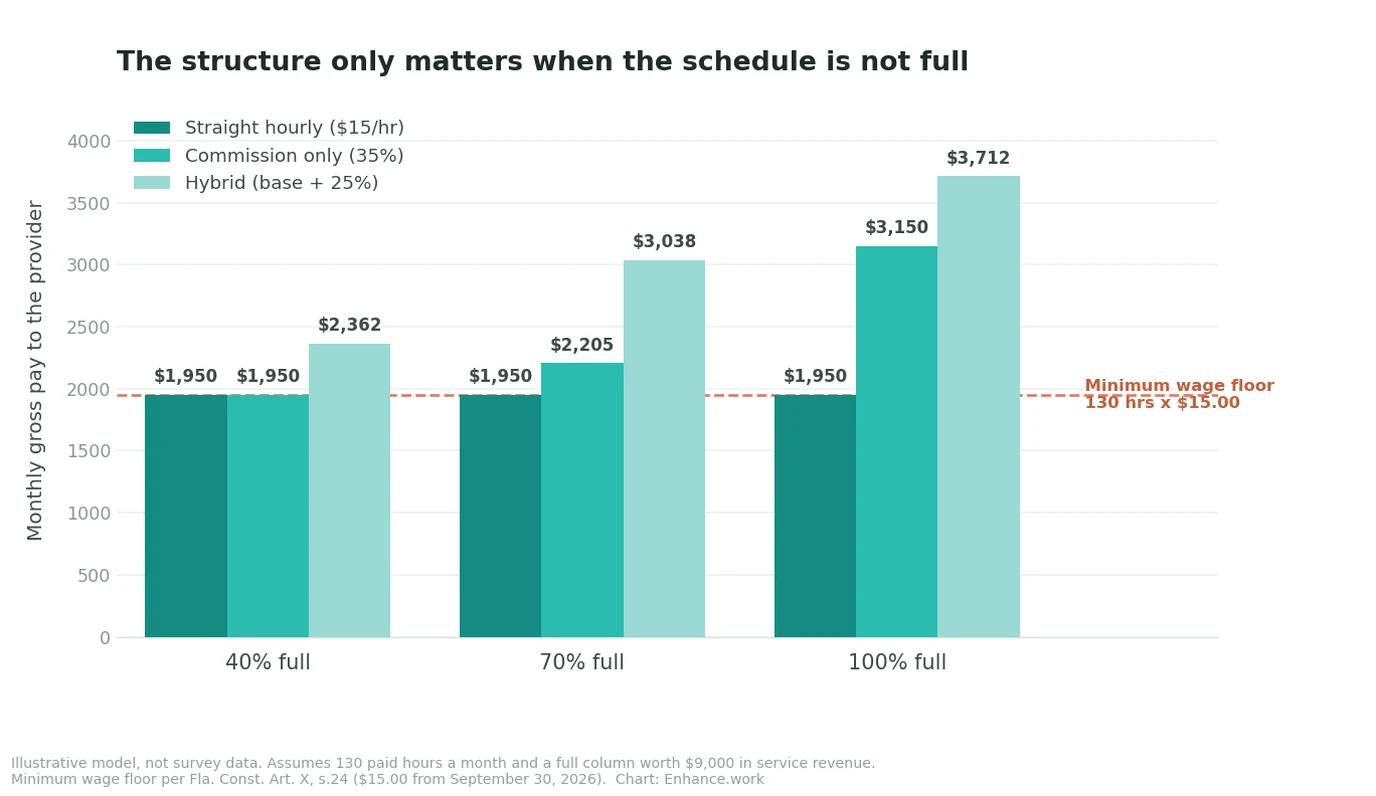
Two observations matter more than the numbers themselves. First, the same percentage means completely different money depending on what it is calculated on: gross service revenue, revenue net of product cost, or the figure after a house deduction. That definition is where most disputes start. Second, a percentage is meaningless without the schedule behind it. Forty five percent of a half empty column pays worse than thirty percent of a full one. The honest version of this conversation includes how many hours the practice can realistically book.
What does Florida's September 30 minimum wage increase do to your structure?
This is the part with a deadline. Six weeks, roughly. Florida's minimum wage is set by the state constitution rather than by the legislature, and it is on a fixed escalator.
Article X, section 24 of the Florida Constitution provides that effective September 30, 2021 the state minimum wage rose to $10.00 per hour, "and then increase each September 30th thereafter by $1.00 per hour, until the Minimum Wage reaches $15.00" per hour. That final step lands on September 30, 2026, taking the rate from $14.00 to $15.00.
Compare that to the base pay range providers report, which starts around $13. Any structure built on a low base and a generous percentage is about to have its floor raised. The practices that feel it are the ones treating the base as a formality. Three consequences are worth planning for now rather than in October.
- Your lowest paid roles reprice first. Front desk and support roles sitting at or near the floor move automatically, and that compresses the gap between them and your junior clinical staff. If a treatment provider is earning barely more than the coordinator who books them, expect the question.
- Commission-only arrangements get tighter. The wage floor applies to hours worked regardless of how pay is labelled, so a slow week costs the practice more than it used to.
- Anything indexed to the minimum wage moves with it. If your overtime analysis or your tipped-role maths references the state rate, rerun it against $15.00 rather than $14.00.
The practices that handle this well announce the change before it happens and frame it as a structure update. The ones that handle it badly let staff discover it on a pay stub. Then they spend the next quarter answering why the coordinator got a raise and the esthetician did not.
Which pay practices actually break the law?
This is the theme running through practitioner complaints, and some of it is genuine legal exposure rather than a bad deal. This is orientation, not legal advice, and a wage and hour attorney should review any structure before you roll it out.
Commission does not replace the wage floor
Calling someone commission only does not exempt the practice from paying at least the minimum wage for the hours they worked. If commissions in a period come in below that, the employer makes up the difference. The hours a provider spends on the schedule with no client on the books are still hours.
The overtime exemption has conditions people skip
A federal exemption can remove the overtime obligation for commissioned employees of a retail or service establishment. Med spas frequently assume it applies to them automatically. The statute, at 29 U.S.C. 207(i), sets two tests that both have to be satisfied: the employee's regular rate of pay has to exceed one and one-half times the applicable minimum hourly rate, and more than half of the employee's compensation for a representative period of not less than one month has to represent commissions on goods or services.
Read those two together and the trap is visible. A hybrid structure with a solid hourly base and a modest commission can easily fail the second test, because commissions are not more than half of the pay. That is the most common structure in med spas. Whether a specific arrangement qualifies is a fact question, and the calculation is genuinely technical. Spend an hour with counsel rather than an afternoon with a blog post.
Deductions and the definition problem
Charging product, backbar or supply costs against a provider's pay is where informal arrangements drift into risk. A deduction that pushes effective pay below the floor is a problem regardless of what the offer letter says. If your commission is calculated after deductions, define the deduction precisely and in writing.
Worker classification sits underneath all of this. None of these rules apply the same way if the person is genuinely an independent contractor. That determination has its own tests. Note that the difference between a 1099 contractor and a W2 employee at a Florida med spa carries consequences that reach well beyond how the commission is calculated.
How should pay differ by role?
One structure applied across the whole team is the most common design mistake. The roles do not generate revenue the same way.
- Estheticians and treatment providers. Hourly plus service commission, with retail treated separately at a lower rate. The service percentage is the lever; the base is the retention floor.
- Injectors. A different market entirely, priced on credential and book rather than on treatment volume, and usually negotiated per person.
- Front desk and patient coordinators. Hourly, with a bonus tied to something they actually control such as rebooking rate or membership conversions. Commission on treatments they do not perform creates the wrong incentives at the point of booking.
- Managers. Salary plus a performance component tied to clinic level metrics, not to their own column.

Injector pay is the outlier. It moves on its own market logic, so treat it separately when you build the model. The pay models South Florida practices use for nurse injectors specifically run on different numbers and a different negotiation than the rest of the clinical team.
What does a fair structure look like from the provider's side?
Worth reading even if you are the one writing the offer, because this is the half that decides whether the hire stays. The consistent complaint in provider discussions is not the percentage. It is opacity. Phrases like not being told clearly what they would be making, or a structure changing without warning, come up far more often than any specific number does.

A provider evaluating an offer should be able to answer five questions from the paperwork alone. What is the base, and does it stand on its own if the schedule is light. What exactly is the commission calculated on, gross or net, and net of what. Is the schedule full, and who is responsible for filling it. Is any draw recoverable. And what has to happen for the structure to change. An offer that cannot answer those in writing is not a generous offer with details pending. It is an incomplete one. The same discipline applies one step earlier. Remember that a job description that names the license and states a real pay range filters out the wrong applicants before you read a single resume.
Candidates weighing a number against the market should see the real pay ranges medical estheticians earn at Florida med spas give a more reliable reference point than the national aggregate figures the job boards publish.
How do you change a pay structure without losing the team?
Most owners will change a structure at least once, and it goes badly for predictable reasons. Changes get announced as finished decisions, they take effect immediately, and they are framed in the practice's terms rather than the provider's.
A better sequence has four steps. Model the new structure against the last two quarters of actual production for each person, so you know precisely who gains and who loses. Tell the people who lose first, and individually. Give a transition period where both structures run in parallel and the provider is paid the better of the two. Then put the reason in writing. If the reason is that the September wage increase changed your cost base, say that. Providers respond far better to an explained constraint than to a structure that quietly appears on a pay stub.
If the change is happening because the practice cannot afford the current model, the structure may not be the real problem. Working out what a med spa owner actually takes home means building the practice profit and loss from the ground up rather than starting from a national average. Payroll is usually the largest line in it.
Sources
- The Florida Constitution - The Florida Senate (flsenate.gov)
- 29 U.S. Code § 207 - Maximum hours (law.cornell.edu)
- Florida Statutes, section 448.110 (leg.state.fl.us)
- State minimum wage notice (floridajobs.org)
Frequently asked questions
What is a typical commission percentage for a med spa esthetician?
Practitioners publicly report service commissions in the 30% to 45% band and retail commissions between 10% and 20%, often alongside an hourly base. Treat that as the range that gets discussed rather than a benchmark, and remember the percentage means nothing until you define what it is calculated on.
Can a med spa pay commission only?
A commission-only arrangement is possible, but it does not remove the obligation to pay at least the minimum wage for hours worked. If commissions fall short in a pay period, the employer covers the difference. Have counsel review any commission-only structure before using it.
When does Florida's minimum wage go up, and to what?
To $15.00 per hour on September 30, 2026, from $14.00. The schedule comes from Article X, section 24 of the Florida Constitution, which set annual $1.00 increases each September 30 until the rate reached $15.00, and it is implemented through section 448.110 of the Florida Statutes. Employers must also keep the current state minimum wage notice posted.
Do commissioned med spa employees get overtime?
Sometimes. A federal exemption exists for commissioned employees of retail or service establishments, but 29 U.S.C. 207(i) requires both that the regular rate exceed one and one-half times the applicable minimum hourly rate and that more than half of compensation over a representative period of at least a month comes from commissions. Many hybrid med spa structures fail the second test. This is a fact-specific analysis for an attorney.
Should the front desk earn commission?
Bonus on what they control, such as rebooking rate, membership conversion or consultation show rate, rather than commission on treatments they do not perform. Commission at the booking point pushes coordinators toward the highest ticket rather than the right treatment.
Is a draw the same as a base salary?
No. A draw is an advance against commission the provider is expected to earn, so depending on how it is written a shortfall can carry forward. A base is money that is not clawed back. Say which one you are offering, in writing, in the offer letter.
Write the structure down before September
Two things make a pay structure work. Neither is the percentage. The first is a definition specific enough that two people reading it reach the same number. The second is a base that survives a slow month. A structure that only works when the schedule is full is not a compensation plan. It is a hope.
Florida has handed operators a deadline. The wage floor moves to $15.00 on September 30. That makes the next few weeks the obvious moment to open the model. Run it against real production numbers rather than intentions, check where the increase lands, and rewrite anything that only ever existed as a verbal understanding. Doing that in August is planning. Doing it in October is damage control.