Most advice on hiring for your aesthetic practice starts with where to post the job. That is the wrong end of the problem. The decision that determines whether a hire works is made before the ad exists, and it is financial. What does this person cost you every month? What do they have to produce to cover themselves? And can your practice carry them while they get there?
Key Takeaways
- A hire costs materially more than the wage. Payroll taxes, insurance and the ramp before they are productive all land on the same line, and that line is usually the largest one in a med spa.
- Federal wage data gives you the floor by role: skincare specialists earn a median of $45,330, registered nurses $97,550, physician assistants $135,880 and nurse practitioners $132,300 (BLS, May 2025).
- One accounting firm that works with med spas puts total payroll at 25 to 35 percent of sales. Treat that as a planning envelope, not a law.
- Hiring order is decided by licence, not by org chart. The question is who can legally be alone with a patient in a treatment room, and that answer changes what you must hire first.
- The most expensive hire is the one whose duties exceed their licence. That is a compliance exposure, not a staffing mistake.

What does each hire actually cost you?
Start with the wage floor. The Bureau of Labor Statistics publishes what each of these occupations actually earns nationally. Those figures are the honest starting point for a staffing budget, because they come from employer-reported payroll rather than from salary surveys people fill in themselves.
| Role | SOC code | Median annual (US) | Mean annual (US) | Mean annual (Florida) |
|---|---|---|---|---|
| Skincare specialist / esthetician | 39-5094 | $45,330 | $51,850 | $51,570 |
| Registered nurse | 29-1141 | $97,550 | $101,420 | $90,650 |
| Nurse practitioner | 29-1171 | $132,300 | $137,300 | $130,410 |
| Physician assistant | 29-1071 | $135,880 | $141,280 | $134,470 |
| Medical assistant | 31-9092 | $45,690 | $46,120 | not published separately |
| Receptionist | 43-4171 | not published separately | $39,460 | not published separately |
Two things in that table matter more than the individual numbers. The first is the gap between an esthetician and an injector: roughly three times the wage for the same treatment room. The second is that the Florida means run below the national means for clinical roles, while the esthetician figure is essentially flat against the national one. Florida is not a cheap market for skin care staff. Owners who budget from a national average tend to discover that at the offer stage rather than during planning.
These are also growing occupations, which is the part that shows up in your offer letter rather than in your spreadsheet. The BLS projects skincare specialist employment to grow 9 percent between 2025 and 2035, and nurse practitioner employment to grow 41 percent over the same decade. You are hiring into a market where the people you want have other options.
Why is the sticker wage not the real cost?
The wage is the part you negotiate. The cost is the wage plus everything that rides on it, and the difference is large enough that it changes which hire you can afford this quarter.
- Employer payroll taxes. Social Security and Medicare, federal and state unemployment. These are a fixed percentage on top of every dollar of wage.
- Insurance. Workers compensation, and professional liability for anyone touching a patient. Clinical roles cost more to cover than front desk roles.
- The ramp. A new injector does not run a full book in week one. Someone has to build it, and until they do you are paying a clinical wage against partial production.
- Supervision time. If the hire requires oversight, the supervising clinician is not treating patients during that time. That is real revenue, and it rarely appears in the budget.
One accounting firm that specialises in medical spas publishes benchmarks from its own client base. It puts total payroll running at 25 to 35 percent of sales, cost of goods at 30 to 40 percent, facilities under 10 percent and net income between 15 and 25 percent for an established practice. Those are one firm's figures, not an industry standard, and the firm cites no external data behind them. Use them the way you would use a colleague's numbers: as a sanity check on your own model, never as a target to reverse-engineer.
The practical test is simpler than the benchmark. Take the fully loaded monthly cost of the role and divide it by the number of treatment hours that person will realistically deliver. That is what the hire must produce per hour before it contributes anything. If your service menu and your booking density cannot clear that number, the problem is the plan, not the person you are about to hire.

The supervising clinician is not treating patients during onboarding. That time is a real cost of the hire and belongs in the model.
In what order should you hire?
The order you hire in is not an organisational preference. When you are hiring for your aesthetic practice, the sequence is set by what each licence permits. The binding constraint is who can legally be alone with a patient during a treatment. Get the order wrong and you have staff you cannot deploy without pulling someone else out of a room.
Work through it in this sequence:
- First, the role that unlocks your service menu. If the treatments that drive your revenue require a clinical licence, that hire comes first, because everything else in the practice is scheduled around their availability.
- Second, the role that protects that person's time. An injector answering the phone and rooming patients is the most expensive receptionist in the building. A front desk or medical assistant hire pays for itself by converting clinical hours back into treatment hours.
- Third, the role that extends capacity. An esthetician adds a second revenue stream that does not compete for the injector's calendar, but price the scope carefully rather than the job title. A Florida facial specialist works at the surface. The state rule that defines the licence treats laser, intense pulsed light, HIFU, radiofrequency and injections as bodily intrusion for medical purposes, and puts all of them outside the licence, while permitting manual and chemical exfoliation. Laser and light-based treatment is a separate regulatory question entirely, covered in our explanation of who may legally operate a hair removal laser in Florida and what direct physician supervision actually requires. Budget the esthetician for what the licence covers, and budget the rest of the menu for the licence that does cover it.
- Last, management. A practice manager is worth hiring when coordination is costing the owner clinical hours, and not before.
The sequence inverts for a practice that already has clinical coverage and is losing revenue to admin. Say your injector is booked out while enquiries go unconverted. Then the next hire is at the front desk, whatever the growth plan says.
Where each licence tier can and cannot operate independently is its own question, and we cover it in detail in our national breakdown of every med spa role and the four licence tiers that determine which of them can work unsupervised.
Which hire needs supervision, and what does that add?
Some roles carry a second cost the wage table does not show. They cannot function without a supervising or collaborating clinician, and securing that relationship is a precondition of the hire, not a detail to sort out afterwards.
In Florida the framework runs across four chapters, not two. Injecting a neuromodulator or a filler, and firing a medical device, are medical acts in the first place: they sit under Chapter 458 of the Florida Statutes, which governs the practice of medicine and the delegation of medical acts to qualified personnel, and its osteopathic counterpart in Chapter 459. A nurse performs them by delegation from a physician, under protocol, and never as an independent service. Nursing practice itself sits under Chapter 464 of the Florida Statutes, which defines the scope of registered nursing and advanced practice registered nursing, while cosmetology and facial specialty licensing sit under Chapter 477, the statute that governs cosmetology and facial specialist practice in Florida. Those four chapters, not your job description, decide what each hire may do. There is also a step that has to happen before any of them treats a patient: Florida requires a good faith examination before injectables, lasers and comparable treatments, and it must be performed by a physician, a nurse practitioner or a physician assistant. A registered nurse cannot perform it. We set out who has to do it and when in our guide to the good faith exam every Florida med spa must complete before injectables, lasers and comparable treatments, and it belongs in your staffing model because it decides whether the practice can legally treat on a day when the prescriber is not available.
The budgeting consequence is straightforward. If the role requires oversight, price the oversight at the same time you price the wage, because you cannot open the position without it. We treat that arrangement in full in our guide to what a medical director actually does for a Florida med spa and how that relationship is structured and in our explanation of collaborative agreements for advanced practice providers working in Florida aesthetics.
One more classification question belongs in the budget before the offer goes out. Employee or contractor is not your choice to make. It is determined by the IRS common-law test covering behavioural control, financial control and the nature of the relationship between the worker and the business. Getting it wrong is expensive in back taxes and penalties. We walk through how the test applies to a med spa in our breakdown of worker classification for Florida med spa staff and what triggers a reclassification.
What does a hire have to produce to pay for itself?
The wage is the input. What you need is the output: the monthly revenue each role must generate before it stops being a cost. The chart below loads each federal mean wage with employer taxes and insurance. It then shows the sales required to hold that role inside a payroll envelope of 25 and 35 percent.
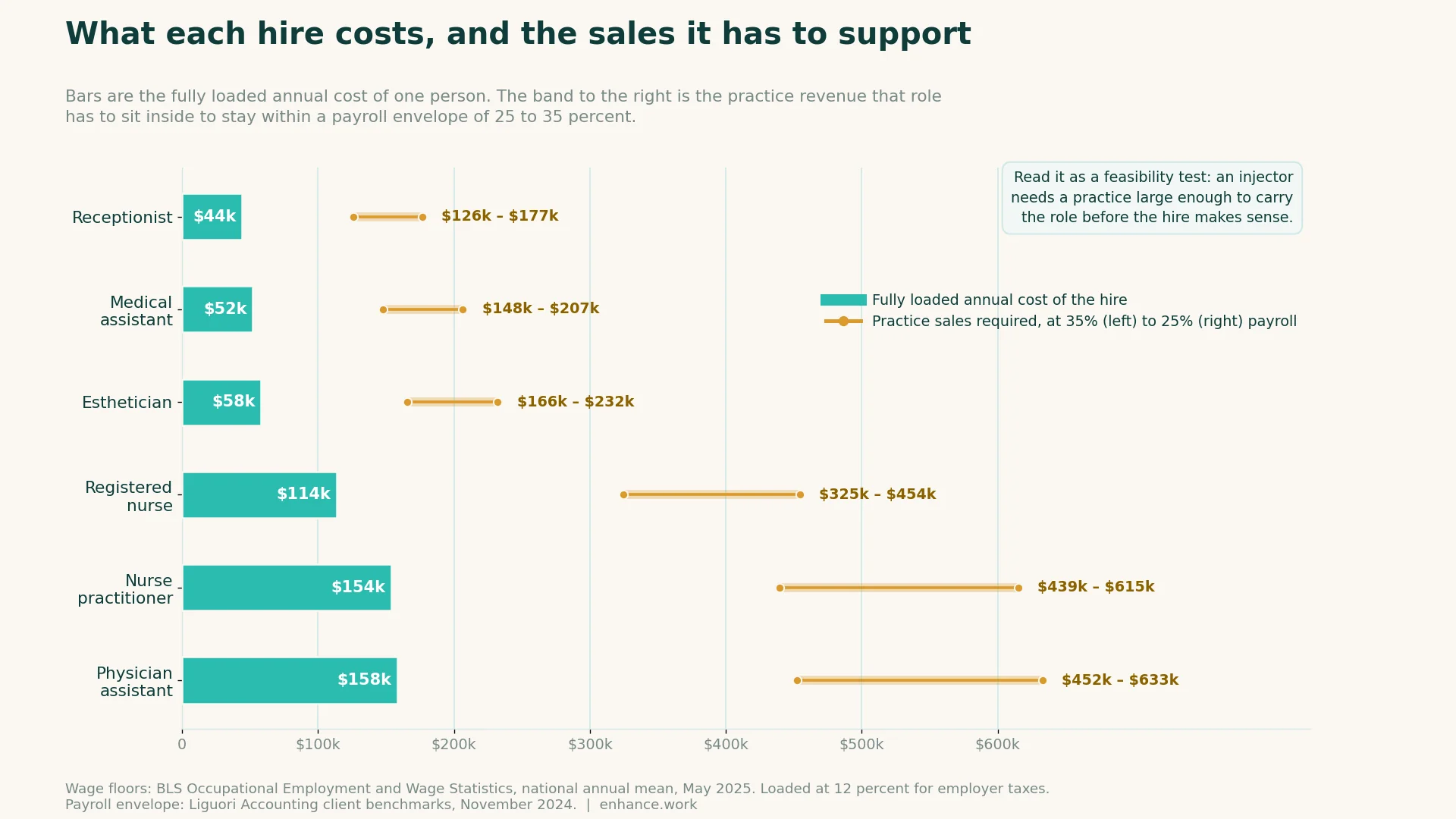
Fully loaded annual cost by role, and the sales each role must support to stay inside a 25 to 35 percent payroll envelope. Wage floors from BLS May 2025; envelope from Liguori Accounting client benchmarks.
Read it as a feasibility test rather than a forecast. A nurse practitioner at the national mean needs to sit inside a practice generating meaningful monthly revenue before that role is sustainable at a disciplined payroll ratio. An esthetician clears a far lower bar. That difference is the whole argument for sequencing your hires instead of building the team you eventually want on day one.
What does a bad hire actually cost?
Turnover cost is the familiar answer: recruiting again, onboarding again, the empty chair in between. In an aesthetic practice there is a second exposure that is larger and less discussed.
If you place someone in a treatment room performing work their licence does not cover, the exposure is not a staffing problem. It is unlicensed practice, and it reaches the practice and the supervising clinician, not only the individual. That risk is created at the moment you write the job description, which is why the duties you advertise deserve the same scrutiny as the wage you offer.
Screening is also constrained. Federal law prohibits employment decisions based on protected characteristics including race, colour, religion, sex, national origin, age and disability. So the filters you apply have to be licence, verified competence and demonstrated experience. That is the lawful approach, and it is also the accurate one. Licence status and hands-on record predict performance in a treatment room. Interview impressions do not.
If you want the screening sequence itself, our comparison of DIY job boards, generic staffing agencies and specialised aesthetic recruitment sets out what each approach verifies and what each one misses.

Licence verification belongs before the offer, not after the first shift.
How do you know you are ready to hire at all?
Three signals, in order of reliability. Your existing providers are turning away bookings or booking beyond a reasonable lead time. Your own clinical hours are being consumed by work that does not require your licence. And your revenue over the last three months, not your best month, supports the fully loaded cost of the role at the payroll ratio you intend to hold.
If only the third is true, wait. Capacity on paper but not in the appointment book turns a new hire into a fixed cost with no book to grow into, and clinical staff who sit idle leave quickly. If the first two are true and the third is marginal, hire the role that frees clinical time rather than the one that adds it. That hire is cheaper, it pays back faster, and it buys the runway to make the bigger one properly.
Frequently asked questions
How much should payroll be as a percentage of revenue at a med spa?
One accounting firm specialising in medical spas puts total payroll at 25 to 35 percent of sales. It puts net income at 15 to 25 percent for an established practice, with a 10 percent floor for a startup. Those are that firm's client benchmarks, not an audited industry standard. Treat the range as a planning envelope and test it against your own service mix.
What qualifications do you need to work in an aesthetic practice?
It depends entirely on the treatment. Skin care within the cosmetology or facial specialist scope requires the relevant state licence. Injectables and other medical procedures require a clinical licence, and in Florida that sits under the nursing and medical practice statutes rather than the cosmetology statute. The licence, not the job title, defines what the person may do in your treatment room.
Can you hire someone into aesthetics with no experience?
Yes for support and front desk roles, and often for esthetician roles where you are prepared to train on your protocols and devices. For injecting, inexperience is a different proposition: you are funding the ramp, absorbing slower treatment times and supervising more closely, all against a clinical wage. That can be the right decision, but it should be a deliberate investment with a timeline attached rather than a way to save on the offer.
Is it cheaper to hire an esthetician or a nurse injector?
An esthetician is roughly a third of the wage. Federal data puts the median for skincare specialists at $45,330 against $97,550 for registered nurses. But the two are not interchangeable, because they unlock different parts of your service menu. The right comparison is not cost against cost, it is cost against the revenue each licence lets you bill.
How long before a new aesthetic hire is profitable?
It depends on whether they arrive with a following. A clinician with an established local patient base can approach full production quickly. Someone building from your marketing takes far longer, and you carry a clinical wage throughout. Model the ramp explicitly instead of assuming full production from month one, and decide in advance how many months of partial production your practice can absorb.
Should the first hire be clinical or administrative?
Whichever one is currently costing you the most clinical time. If your providers are booked out and turning away work, add clinical capacity. If your providers have gaps in the calendar while enquiries go unanswered, the constraint is administrative and a front desk hire will recover more revenue per dollar spent.
Hire in the order your licences allow
When you are hiring for your aesthetic practice, the financial question and the compliance question turn out to be the same question. What a hire costs depends on what their licence lets them do unsupervised. What they must produce depends on which part of your service menu they unlock. Price the role fully, sequence it against your real constraint, and verify the licence before the offer rather than after the first shift.
When you are ready to fill the role, post it to a marketplace built specifically for aesthetic professionals, where candidates arrive with their licence tier and clinical experience already stated rather than filtering a general job board by hand.