
Key Takeaways
- Florida has no single med spa staff training requirement. Each role carries its own obligation, and the clinic is responsible for knowing which ones apply to which employee.
- If any employee has occupational exposure to blood, OSHA requires bloodborne pathogens training at initial assignment and at least annually after that, at no cost and during working hours.
- Electrologists using laser or light devices need semiannual training in infection control, sterilization, and emergency procedures, and the supervising physician is the one who must ensure it happened.
- Nurses renew biennially with up to 30 hours of continuing education. That is the nurse's obligation, not the clinic's, but a lapsed license is the clinic's problem.
- The training the law requires and the training that makes a provider profitable are two different lists. Most clinics document the first and improvise the second.
- If you offer electrolysis or laser hair removal, the premises also need an electrology facility license under Fla. Stat. 478.51, with an initial inspection inside 60 days and renewal inspections each biennium.

Training in a Florida med spa splits into two categories, and only one of them gets documented.
Florida has no single med spa staff training requirement; each role carries its own. Staff with occupational exposure to blood need OSHA bloodborne pathogens training at initial assignment and at least annually after that, and electrologists using laser or light devices need semiannual training in infection control, sterilization and emergency procedures.
Search for med spa staff training and you get two kinds of results. Schools selling certificate programs, and software vendors selling platforms to track them. Almost nothing written for the owner who simply needs to know what the state requires, who has to prove it, and how often.
That gap matters because the answer is not one requirement. It is a set of separate obligations attached to separate licenses. On top of those sits a federal rule that applies to your clinic as an employer, regardless of anyone's license. Miss the wrong one and the consequence lands on the practice, not the employee.
Here is the actual map, and then the harder question of what to train beyond it.
What training does Florida actually require for med spa staff?
There is no single med spa training requirement in Florida law. Training obligations attach to the individual license, and one federal standard attaches to you as the employer.
This trips up owners who expect a med spa rulebook. There is no single license called a medical spa in Florida, and most of what the state regulates is the people inside the building rather than the building itself. So a clinic with a nurse injector, an esthetician, and a laser tech runs three compliance calendars at once, administered by two different state departments.
That said, the facility itself is not always unregulated, and this is a real trap. If your clinic performs electrolysis or laser hair removal, Florida Statute 478.51 requires an electrology facility license issued by the Department of Health. The license must be displayed conspicuously on site. An initial inspection follows within 60 days of licensure, and a renewal inspection happens at least once per biennium. The license cannot be transferred to another owner, and moving locations requires department approval. Separately, some non physician owned clinics that bill for health care services fall under the Health Care Clinic Act in Chapter 400, Part X, which carries its own licensure question and a list of exemptions worth checking with counsel.
Sorting it out is easier with three buckets. Licensure training is what a person completed to get licensed, and you verify it once at hire. Continuing education keeps that license current, and it is generally their obligation. Employer mandated training is what you must provide and document. That one is entirely yours. Most clinics handle the first well, assume the second, and forget the third.
Which training is the clinic legally required to provide?
Bloodborne pathogens training, if any employee has occupational exposure to blood or other potentially infectious material. That is a federal OSHA requirement and it sits squarely on the employer.
The standard is 29 CFR 1910.1030. It requires training at initial assignment to tasks where exposure may occur, and at least annually thereafter. Each annual session must fall within one year of the previous one. Two details are frequently missed. The training must be provided at no cost to the employee, and it must happen during working hours. Telling a new injector to complete an online module unpaid, on their own time, does not satisfy the standard.
The rule also requires additional training whenever tasks or procedures change in a way that affects exposure. Bring in a new device or protocol and the obligation refreshes for the affected staff. It does not wait for the annual cycle.
Does your clinic perform injectables, microneedling, PRP, or anything else that breaks skin? Then you almost certainly have employees with occupational exposure. This is the requirement most likely to be missing from a Florida med spa's files. It is also the easiest to fix.
What recurring training applies to laser and electrolysis staff?
Semiannual training in infection control, sterilization, and emergency procedures, and the supervising physician carries the duty to ensure the electrologist received it.
Microneedling sits in the same category of device training your clinic has to document. Our microneedling certification guide covers the FDA device class, the state scope rules and the training record a clinic should keep on each provider.
This comes from Rule 64B8-56.002(3) of the Florida Administrative Code. The same subsection requires the physician to review and inspect the electrologist's techniques, procedures, and equipment on first assuming the role, then semiannually. Two separate obligations. Both run on a six month cycle, and both are the physician's to evidence.
Notice how this differs from the OSHA rule. The bloodborne standard makes the employer responsible. This one makes the supervising physician responsible. In practice the clinic administers both. But if the documentation is missing, it is the physician's license exposed. That is why medical directors who understand the rule ask for it in writing.
There is also a device level constraint worth building into your plan. An electrologist may only use laser or light based devices on which they have been trained. Adding a new platform is not just a purchase. It is a training event with a compliance consequence. We covered the full supervision framework in who can legally perform laser hair removal in Florida and what direct physician supervision requires of the clinic.
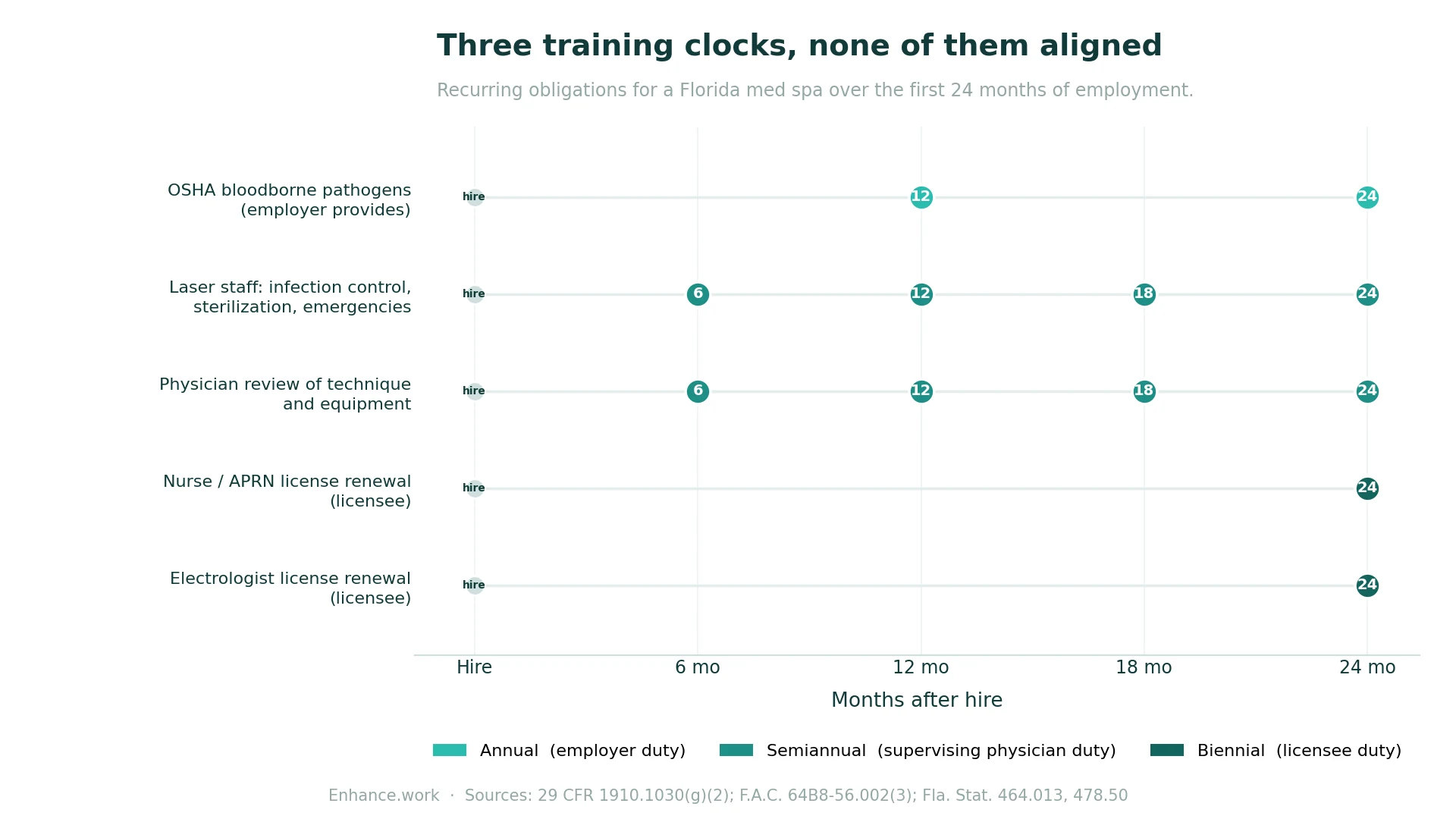
The recurring obligations run on different clocks. Annual, semiannual, and biennial cycles rarely line up.
What continuing education do nurses and injectors have to complete?
Florida nurses renew biennially, and the Board of Nursing may prescribe up to 30 hours of continuing education as a condition of renewal under Florida Statute 464.013.
Estheticians on your team carry their own version of this obligation. Our guide to esthetician continuing education sets out the ten hours Florida requires and the renewal group that decides which October they are due.
A few specifics shape how this affects staffing. Nurses certified by a specialty program accredited by the National Commission for Certifying Agencies or the Accreditation Board for Specialty Nursing Certification may be exempt from the general requirement. APRNs must still complete at least three hours on the safe and effective prescription of controlled substances. Separately, Florida Statute 456.033 requires an approved HIV and AIDS course for a range of licensed health professionals at biennial relicensure.
Here is the part that matters for the clinic. None of that is your legal obligation. It belongs to the licensee. But a lapsed license means that person cannot legally treat patients tomorrow. The schedule you built around them collapses the same day. Tracking renewal dates is not a compliance requirement. It is operational self defense.
Set a reminder ninety days before each licensee's renewal window. Verify status through the Department of Health license lookup rather than asking the employee. It takes under a minute, and it removes the most avoidable cause of an empty treatment room.
Required training by role in a Florida med spa
The table below separates what you must provide from what the licensee must maintain. Verify the current requirement with the relevant board before relying on it, since renewal rules change.
What has to be documented, and where does it live?
Training records need to be retrievable by whoever is in the building when an inspector or auditor asks, not filed in an owner's laptop.
For laser and electrolysis services, the written protocol developed jointly by the supervising physician and the electrologist must be signed, dated, and kept on the premises. A copy goes to the Department of Health. The rule is explicit that the on site copy must be readily available for inspection by agents of the Department.
For OSHA purposes, keep dated rosters showing who attended, what was covered, and who delivered it. The value of these records is entirely retrospective. Nobody asks until something has already gone wrong. At that point an undated certificate in an email thread is not much of a defense.
A practical structure is one folder per employee. It holds license verification with the date checked, the renewal date, initial and annual bloodborne training records, device specific training, and any role specific items. Where those policies get written down for the whole team, what belongs in a Florida med spa employee handbook and the state specific sections most handbooks leave out is the companion document.
What training does the law not require but the business does?
Consultation skill, treatment planning, and retail and package conversation. None of it is regulated, and all of it determines whether a provider pays for themselves.
This is the half nobody documents. A clinically excellent injector who cannot run a consultation will underperform a competent one who can. The gap shows up in rebooking rates, not in clinical outcomes. Owners notice the symptom, which is soft revenue, without connecting it to a training gap. The provider's technique is genuinely fine, so it never looks like the problem.
One caveat before going further, because this argument is easy to take too far. Commercial skill affects earnings, but it never substitutes for clinical judgment. Device parameters have to be matched to the patient's Fitzpatrick skin type, with the right pulse duration and fluence, and getting that wrong causes thermal burns and post inflammatory hyperpigmentation. Darker skin types carry the higher risk. A provider who sells well and parameterizes badly is a malpractice claim, not an asset. Treat commercial training as something you add on top of clinical competence, never as a trade against it.
With that said, the pattern is well established in aesthetics hiring. In laser services especially, selling a package rather than a single session tends to matter more to earnings than technique does. We examined that dynamic in what laser tech jobs in South Florida actually pay and why selling packages matters more than laser technique.
Three areas are worth structuring deliberately. Consultation covers how a provider assesses goals, sets expectations, and explains why a plan runs several sessions. Documentation means consistent notes and photography, which protects the clinic and makes outcomes visible to the patient. Escalation means knowing exactly when to stop and involve the physician. That last one is a safety skill and a confidence skill at once.
You do not need a curriculum to do this well. You need someone accountable for it, a defined competency the new hire is working toward, and a date by which they are expected to reach it.
Consultation skill is unregulated, unmeasured in most clinics, and the clearest predictor of whether a provider pays for themselves.
How often does training actually have to be repeated?
Three different clocks run at once, and they do not align. Annual for OSHA bloodborne training, semiannual for laser and electrolysis staff, biennial for most professional license renewals.
Because the cycles differ, a single annual compliance day does not cover everything. The semiannual obligations fall out of it entirely. Biennial renewals land on each licensee's own schedule rather than the clinic's. Owners who batch it all into one date usually discover the gap during an audit.
A workable approach anchors the recurring employer obligations to fixed calendar dates. Renewal dates get tracked individually per licensee. Two standing sessions a year cover the semiannual items and absorb the annual OSHA requirement. Individual renewals get their own reminders.
Build this at hire rather than retrofitting it later. The sequence for getting a new provider productive is covered in a med spa onboarding checklist running from before day one through the first ninety days, and the training calendar belongs inside that first week.
How does training affect retention?
Training is one of the few investments that pays back twice, once in competence and once in the reason a provider gives for staying.
Aesthetic providers are unusually mobile. Their license travels, demand across South Florida is steady, and a competing clinic is rarely a long drive away. What keeps good people in place is the sense that they are still developing. A clinic that funds device training and pays for continuing education makes that case concretely rather than rhetorically.
There is a version of this that backfires. Train someone thoroughly, then give them no room to use it, and you have produced a well qualified employee with an updated resume. The investment only holds if the scope of work grows alongside the skill. For the wider picture, why med spa turnover is so expensive in Florida and what actually keeps clinical staff from leaving sets out the retention economics.
Who owes which training, and who pays for it?
The useful split is not by topic. It is by who carries the obligation, because that decides who pays and what happens when somebody leaves.
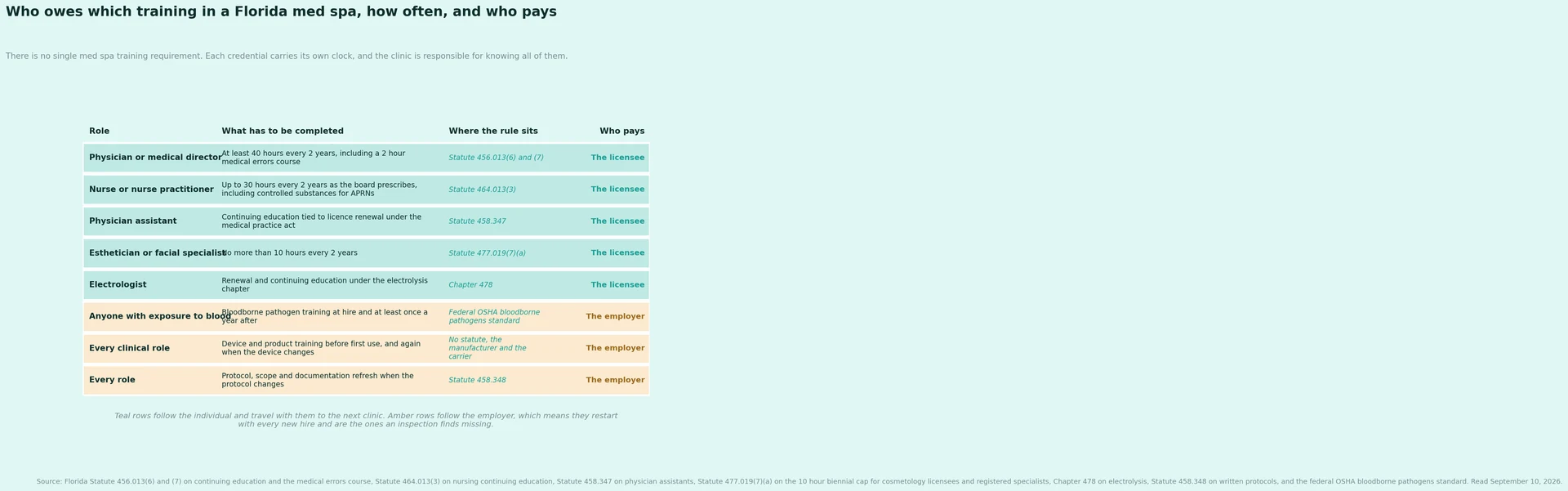
Training obligations by role. Statute 456.013(6) and (7), Statute 464.013(3), Statute 458.347, Statute 477.019(7)(a), Chapter 478, Statute 458.348 and the federal OSHA bloodborne pathogens standard, read 10 September 2026.
The teal rows travel with the person. Statute 456.013 requires at least 40 hours of continuing education every two years for physicians, including a 2 hour medical errors course, Statute 464.013(3) lets the Board of Nursing prescribe up to 30 hours every two years for nurses, and Statute 477.019(7)(a) caps continuing education at 10 hours biennially for cosmetology licensees and registered specialists. None of that is the clinic problem, though a clinic that tracks it avoids an expired licence in a treatment room.
The amber rows are the clinic problem, and they restart with every hire. The federal OSHA bloodborne pathogens standard requires training at hire and at least once a year afterwards, and the record of who completed it is what an inspection asks for.
What does the training file have to contain?
A completed course with no record is the same as no course. Keep these five things for every member of staff, in one place, dated.
One practical note. Keep the file per person rather than per course. When somebody asks whether a specific practitioner was trained on a specific device, a folder organised by course will not answer it.
Sources and how we checked them
Every obligation above is tied to the statute, rule or federal standard linked here. Where a retention practice is our recommendation rather than a stated requirement, the table says so.
- Physician continuing education: Florida Statute 456.013, which requires at least 40 hours every two years and a 2 hour medical errors course as part of biennial renewal. Read on 10 September 2026.
- Nursing continuing education: Florida Statute 464.013(3), which allows the board to prescribe up to 30 hours every two years, including controlled substances hours for advanced practice nurses. Read on 10 September 2026.
- Esthetics continuing education: Florida Statute 477.019(7)(a), which caps continuing education at 10 hours biennially for licensees and registered specialists. Read on 10 September 2026.
- Exposure training: the federal OSHA bloodborne pathogens standard, which requires training at hire and at least annually afterwards. Read on 10 September 2026.
- Protocols and licence checks: Florida Statute 458.348 on written protocols and the Florida Department of Health licence verification service. Read on 10 September 2026.
Frequently asked questions
What qualifications do medical spa staff need in Florida?
It depends on the treatment. Injectables require an appropriately licensed medical professional under physician oversight. Laser hair removal requires a licensed electrologist with the laser qualification, under direct physician supervision. Facials and skincare fall under the esthetician license. There is no single med spa credential in Florida.
Does a Florida med spa have to pay for staff training?
For OSHA bloodborne pathogens training, yes. The standard requires it be provided at no cost to the employee and during working hours. Continuing education for license renewal is generally the licensee's own responsibility, though many clinics fund it as a retention measure.
How often is bloodborne pathogens training required?
At the time of initial assignment to tasks involving occupational exposure, and at least annually after that, with each annual session falling within one year of the previous one. Additional training is required whenever tasks or procedures change in a way that affects exposure.
Who is responsible if a staff member's license lapses?
Maintaining the license is the individual's legal duty. The operational consequence is the clinic's. An unlicensed person cannot treat patients, so their booked appointments cannot proceed. Verifying status through the Department of Health lookup ahead of each renewal window avoids the problem entirely.
Do estheticians need continuing education in Florida?
Esthetician licensing sits with the Department of Business and Professional Regulation, not the Department of Health. Renewal requirements differ from the medical professions. Confirm current requirements directly with DBPR, since they are set separately from the health profession rules described here.
What training records should a med spa keep?
Dated rosters for each OSHA session showing attendees, content, and presenter. License verification records with the date checked. Device specific training for anyone operating laser or light based equipment. For laser services, the signed written protocol stays on the premises, with a copy filed with the Department of Health.
Run the calendar, then build the competence
The compliance half of med spa training is finite and knowable. A handful of recurring obligations, each with a named source, a frequency, and a person responsible. Once that is on a calendar and documented, it largely runs itself.
The other half is where clinics actually differentiate. No rule requires you to teach a new injector how to run a consultation, and no inspector will ever ask. It is also the training most likely to decide whether that hire becomes profitable or quietly underperforms for a year. Treating the legal minimum as the whole program is the most common mistake here. It is also the most expensive.
If you are building a team and want candidates whose licenses are verified before they reach your inbox, Enhance.work connects Florida med spas with credentialed aesthetic professionals across injectables, laser, and skincare. 🎯
This article summarizes Florida and federal training requirements for general informational purposes and is not legal advice. Requirements change and vary by role and practice setting. Confirm current obligations with the relevant licensing board and a Florida healthcare attorney.