Key takeaways
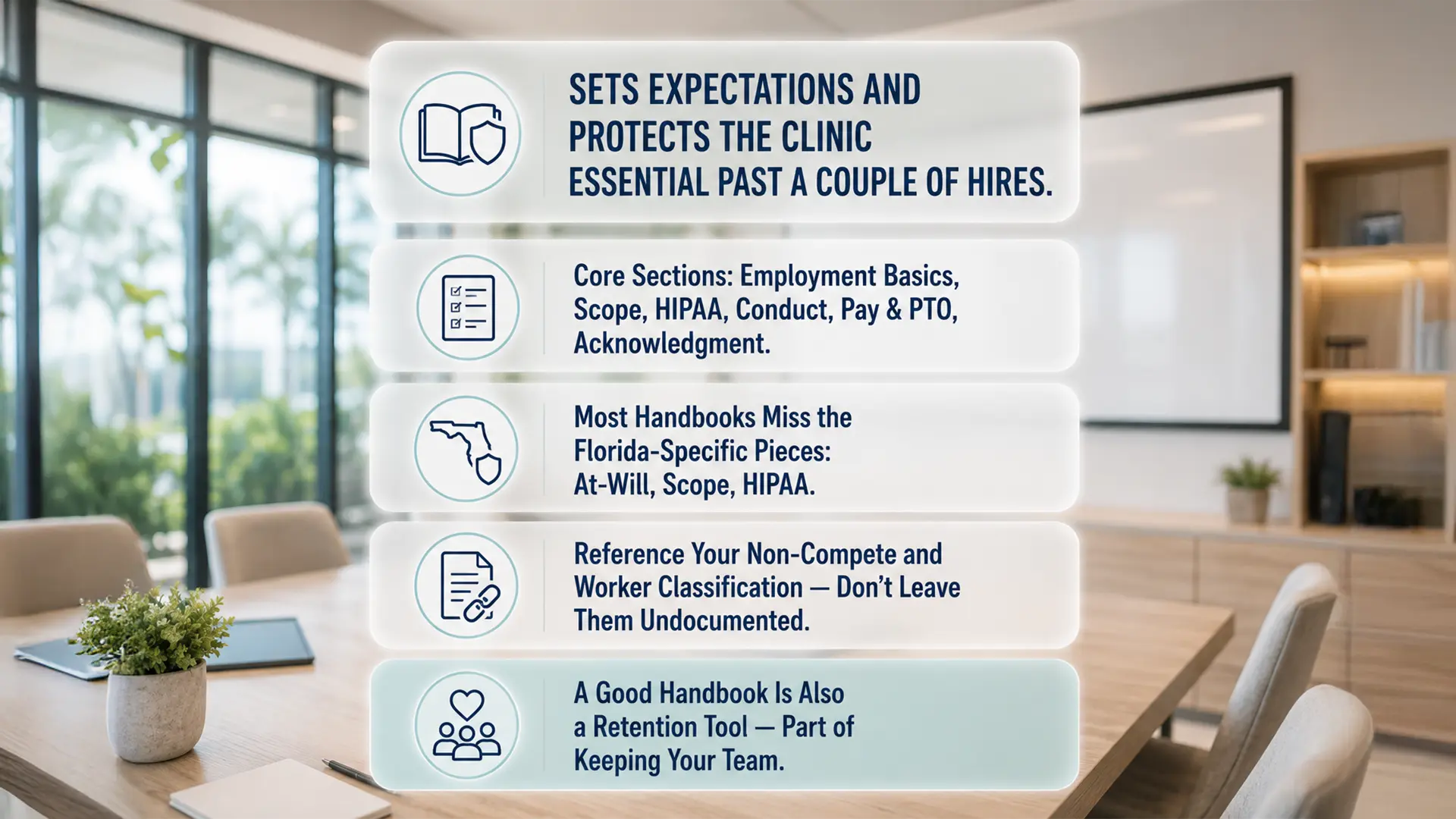
- A med spa employee handbook sets expectations and protects the clinic; past a couple of hires it is essential.
- Core sections: employment basics, scope and protocols, HIPAA, conduct, pay and PTO, and a signed acknowledgment.
- The pieces most handbooks miss are Florida-specific: at-will status, scope of practice, and HIPAA in a medical setting.
- Reference your non-compete and worker classification in the handbook; do not leave them undocumented.
- A good handbook is also a retention tool, part of keeping the team you worked hard to hire.
A med spa employee handbook is the document that says who may do what, how people are paid and what happens when something goes wrong. Florida does not require one. It becomes the clinic defence the first time a wage claim, a scope question or a regulatory inspection arrives, which is why it matters past the second hire.
A clear employee handbook sets expectations from day one and protects a Florida med spa.
Most Florida med spa owners do not think about an employee handbook until a problem forces it. That is backwards. A good handbook sets expectations, protects the clinic, and makes onboarding faster, and in a medical setting it also has to carry compliance weight a generic template will not. This guide covers what to include, the Florida-specific sections most handbooks miss, and how a handbook helps you keep the team you hired. It is general information for owners, not legal advice, so have your final version reviewed by a Florida employment attorney.
What is a med spa employee handbook, and why does it matter?
A med spa employee handbook is the written document that sets out your clinic's policies, expectations, and compliance rules for staff, from scope of practice to privacy, pay, and conduct. It matters because a med spa is a medical workplace: unclear expectations do not just cause friction, they create compliance and liability risk. A handbook turns how we do things here into something consistent, defensible, and easy to onboard new hires into.
The core sections a Florida med spa employee handbook should include, from employment basics to HIPAA.
What to include in a med spa employee handbook
A strong med spa handbook covers the essentials every workplace needs plus the medical and Florida-specific pieces. Include:
→ how to reduce med spa turnover in Florida, the retention levers that keep injectors and estheticians from leaving, and what turnover really costs an owner supports retention.
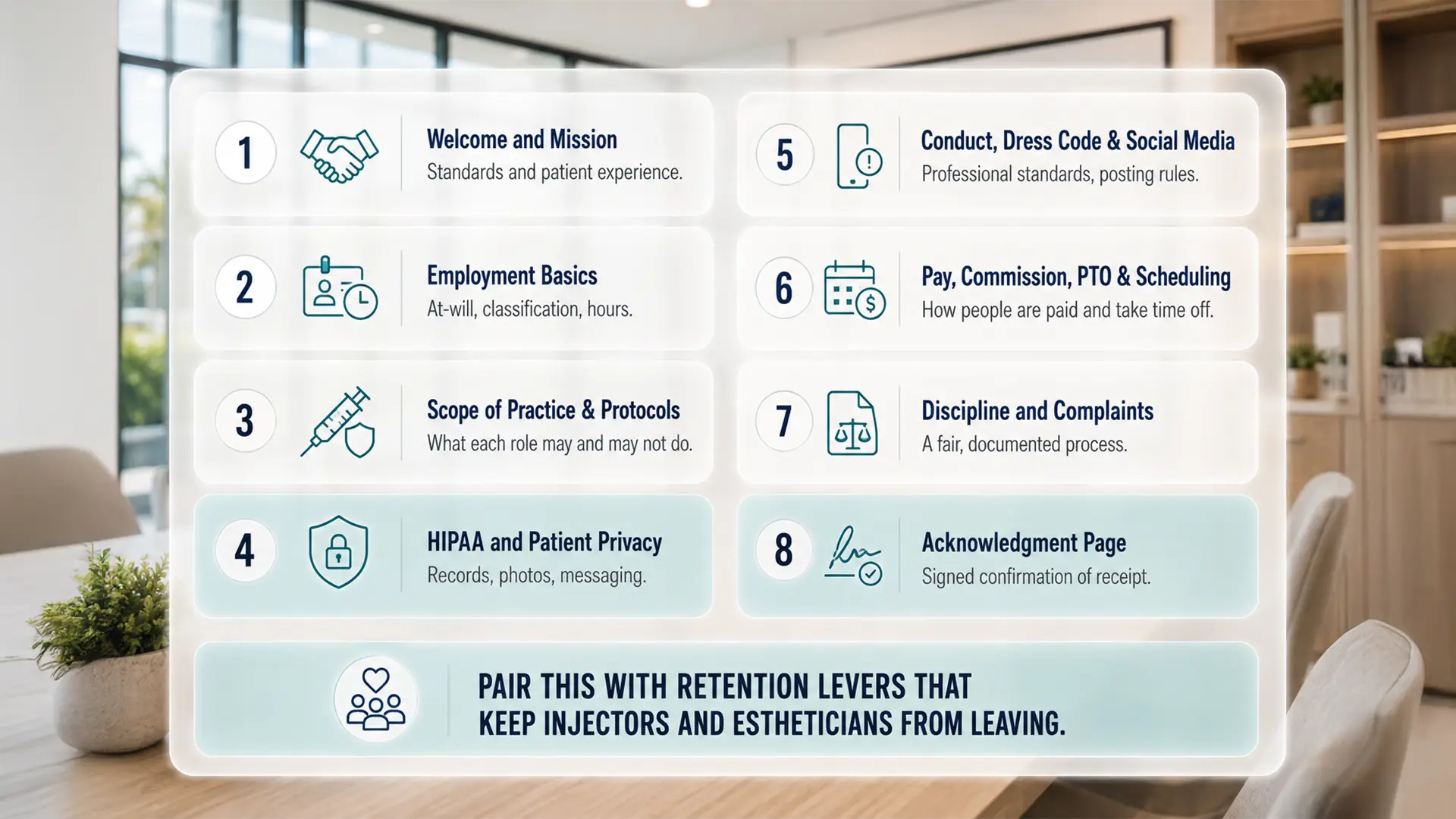
- Welcome and mission. Who you are, your standards, and the patient experience you expect.
- Employment basics. At-will status, worker classification, hours, and probationary periods.
- Scope of practice and protocols. What each role may and may not do, tied to your clinical protocols.
- HIPAA and patient privacy. How staff handle records, photos, and messaging.
- Conduct, dress code, and social media. Professional standards and rules for posting about patients or treatments.
- Pay, commission, PTO, and scheduling. How people are paid and how time off works.
- Discipline and complaints. A fair, documented process for issues.
- Acknowledgment page. A signed page confirming each employee received and read it.
A general small-business handbook template is a reasonable starting point, but a med spa needs the medical and Florida layers below.
The handbook governs the person once they are hired. The job description governs who applies in the first place, and the two should agree on scope, because a duties list that contradicts the handbook creates exactly the ambiguity both documents exist to remove. Our guide to building an esthetician job description by license level, including the scope language Florida statute does not permit in a duties list covers the posting side.
The Florida-specific sections most handbooks miss
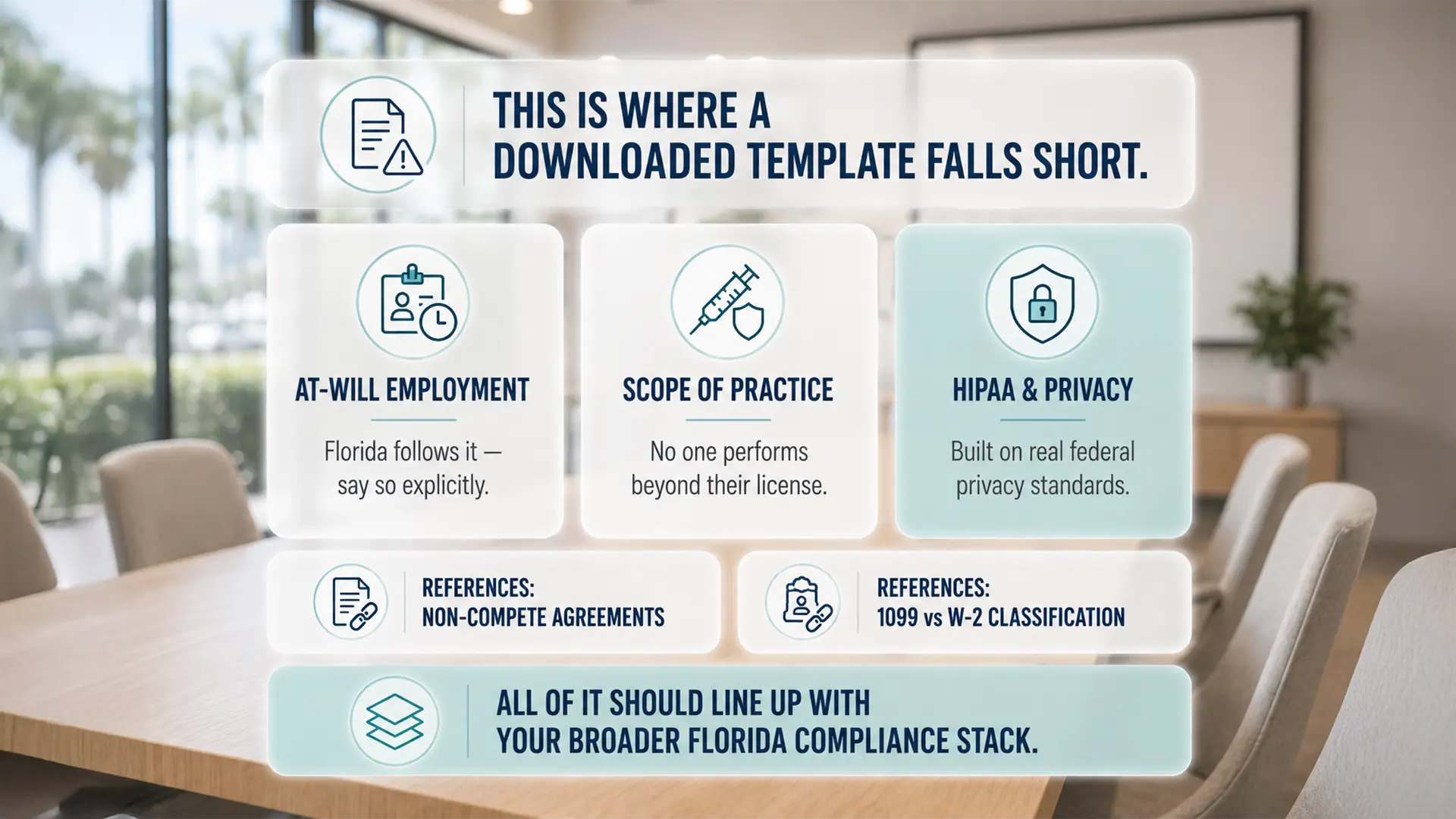
This is where a downloaded template falls short. A Florida med spa handbook should be explicit about at-will employment, which Florida follows, and about scope of practice so no one performs a treatment their license does not cover. It must build on real privacy rules; ground that section in the U.S. Department of Health and Human Services overview of HIPAA, which sets the privacy standards a med spa handbook has to reflect. It should also reference the agreements staff sign. Point to our guide to med spa non-compete agreements in Florida, which explains what is enforceable and how to protect your patient base when a provider leaves, and set expectations on pay with our breakdown of 1099 versus W-2 for med spa staff in Florida, which explains how to classify and pay your team correctly. All of it should line up with our complete Florida med spa compliance guide, which covers medical direction, good faith exams, scope, and the rules your handbook has to reflect.
A handbook makes onboarding faster and sets one consistent standard for the whole team.
A handbook is a retention tool, not just a rulebook
Owners underrate this: a clear handbook is part of keeping good people. Ambiguity about pay, scope, and expectations is a top reason strong providers leave, and a fair, transparent handbook removes that friction. It works best paired with hiring well in the first place, which is why it belongs next to our guide to med spa staffing in Florida, which covers building the team your handbook then helps you keep for the long term. The clinics with the lowest turnover are clear about the rules and consistent in applying them.
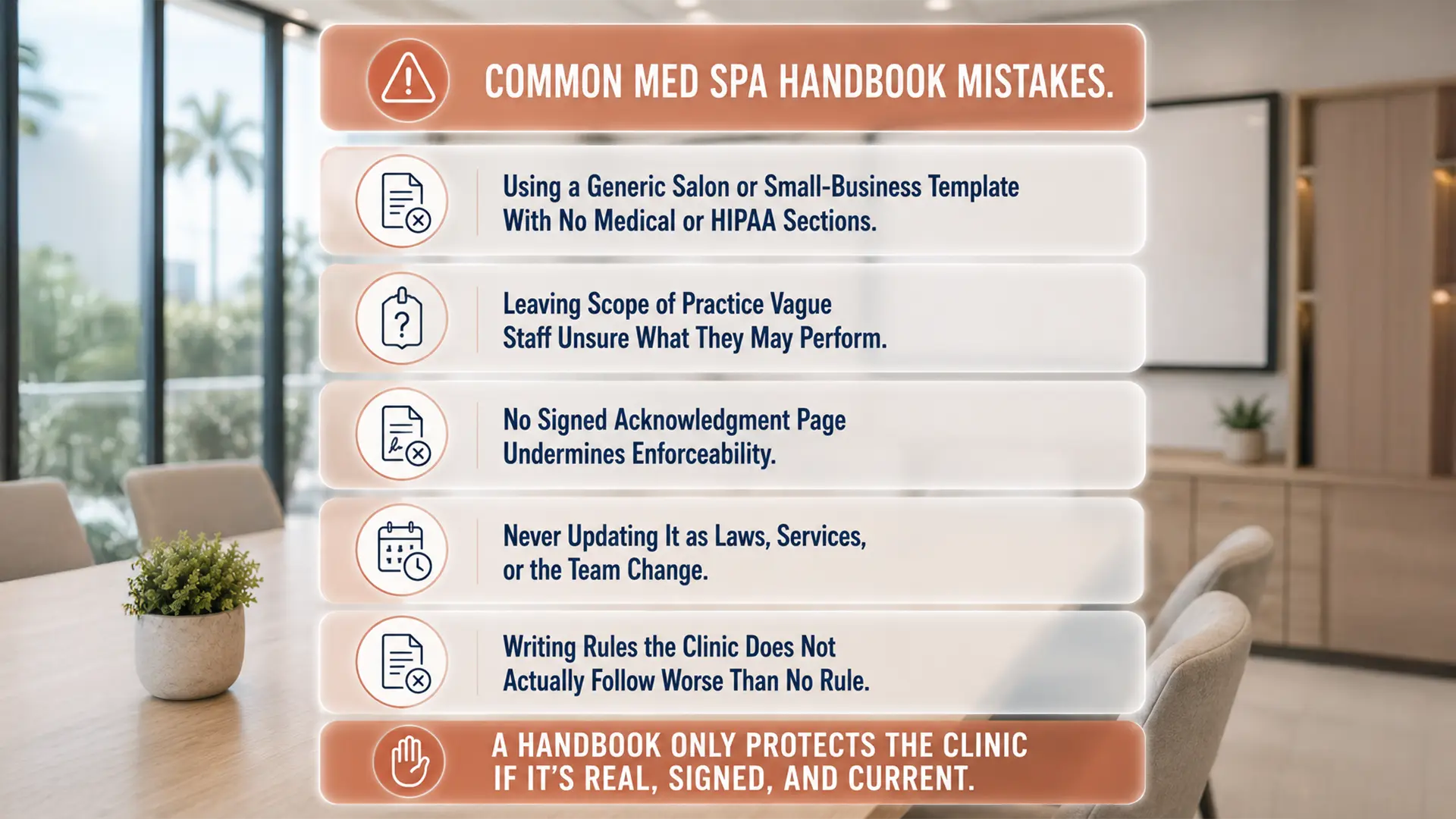
Common med spa handbook mistakes
- Using a generic salon or small-business template with no medical or HIPAA sections.
- Leaving scope of practice vague, so staff are unsure what they may perform.
- No signed acknowledgment page, which undermines enforceability.
- Never updating it as laws, services, or the team change.
- Writing rules the clinic does not actually follow, which is worse than no rule.
A transparent handbook reduces friction over pay and expectations, which helps retain strong providers.
Sources: American Med Spa Association.
Is a med spa employee handbook legally required in Florida?
Florida does not legally require a private employer to hand every worker a written handbook. But not required and not needed are different things. The handbook is where an at-will disclaimer, an anti-harassment and complaint procedure, and a wage and hour acknowledgment under the federal Fair Labor Standards Act live, and each of those is a documented defense if a dispute ever reaches a lawyer. Without them, you are not saving effort, you are removing the paper trail that protects the clinic.
Handbook policies for 1099 contractors versus W-2 employees
One handbook rarely fits both a W-2 front desk team and a 1099 injector, and treating them the same is a classification risk. A handbook that dictates a contractor's schedule, methods, and dress code is evidence the state can use to reclassify that contractor as an employee, with back taxes attached. Before you write a single policy, get clear on how Florida draws the line between 1099 contractors and W-2 employees at a med spa, then write separate, clearly labeled sections so the handbook supports the classification instead of undermining it.
How often should you update the handbook, and what keeps staff?
Review the handbook at least once a year and any time the law changes, and Florida gives you a built-in reminder: the state minimum wage rises every September 30 on its way to $15 an hour, so a wage section written two years ago is already stale. Beyond compliance, the policies that actually retain people, transparent pay and progression, clear time off, a real complaint path, are the same ones that reduce churn. If retention is the goal, pair the handbook with the levers in a practical playbook for reducing med spa turnover in Florida, because a rulebook nobody feels good about is not a retention tool.
Which sections are backed by a rule, and which are only policy?
Owners write the easy sections first. The sections with a rule behind them are the ones that go missing, and they are the ones that would have protected the clinic.
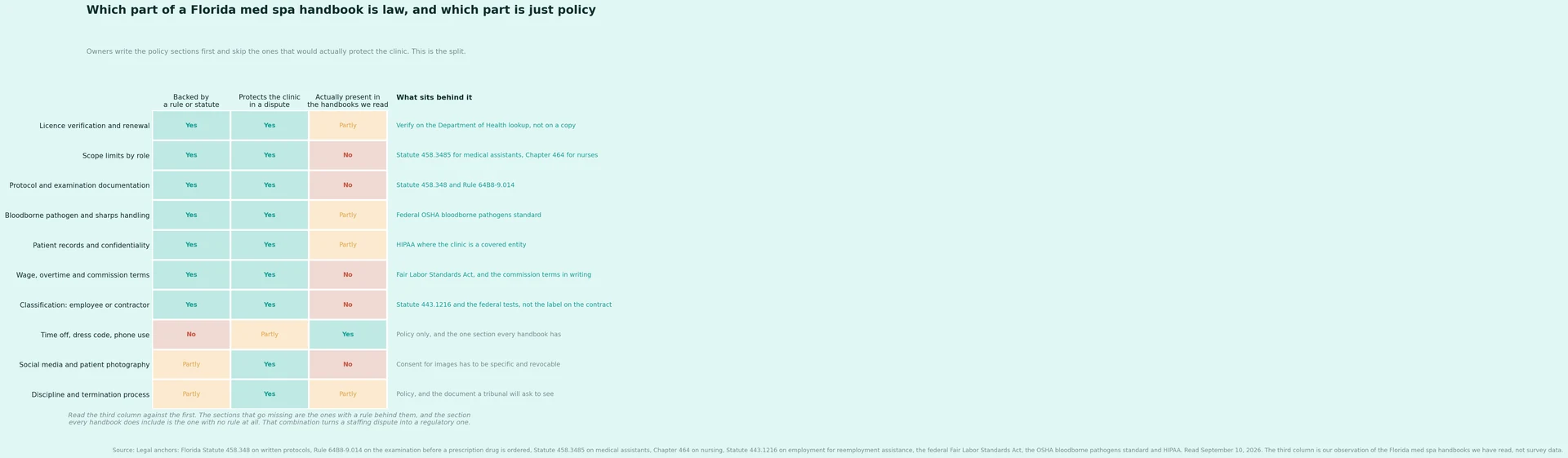
Handbook sections mapped against the rule behind them. Legal anchors from Statute 458.348, Rule 64B8-9.014, Statute 458.3485, Chapter 464, Statute 443.1216, the Fair Labor Standards Act, the OSHA bloodborne pathogens standard and HIPAA. The third column is our observation.
The pattern is uncomfortable. The one section every handbook contains is time off and dress code, which has no rule behind it at all. The sections that decide a dispute are the ones people skip.
Fixing that costs an afternoon. It does not require a lawyer to start, though it is worth having one read the classification and wage sections before the handbook is issued.
What does each required section actually have to say?
Specifics, not principles. A section that says the clinic complies with all applicable laws is worth nothing in a dispute. Here is the minimum each one has to contain.
| Section | What it has to state | What sits behind it |
|---|---|---|
| Licence verification | That the clinic verifies every clinical licence on the state record at hire and at renewal | Verification through the Department of Health, not a copy from the employee |
| Scope by role | What each role may and may not do, named role by role | Statute 458.3485 for medical assistants, Chapter 464 for nurses |
| Protocol and examination | That treatment follows a written protocol and a documented examination | Statute 458.348 and Rule 64B8-9.014 |
| Pay and commission | How base, commission and product cost are calculated, and when they are paid | The Fair Labor Standards Act, and the commission terms in writing |
| Classification | Which roles are employees and which are contractors, and on what basis | Statute 443.1216 and the federal tests, not the label on the contract |
| Exposure and sharps | Training at hire and annually, with the record of who completed it | The federal OSHA bloodborne pathogens standard |
| Patient images and social media | That consent for images is specific, written and revocable | Patient confidentiality obligations, and HIPAA where the clinic is a covered entity |
The classification row causes the most litigation. Statute 443.1216 defines employment for Florida reemployment assistance purposes, and the label on a contract does not settle it. If the clinic sets the hours, supplies the product and directs the treatment, calling somebody a contractor does not make them one.
How do you keep the handbook from going stale?
A handbook that nobody has updated in three years is worse than none, because it documents a standard the clinic is no longer meeting. Put it on a schedule.
- Review the scope sections whenever a role changes or a new device arrives, because Statute 458.348 ties the protocol to the individual practitioner and the treatments named in it.
- Review the pay section whenever the commission model changes, and reissue it rather than sending an email that contradicts the handbook.
- Re-verify every clinical licence at renewal on the Florida Department of Health licence verification service, and record the date the check was made.
- Refresh exposure training annually and keep the sign in sheet, because the federal OSHA bloodborne pathogens standard requires training at hire and at least once a year after that.
- Get a signed acknowledgement from every member of staff each time the handbook is reissued, and keep it with the personnel file rather than in a shared drive nobody controls.
One rhythm works well. Review it every January, and again whenever a role, a device or a pay model changes. That is usually two or three touches a year, and it takes an hour each time.
Sources and how we checked them
The legal anchors above are primary sources. The observation about which sections go missing is ours, drawn from the Florida med spa handbooks we have read, and the chart caption says so.
- Scope and protocols: Florida Statute 458.348 on written protocols between a physician and each practitioner supervised, Statute 458.3485 on what a medical assistant may do and Rule 64B8-9.014 on the examination required before a prescription drug is ordered. Read on 10 September 2026.
- Classification and pay: Florida Statute 443.1216, which defines employment for reemployment assistance purposes, with the federal Fair Labor Standards Act as administered by the Wage and Hour Division. Read on 10 September 2026.
- Exposure training: the federal OSHA bloodborne pathogens standard, which requires training at hire and at least annually afterwards. Read on 10 September 2026.
- Confidentiality: the Department of Health and Human Services guidance on the HIPAA Security Rule, which applies where the clinic is a covered entity. Read on 10 September 2026.
- Licence checks: the Florida Department of Health licence verification service. Read on 10 September 2026.
Frequently asked questions
Does a med spa need an employee handbook?
Once you have more than a couple of employees, yes. A handbook sets consistent expectations, supports compliance in a medical setting, and protects the clinic if a dispute arises.
What should a med spa employee handbook include?
Employment basics, scope of practice and protocols, HIPAA and privacy, conduct and social media, pay and PTO, a discipline process, and a signed acknowledgment page.
Is Florida an at-will employment state?
Yes. Florida follows at-will employment, and your handbook should state that clearly while avoiding language that accidentally implies a fixed term or guaranteed employment.
Should a med spa handbook cover HIPAA?
Yes. Because a med spa handles protected health information, the handbook must set rules for records, photos, and messaging that reflect HIPAA and Florida privacy requirements.
Can I use a generic employee handbook template for my med spa?
You can start from one, but a generic template lacks the medical, scope, and HIPAA sections a med spa needs. Adapt it to Florida and have it reviewed by an employment attorney.
Should the non-compete go in the employee handbook?
Reference it in the handbook, but keep the actual non-compete or non-solicitation as a separate signed agreement. The handbook sets expectations; the signed agreement is the enforceable document.
Does a Florida med spa have to have an employee handbook?
No. Florida does not require one at any headcount. It becomes worth having at the second or third hire, because it is the document that shows what the clinic told staff about scope, pay and documentation when a dispute or an inspection arrives.
Can the same handbook cover employees and 1099 contractors?
It should not. A handbook that directs a contractor how and when to work is evidence that the person is an employee. Keep a separate short document for contractors covering safety, confidentiality and documentation, and leave scheduling and conduct rules out of it.
Who should write a med spa handbook?
The operations lead can draft it. The scope sections should be checked against the protocols the medical director signed, and the pay and classification sections should be reviewed by an employment lawyer before it is issued.
A handbook that protects the clinic and the team
A med spa employee handbook is not busywork. Done right, it sets one clear standard, carries your Florida compliance obligations, and helps you keep the providers you worked hard to hire. Build it on the core sections, add the Florida and medical layers, get it reviewed by an attorney, and keep it current.