Key takeaways
- In Florida a non-physician can own a medical spa, because Florida is not a strict corporate practice of medicine state the way California, New York, and Texas are.
- Owning the business is not the same as controlling the medicine; every medical decision has to sit with a licensed physician through a medical director.
- A nurse practitioner, physician assistant, esthetician, or pure investor can all own a med spa in Florida, as long as the clinical side is properly supervised.
- The fastest ways to lose a clinic are letting a non-physician direct treatment, skipping the good faith exam, and splitting medical fees with a non-licensee.
- Get the ownership structure and the medical director right first; the treatments, the staff, and the marketing all depend on that foundation.
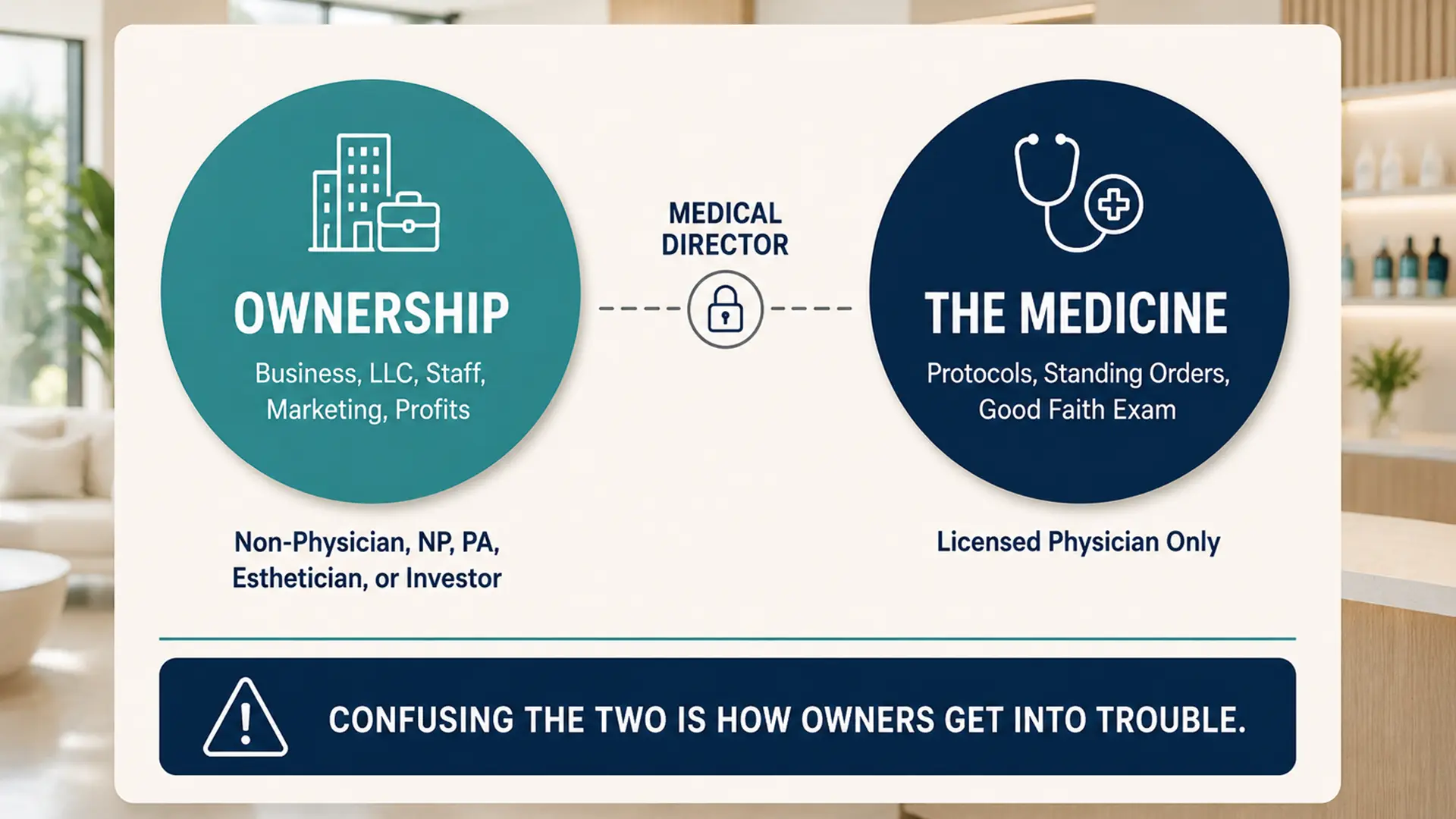
In Florida a non-physician can own a medical spa, but the medicine still belongs to a licensed physician.
→ what med spa insurance in Florida actually costs and which policies protect the clinic and its providers rounds out the setup.
If you want to own a medical spa in Florida but you are not a physician, the good news is simple: you almost certainly can. Florida is one of the friendlier states for non-physician owners. The catch is that owning the business and controlling the medicine are two different things, and confusing them is how owners get into trouble.
Staffing a hair removal service line has a compliance step owners routinely discover late, because an electrolysis facility needs its own license from the Department of Health and laser work requires a supervising physician in the arrangement from day one.
Owning the practice means owning its employment obligations from the first shift onward, and the onboarding steps that belong before a new hire ever touches a client include verifying the licence yourself and settling whether orientation is compensable.
Who can own a medical spa in Florida?
In Florida, almost anyone can own a medical spa. A non-physician entrepreneur, a nurse, an esthetician, or an outside investor can all legally own the business. What none of them can do is own or direct the medical side of the practice unless they hold the right license. That part stays with a physician, which is why the question of who can own a medical spa in Florida is really two questions: who owns the company, and who is responsible for the medicine.
Is Florida a corporate practice of medicine state?
This is the detail that changes everything. Some states follow a strict corporate practice of medicine doctrine, which says only a licensed physician can own a practice that delivers medical care. In those states a non-physician cannot be the owner at all, and they use a management model to work around it.
Florida is not one of those strict states. A non-physician can directly own a medical spa in Florida. That is a real advantage over states like California, New York, New Jersey, and Texas, where ownership itself is restricted. The American Med Spa Association tracks these rules state by state, and the American Med Spa Association's legal resources put Florida among the more permissive states for ownership. Because interpretation and enforcement can shift, confirm your specific setup with a Florida healthcare attorney and verify the current medical spa ownership and oversight requirements directly with the Florida Board of Medicine before you commit before you sign anything.
What a non-physician owner can and cannot do
The line is not about the building or the brand; it is about clinical control. As the owner you run the business. The physician runs the medicine. Here is how that splits in practice:
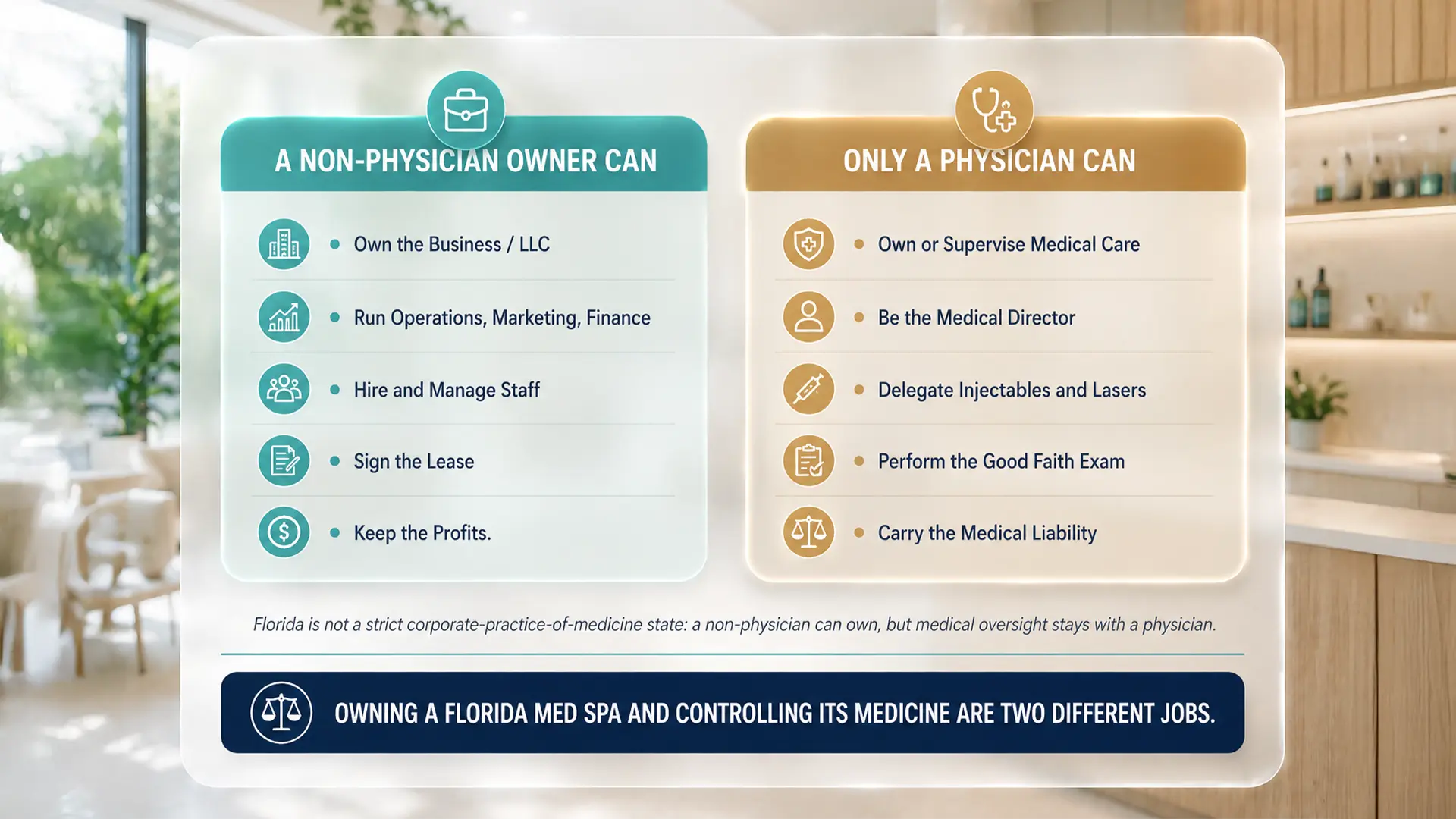
Owning a Florida med spa and controlling its medicine are two different jobs; a non-physician owner can do the first, not the second.
| A non-physician owner CAN | Only a physician CAN |
|---|---|
| Own the business and the LLC | Own or supervise the medical care |
| Run operations, marketing, and finance | Serve as the medical director |
| Hire, manage, and pay staff | Set treatment protocols and standing orders |
| Sign the lease and buy the equipment | Delegate injectables and laser treatments |
| Keep the profits from the business | Perform or authorize the good faith exam |
Read the right column again, because it is the part owners underestimate. Even though you own the company, you cannot make clinical decisions, direct how a provider treats a patient, or pressure a provider to treat someone the medicine says they should not. Our breakdown of what an aesthetic RN can legally do in Florida shows where those scope lines fall, and the same logic governs your role as owner.
Do you need a medical director to own a med spa in Florida?
Yes. If your medical spa offers medical treatments, and almost all of them do, you need a licensed physician acting as your medical director. The medical director is legally responsible for the medicine: the protocols, the standing orders, the delegation to nurses and injectors, and the oversight that keeps every treatment inside the law.
For a non-physician owner, the medical director is not a formality; it is the person who makes your ownership legal in the first place. Our guide to the med spa medical director in Florida explains what the role actually requires and who is accountable, and if you are the physician considering the role, the guide on how to become a medical director for a Florida med spa covers it from that side.
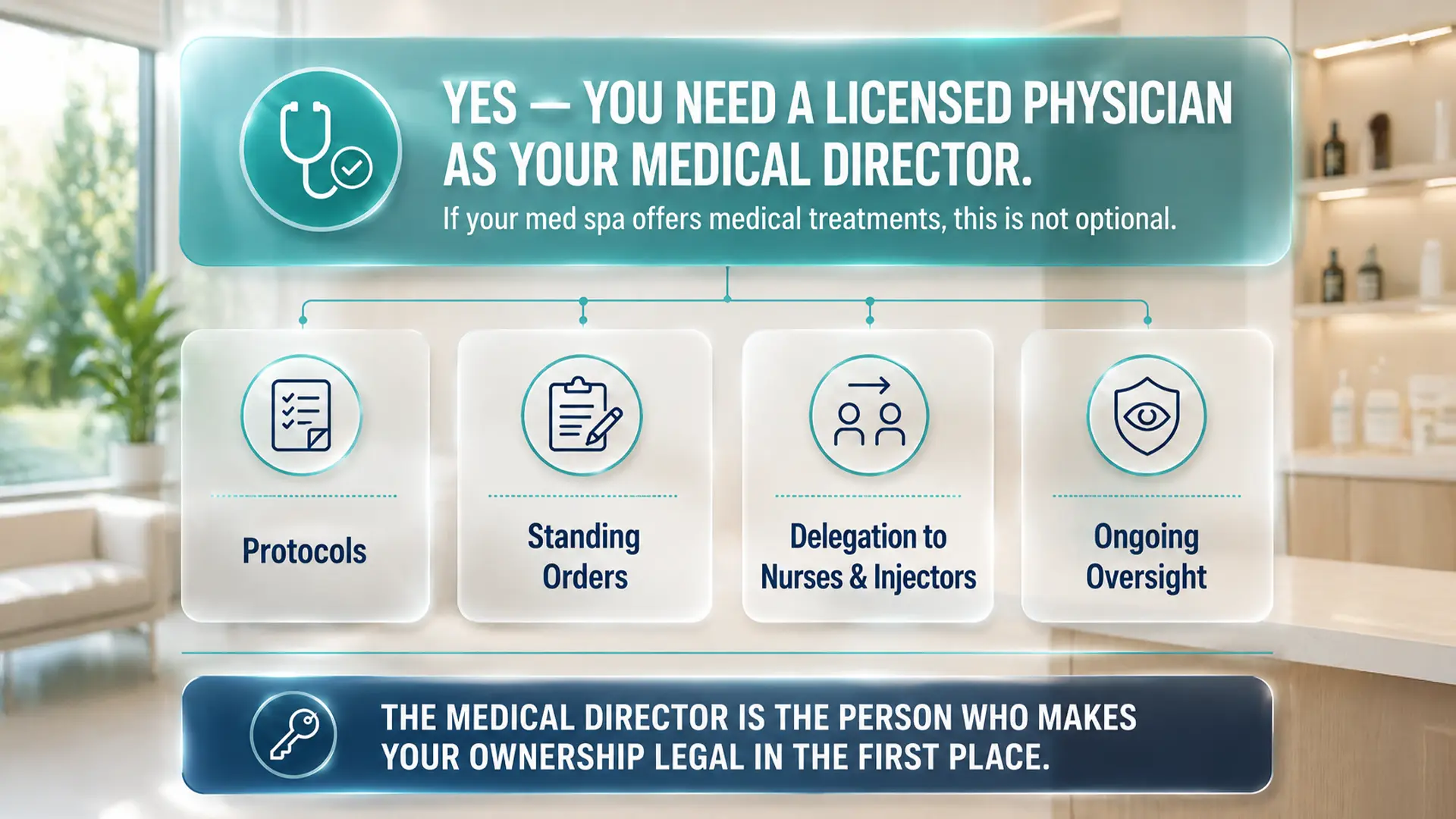
Owners who get the structure right treat the ownership agreement and the medical director relationship as one connected decision.
Can a nurse practitioner or PA own a med spa in Florida?
Yes. A nurse practitioner (NP), physician assistant (PA), registered nurse, or esthetician can all own a medical spa in Florida. Owning it, though, does not expand what their license lets them do. An NP who owns a clinic still practices within NP scope, and the clinic still needs proper physician oversight for anything beyond that scope. Ownership is a business right; scope of practice is a licensing rule, and the two do not merge just because your name is on the LLC. An NP owner also cannot supervise herself, which is why our guide to the collaborative agreement Florida actually requires and who may lawfully sign the protocol for an aesthetic clinic matters as much to owners as it does to the providers they hire.
Ownership structures: direct ownership and the management model
Because Florida allows direct ownership, most owners simply form an LLC and own the med spa outright, with a contracted medical director handling the medicine. That is the straightforward path.
A franchise agreement sits on top of one of these structures rather than replacing it. Our med spa franchise guide explains why the franchisor cannot answer the Florida ownership question for you, and what the fee does and does not buy.
Some owners still choose a management model, where a management company handles the non-clinical side and a physician-owned entity holds the medical side. In a strict corporate practice of medicine state this structure is mandatory, but in Florida it is usually a choice made for multi-state plans, investor requirements, or extra caution. Whichever structure you pick, the money rules still apply: you cannot split medical fees with a non-licensee in a way that counts as fee-splitting or a kickback. This is a place to spend money on a healthcare attorney, not to improvise.
A related mistake is hiring before deciding what the role legally is. Our esthetician job description templates by license level, including the duties Florida statute does not allow a facial specialist to perform keep the posting inside the scope your structure actually supports.
What owners get wrong about medical spa ownership
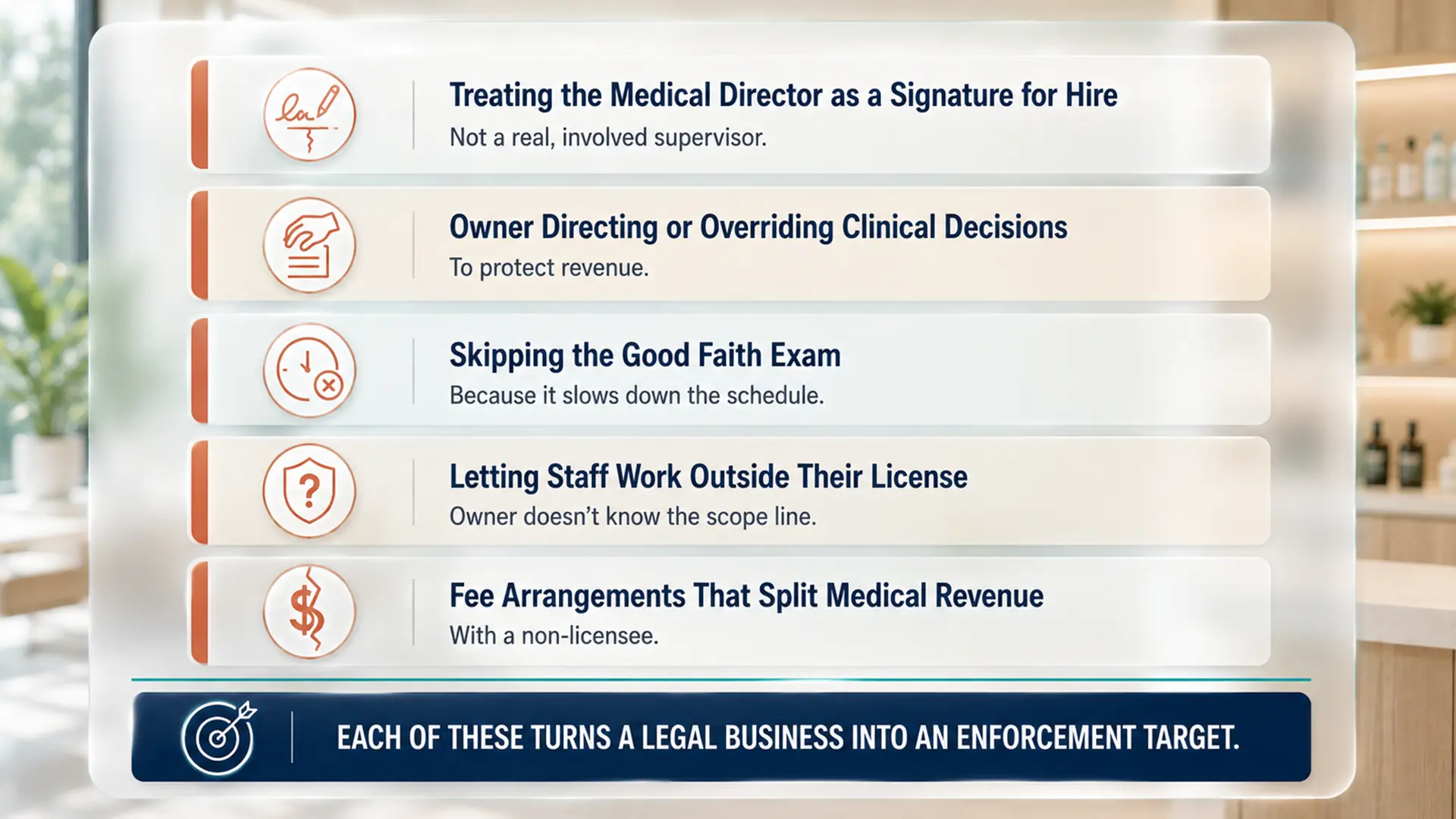
The mistakes that close Florida med spas are predictable, and they almost always come from blurring the ownership and medicine line:
- Treating the medical director as a signature for hire instead of a real, involved supervisor.
- A non-physician owner directing or overriding clinical decisions to protect revenue.
- Skipping the good faith exam before treatment because it slows down the schedule.
- Letting staff work outside their license because the owner does not know where the scope line is.
- Fee arrangements that quietly amount to splitting medical revenue with a non-licensee.
Each of these turns a legal business into an enforcement target. The good faith exam alone is a common failure point, and our guide to the good faith exam for Florida med spas explains why skipping it is one of the fastest ways to lose a clinic.
A compliant Florida med spa looks calm from the front desk because the ownership and oversight structure behind it is sound.
Once the structure is compliant, the next question every owner asks is what the business will actually pay them. Our breakdown of what med spa owners really take home, the difference between owner wages and distributions, and the payroll math that decides the number covers it without the invented averages.
How to set up compliant med spa ownership in Florida
If you want to own a medical spa in Florida the right way, build it in this order:
- Confirm your ownership structure with a Florida healthcare attorney before you form the entity.
- Form the business (usually an LLC) and keep the business side and the medical side clearly defined.
- Contract a qualified physician as your medical director, with a real oversight agreement.
- Adopt written protocols and standing orders that the medical director owns and signs.
- Build the good faith exam into your patient flow so no treatment happens without it.
- Staff each role within its license, and document who is delegated to do what.
That sequence is the backbone of a legal clinic. For the full launch checklist around it, our complete step-by-step guide on how to open a med spa in Florida walks through the entire legal and compliance setup, and the Florida med spa business plan guide helps you turn that structure into real numbers.
Many new owners benefit from first reading our practical breakdown of hiring a medical spa consultant in Florida, including the strategy work, the real monthly and project cost ranges, and the compliance layer owners face before they commit to a launch timeline.
Ownership is only one piece of the broader Florida med spa compliance framework, which also spans medical direction, good faith exams, and the supervision standards a clinic must meet to operate legally.
→ the Florida rule governing who may operate a hair removal laser and the four to one supervision cap covers the employer side of the laser rule.
→ what training Florida requires of med spa staff and who carries the duty to provide and document it maps the recurring obligations by role.
Frequently asked questions
Who can own a medical spa in Florida?
Almost anyone. A non-physician entrepreneur, nurse, esthetician, or investor can legally own a medical spa in Florida, because Florida is not a strict corporate practice of medicine state. The medical care itself, however, must be supervised by a licensed physician.
Can a non-physician own a med spa in Florida?
Yes. Florida allows non-physicians to directly own a medical spa. The owner runs the business, but a licensed physician acting as medical director must be responsible for all clinical decisions and oversight.
Is Florida a corporate practice of medicine state?
No, not in the strict sense. Unlike California, New York, New Jersey, and Texas, Florida does not bar non-physicians from owning a practice that delivers medical care, which is why direct ownership of a med spa is allowed.
Do you need a medical director to own a med spa in Florida?
Yes. Any Florida med spa offering medical treatments needs a licensed physician as medical director to set protocols, provide oversight, and take medical responsibility for the treatments delivered.
Can a nurse practitioner own a med spa in Florida?
Yes. A nurse practitioner can own a medical spa in Florida, but ownership does not expand their scope of practice. The clinic still needs proper physician oversight for anything beyond NP scope.
Can you own a med spa without being a doctor?
In Florida, yes. You do not need to be a doctor to own a medical spa, but you cannot control the medical decisions. Those must belong to a licensed physician through a medical director relationship.
Own the business, respect the medicine
Who can own a medical spa in Florida? You can, even without a medical license. The winning move is to accept the one rule that comes with that freedom: you own the business, and a physician owns the medicine. Get the structure and the medical director right, and everything else you want to build has a foundation that will hold.
This article is general information, not legal advice. Florida rules and enforcement change; confirm your ownership structure with a Florida healthcare attorney and the Florida Board of Medicine.