
Key Takeaways
- Florida law does not use the phrase collaborative agreement. The statute requires an established protocol, and Fla. Stat. 464.012(3) says it must be maintained on site at every location where the APRN practices.
- The physician, not the nurse practitioner, carries the filing duty. Fla. Stat. 458.348(1) gives the physician 30 days to notify the Board of Medicine after entering a protocol, and 30 days again after ending it.
- Autonomous APRN registration does not release an aesthetic NP from the protocol. Fla. Stat. 464.0123(3)(a)1 limits autonomous practice to primary care, and aesthetics is not primary care.
- The rule that used to list what a protocol must contain, Fla. Admin. Code 64B9-4.010, was repealed in September 2017. Any article still quoting its checklist is quoting a dead rule.
- The provision that disqualifies most remote medical directors is Fla. Stat. 458.348(3)(c): at an off-site aesthetic office the supervising physician must be board certified or board eligible in dermatology or plastic surgery, must be within 25 miles, and may cover only one such office.
- A clinic that signs a collaborative agreement in Florida without checking that last provision has bought a document that does not do what it thinks it does.
Every med spa owner in Florida eventually asks the same question, usually the week before opening: does the nurse practitioner need a collaborative agreement, and who signs it. The question is reasonable. The vocabulary is wrong, and the wrong vocabulary is what sends clinics to the wrong template. Florida does not license a collaborative agreement, does not define one, and does not require a collaborative agreement by that name. What Florida requires is an established protocol, and the statutory framework around it is stricter for aesthetics than for almost any other setting an APRN can work in.
This guide is written for both sides of that signature. If you are an NP moving into aesthetics, it tells you what you are actually signing and what it costs. If you own or manage a clinic, it tells you which provision of Florida law most collaborative agreements in aesthetics quietly fail, and what to keep on file when a Department of Health investigator asks.
Does Florida require a collaborative agreement for aesthetics?
Yes, in substance, but not under that name. A nurse practitioner working in a Florida med spa must practice under an established protocol with a physician licensed under chapter 458 or 459. Florida Statute 464.012(3), which sets the framework an advanced practice registered nurse must work within states that the APRN performs the authorized functions "within the framework of an established protocol that must be maintained on site at the location or locations at which an advanced practice registered nurse practices." The phrase collaborative agreement comes from other states and from national practice guides. In Florida it is industry shorthand, not a legal term.
That distinction matters for a practical reason. If you search for a collaborative agreement template, you will find documents built for states with collaborative practice statutes that spell out chart review percentages, meeting frequency, and co-signature rules. Florida imposes none of those by statute. Copying that template into a Florida clinic gives you obligations you do not have, and leaves out the one obligation the state actually enforces, which is the on-site copy.
The same statute also settles who has the last word clinically. It says a practitioner licensed under chapter 458, 459, or 466 "shall maintain supervision for directing the specific course of medical treatment." The protocol is the instrument through which that supervision happens. It is not a formality between colleagues, and it is not a rental agreement for a signature, even though a large part of the Florida market treats it as exactly that.
Collaborative agreement, protocol, and standing order: the three terms clinics mix up
Most compliance confusion in Florida aesthetics traces back to three words used interchangeably in job postings and vendor contracts. They are not synonyms, and only one of them is what the statute requires.
| Term | Status in Florida law | What it actually governs |
|---|---|---|
| Collaborative agreement | Not a defined term. Industry shorthand borrowed from other states. | Nothing on its own. The document only matters if its contents satisfy the protocol requirement. |
| Established protocol | Required by Fla. Stat. 464.012(3). Must be maintained on site at each practice location. | The scope of medical acts the APRN may perform and the physician supervision behind them. |
| Standing order | Named in Fla. Stat. 458.348(1) alongside protocols, and used mainly for EMTs and paramedics. | A physician instruction to carry out a specific act, not a substitute for the APRN protocol. |
If a vendor sells your clinic a collaborative agreement in Florida, the correct question is not whether the title is right. It is whether the document defines the medical acts, names the supervising physician, and lives on site at the address where the NP injects. A document that sits in a Dropbox folder in another county satisfies neither the letter nor the point of the statute.
Who signs the protocol, and what the physician has to file
The protocol is signed by the APRN and by the supervising physician. The filing duty, however, sits with the physician alone, and this is the step clinics most often miss because they assume the nurse practitioner handles her own paperwork.
Florida Statute 458.348(1), which sets the notice requirements for formal supervisory relationships and established protocols requires the physician to submit notice to the Board of Medicine stating that he or she has entered into an established protocol with a stated number of advanced practice registered nurses. The notice is due within 30 days of entering the protocol. A second notice is due within 30 days of terminating it.
That termination notice is the one that causes trouble later. A medical director who resigns from a med spa and never files the termination notice remains on record as the supervising physician for a clinic he no longer visits. When something goes wrong at that clinic two years on, the board record still points at him. Anyone signing a collaborative agreement in Florida aesthetics should treat the exit notice as part of the deal, in writing, before signing the entry.
Does autonomous APRN registration remove the requirement?
No, not for aesthetics, and this is the single most expensive misunderstanding in the Florida market. Since 2020 Florida has registered autonomous advanced practice registered nurses, and an autonomous registration does lift the protocol requirement. The catch is the scope of that registration.
Florida Statute 464.0123(3)(a)1, the practice requirements for autonomous advanced practice registered nurses says a registered autonomous APRN may "engage in autonomous practice only in primary care practice, including family medicine, general pediatrics, and general internal medicine, as defined by board rule." Aesthetic medicine is not primary care. Neurotoxin, dermal filler, and device work fall outside the authorized field, which means an autonomously registered NP injecting in a med spa is back inside Fla. Stat. 464.012(3) and needs the protocol like anyone else.
The registration is still worth having for an NP who splits time between a primary care panel and an aesthetics practice, and it is a real credential that takes 3,000 supervised clinical hours plus graduate coursework in differential diagnosis and pharmacology to obtain. What it is not is a way out of the collaborative agreement conversation in Florida aesthetics. Clinics that hired an autonomous NP believing they no longer needed a medical director have been operating uncovered without knowing it.
If you are evaluating a candidate who lists autonomous registration, verify it on the Florida Board of Nursing advanced practice registered nurse licensing page, which publishes registration status and requirements and then ask the second question anyway: who is the supervising physician for the aesthetic side.
What must the agreement include, now that the old rule is repealed?
Here is where most published guidance in this niche is out of date. For years the answer was Fla. Admin. Code 64B9-4.010, Standards for Protocols, which listed the required contents. That rule was repealed effective September 14, 2017, as recorded in the rule history for Fla. Admin. Code 64B9-4.010. Florida no longer publishes a mandatory contents checklist for an APRN protocol.
That does not make the document optional or freeform. It means the standard is now functional rather than itemized: the protocol has to actually establish the framework the statute refers to, and it has to survive review by a board that will read it after an adverse event, not before. In practice, a defensible protocol for a Florida aesthetic practice covers the following.
- The full legal name and license number of both the APRN and the supervising physician, with the physician license type stated.
- Every practice address where the APRN will work under this protocol, because the statute ties the on-site copy to each location.
- The specific medical acts authorized, listed by name. Neurotoxins, dermal fillers, biostimulators, microneedling, chemical peels, laser and light based devices, and any weight management prescribing should each be named rather than implied.
- What the APRN may not do without direct physician involvement, including which complications trigger a mandatory physician call.
- Prescriptive authority terms, including whether controlled substances are within scope under Fla. Stat. 464.012(3)(a).
- Emergency and adverse event procedure, naming who is reached and how fast, with a fallback if the primary physician is unreachable.
- How and how often the physician reviews charts, even though no percentage is mandated by rule.
- Effective date, review date, and the signature of both parties.
The absence of a rule cuts both ways. A clinic cannot point to a checklist and claim compliance because it ticked every box. It also cannot be cited for omitting an item the state no longer requires. What a Florida clinic can be cited for is not having the document on site, and that one is easy to fix. A collaborative agreement in Florida lives or dies on where the paper physically sits.
The provision that disqualifies most remote medical directors
This is the section to read twice if your clinic pays a monthly fee to a physician who is rarely in the building. Fla. Stat. 458.348(3) sets standards for a physician who supervises an APRN or physician assistant at an office other than the physician's primary practice location, where the APRN is not under on-site supervision. Subsections (a) and (b) allow a primary care physician to cover four additional offices and a specialty physician to cover two. Both of those definitions expressly exclude "practices providing primarily dermatologic and skin care services, which include aesthetic skin care services."
Aesthetics gets its own subsection, and it is far tighter. Under Fla. Stat. 458.348(3)(c), where the services at the off-site office are primarily dermatologic or aesthetic skin care other than plastic surgery, the supervising physician must meet all of the following.
| Requirement under 458.348(3)(c) | What it means for a med spa |
|---|---|
| Submit to the board the addresses of all such offices | The board knows every location the physician covers, not just the primary practice. |
| Be board certified or board eligible in dermatology or plastic surgery | A family medicine or emergency physician does not qualify for this arrangement, however experienced. |
| Offices within 25 miles of the primary practice, or a contiguous county, and never more than 75 miles apart | A Miami based physician cannot cover an Orlando clinic under this provision. |
| May supervise only one office other than the primary practice location | The physician who signs for six med spas across South Florida is outside the statute at office number two. |
| Post current hours in each office showing when the physician is and is not present | A visible, dated schedule at the front of house, not a file in a drawer. |
Read together, these five conditions eliminate the business model that a large part of the Florida market runs on. The signature-only medical director covering a portfolio of clinics from another county is not a gray area under 458.348(3)(c). Clinics negotiating a collaborative agreement in Florida should ask for the physician's board certification and primary practice address before discussing fees, because those two facts decide whether the arrangement is available at all.
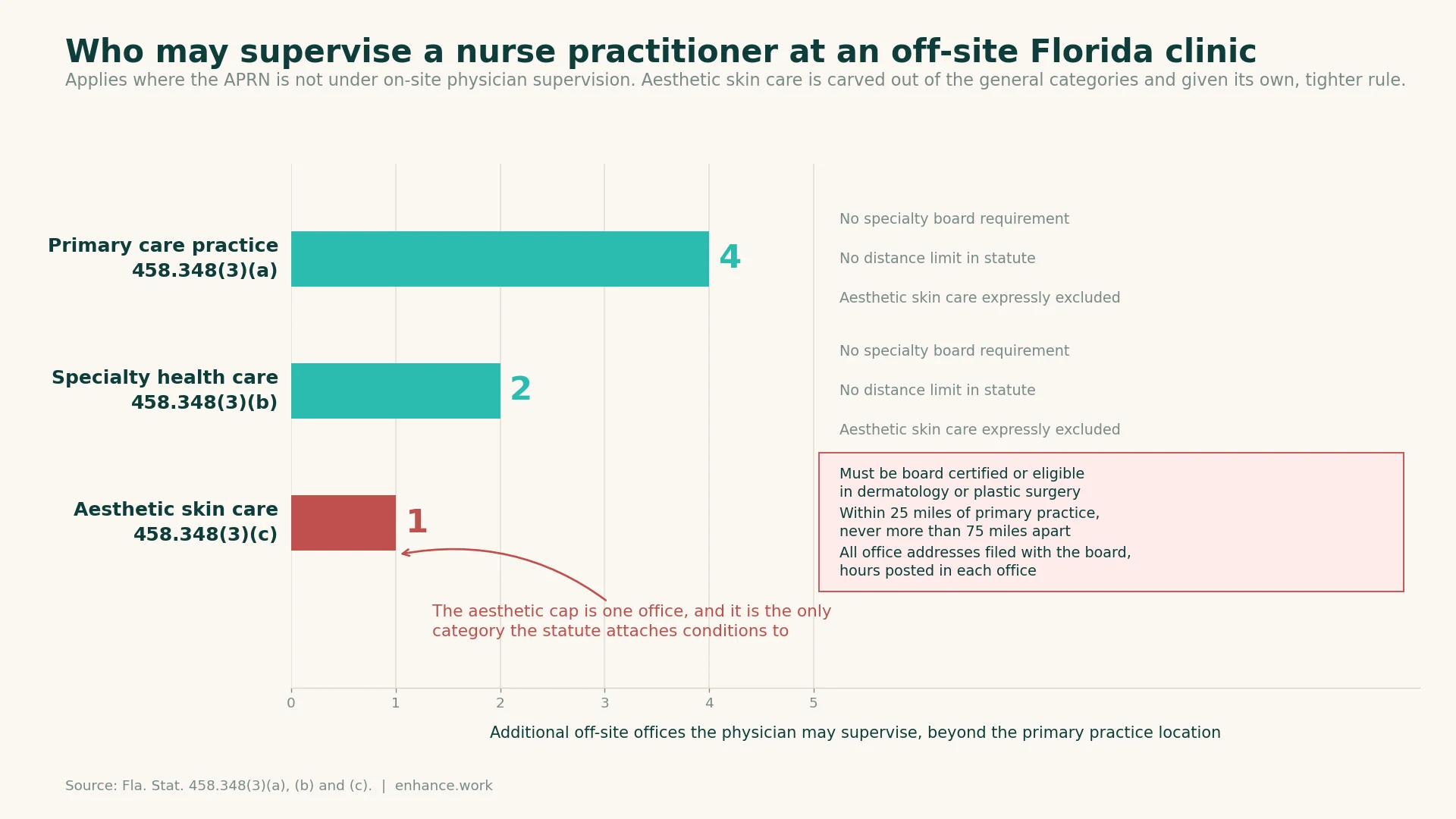
Additional off-site offices a physician may supervise an APRN in, by practice type. Aesthetic skin care is capped at one and carries requirements the other categories do not. Source: Fla. Stat. 458.348(3).
One caveat worth stating plainly, because it is the difference between a compliant clinic and a cited one: subsection (3) governs offices where the APRN is not under on-site supervision. A physician who is physically present and supervising is in a different posture. The business question is whether your medical director is genuinely present at the schedule you post, and whether you can prove it.
Does the physician have to be on site with the nurse practitioner?
Not as a general rule. Florida defines general supervision in Fla. Admin. Code 64B9-4.001(14), the Board of Nursing definitions for advanced practice registered nurses, as supervision where the physician "authorizes procedures being carried out but need not be present when such procedures are performed," with the condition that the APRN "must be able to contact the practitioner when needed for consultation and advice either in person or by communication devices." A reachable phone satisfies the definition. An unanswered one does not.
There is one hard exception that catches med spas constantly. Fla. Stat. 458.348(2) states that all protocols relating to electrolysis or hair removal using laser or light based devices, performed by anyone other than a physician, require the person performing the service to be appropriately trained and to work "only under the direct supervision and responsibility" of a physician. Direct supervision is a higher bar than general supervision, and it applies to the treatment your clinic probably runs most often. We break down who may operate those devices and under what supervision in our guide to who can legally perform laser hair removal in Florida and what supervision the state requires.
Can a nurse practitioner own a med spa in Florida?
Yes, an NP can hold an ownership interest, and many do. Ownership and clinical oversight are separate questions in Florida, and conflating them is how otherwise careful owners end up out of compliance. Owning the entity does not authorize the owner to perform or direct medical acts outside her own license, and an NP owner still practices under the established protocol described above.
The corollary matters for hiring: the NP owner cannot supervise herself. She needs a physician in the supervising role, and if she is not on site with that physician, the 458.348(3)(c) conditions apply to her clinic exactly as they would to a non-clinical owner's. We cover the ownership structures and the corporate practice of medicine question in detail in our guide to who can legally own a medical spa in Florida and how ownership differs from clinical oversight.
What a Florida med spa should keep on file
When an investigator walks in, the question is never whether you meant to comply. It is what you can produce in ten minutes. This is the documentation set that answers a collaborative agreement inquiry in Florida aesthetics without a scramble.
| Document | Where it lives | Why it is asked for |
|---|---|---|
| Signed established protocol, current version | On site, at every practice address | Fla. Stat. 464.012(3) requires the on-site copy by name. |
| Proof the physician filed the 30 day notice | Clinic compliance file, copy to the NP | Fla. Stat. 458.348(1) puts the duty on the physician, but the clinic bears the consequence. |
| Physician license, board certification, and primary practice address | Clinic compliance file | Decides whether 458.348(3)(c) is satisfied at all. |
| APRN license and, if claimed, autonomous registration | Clinic compliance file | Verifies scope, and flags that autonomous status does not cover aesthetics. |
| Posted schedule of physician hours | Visible in each office | Required by Fla. Stat. 458.348(3)(d) for off-site supervision arrangements. |
| Device specific training records for laser and light based treatments | Employee file | Fla. Stat. 458.348(2) requires appropriate training plus direct supervision. |
| Dated protocol review log | Clinic compliance file | No longer mandated by rule, but it is the cheapest evidence that supervision was real. |
Clinics that already run a structured onboarding find this easy, because the same file holds the training records the state expects. If yours does not, our breakdown of med spa staff training requirements in Florida and what belongs in each employee file covers the rest of the set.
What this means for hiring on both sides
If you are a nurse practitioner
Treat the protocol as part of your compensation, not paperwork you sign on day one. Ask who the supervising physician is, what their board certification is, how far their primary practice is from the clinic, and how many other locations they cover. If the answers put the clinic outside 458.348(3)(c), you are the licensee standing in the room when it matters. Ask for the termination notice commitment in writing too, so your name comes off the board record when you leave. NPs comparing offers will find the pay side of this in our analysis of what nurse practitioner injectors in Florida actually earn and what the job demands day to day.
If you run or own a clinic
Price the medical director role for what the statute actually requires rather than for a signature. A dermatologist or plastic surgeon within 25 miles who covers only your clinic costs more than a remote signature and is the arrangement the statute contemplates. The market rate conversation and the vetting checklist are in our guide to what a med spa medical director in Florida costs, what the role requires, and how to find one.
Frequently asked questions
Do NPs need a collaborative agreement in Florida?
They need an established protocol, which is the Florida equivalent. Fla. Stat. 464.012(3) requires an APRN to work within the framework of an established protocol with a supervising physician, and requires a copy to be maintained on site at each practice location. The phrase collaborative agreement is industry shorthand rather than a Florida legal term.
Who signs the protocol?
The advanced practice registered nurse and the supervising physician, who must be licensed under chapter 458 or 459. The physician then files notice with the Board of Medicine within 30 days under Fla. Stat. 458.348(1), and files again within 30 days of ending the protocol.
Can an NP own a med spa in Florida?
Yes. Ownership and clinical supervision are separate. An NP owner still practices under an established protocol with a supervising physician, and cannot supervise herself.
Does autonomous APRN registration let an NP inject without a physician?
No. Fla. Stat. 464.0123(3)(a)1 limits autonomous practice to primary care practice, defined as family medicine, general pediatrics, and general internal medicine. Aesthetic treatment falls outside that scope, so the protocol requirement still applies.
What must the agreement include?
Florida no longer publishes a mandatory contents list, because Fla. Admin. Code 64B9-4.010 was repealed in September 2017. A defensible protocol names both parties and their licenses, lists every practice address, itemizes the authorized medical acts, sets the emergency procedure, and is dated and signed.
Does the supervising physician have to be on site?
Generally no. Fla. Admin. Code 64B9-4.001(14) defines general supervision as authorization without physical presence, provided the APRN can reach the physician. Laser and light based hair removal is the exception: Fla. Stat. 458.348(2) requires direct supervision.
How much does a collaborative agreement cost in Florida aesthetics?
The document itself is a legal drafting cost. The recurring cost is the medical director relationship behind it, which in Florida aesthetics typically runs as a monthly retainer and rises with how genuinely involved the physician is. In South Florida an administrative retainer commonly runs $2,000 to $5,000 a month, with signature-level quotes as low as $800 to $2,000. A qualifying dermatologist or plastic surgeon near the clinic prices higher than a remote signature, and is the arrangement 458.348(3)(c) actually permits.
Get the oversight structure right before you hire
A collaborative agreement in Florida aesthetics is only as good as the physician behind it and the statute it is measured against. Most of the risk in this area is not in the wording of the document. It is in hiring a supervising physician who cannot lawfully cover the clinic, or an injector whose scope does not match the treatment menu.
Clinics hiring injectors or a qualifying medical director can post the role and reach Florida candidates through Enhance.work for employers, where Florida clinics reach licensed aesthetic providers and medical directors directly. Nurse practitioners and injectors comparing roles can browse verified openings in the the Enhance.work directory of aesthetic injector, nurse practitioner, and med spa positions across Florida. Getting the protocol right is the part nobody sees until it is the only thing anyone is looking at.