
An electrolysis license in Florida is the only credential the state issues for permanent hair removal. It is also the credential that decides who may run a hair removal laser in this state. Those two facts sit in different rulebooks, written by different agencies. That is why the question gets answered wrong so often, including by people already working in the industry.
This is what the license actually authorises, what it does not, and the exact conditions attached to the laser part.
Key Takeaways
- The electrolysis license comes from the Department of Health through the Electrolysis Council, not from the DBPR cosmetology board that handles esthetics.
- Florida defines electrology as the permanent removal of hair using board approved devices that carry federal clearance. That definition, not the job title, is what sets the scope.
- A licensed electrologist may perform laser and light based hair removal only with specific additional training. A supervising physician is also required.
- Direct supervision means the physician is on the premises, or supervising by telehealth from within 150 miles with continuous synchronous communication. The 150 mile figure is a telehealth condition, not a general rule.
- Your personal license does not cover your room. An electrology facility needs its own license and inspection.
What is an electrolysis license in Florida, and who issues it?
It is a health profession license issued by the Florida Department of Health, through its Division of Medical Quality Assurance. Chapter 478 of the Florida Statutes governs it, and the Electrolysis Council oversees it. It is not a cosmetology credential and it does not come from the Department of Business and Professional Regulation.
That distinction is the single most expensive administrative mistake in this field. Estheticians, cosmetologists and nail specialists all deal with DBPR. Electrologists deal with the Department of Health, in the same regulatory neighbourhood as nurses and physicians. People who already hold a DBPR credential routinely start their electrology application in the wrong portal and lose weeks.
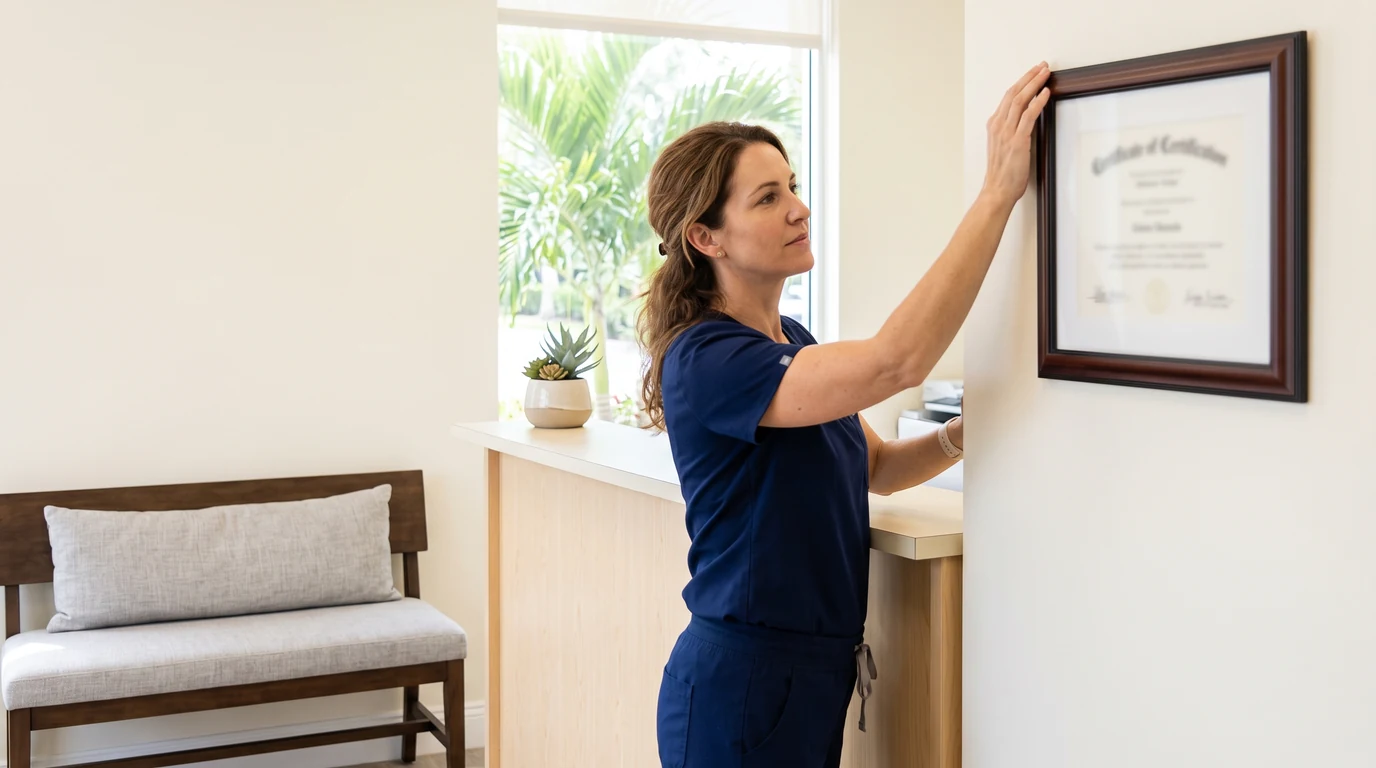
The requirement to hold the license is written without exceptions. Section 478.49 states that no person may practise electrology or hold herself or himself out as an electrologist in Florida without an active license from the department. A licensee must also display the license conspicuously at the place of practice, and produce it to the department or the board on request. Advertising the service is enough to trigger the requirement, whether or not a client is ever treated.
If your question is the route rather than the rules, that is covered separately. The training itself is fixed by Rule 64B8-53.002, which sets the electrolysis programme at 320 hours. See the full walkthrough of how to become an electrologist in Florida, including the 320 hour programme and the state examination that follows it.
What does the license actually let you do?
The scope comes from the statutory definition rather than from custom or job title.
Section 478.42 defines electrolysis or electrology as "the permanent removal of hair by destroying the hair-producing cells of the skin and vascular system, using equipment and devices approved by the board which have been cleared by and registered with" the federal device authority.
Two conditions do the work. Permanence means the practice is defined by destroying the structure that grows the hair, which is why temporary methods sit outside it entirely. Device clearance means the equipment must be both board approved and federally cleared, which is a medical device standard rather than a cosmetology one. Read together they explain why this license lives with the Department of Health. It also puts electrology closer to the clinical side of a med spa than to its spa side. That is worth weighing if you are still choosing a lane. Compare the med spa career paths available in South Florida and the very different credentials each of them requires.
What the license does not carry matters just as much. It is not a skin care credential. Facials, exfoliation and general esthetic services belong to the facial specialist registration, and holding an electrolysis license gives you no authority over them. The two credentials do not overlap, they sit beside each other, which is why some practitioners eventually hold both.
Can an electrologist perform laser hair removal in Florida?
Yes. But the conditions are far more specific than the industry shorthand suggests. The governing rule is rule 64B8-56.002 of the Florida Administrative Code, and it sets two requirements that both have to be satisfied.
Requirement one: the training
The rule gives two qualifying routes. The first is training in needle-type epilation together with laser and light based hair removal and reduction, meeting the standards in rule 64B8-52.004. That route also requires passing the Society for Clinical and Medical Hair Removal test for certification as a Certified Medical Electrologist. The second combines needle-type epilators with laser and light based hair removal and reduction, meeting the curriculum standards of rule 64B8-53.002. It requires passing a licensure examination approved by the Board.
There is a third situation. Some electrologists are already licensed on the needle-only pathway. For them, the Department of Health points to a 30 hour laser and light based hair removal course approved by the Florida Electrolysis Council. That course is the continuing education route into laser work. Verify your own position with the department rather than assuming. The answer depends on which programme and examination you originally completed.
Requirement two: the physician
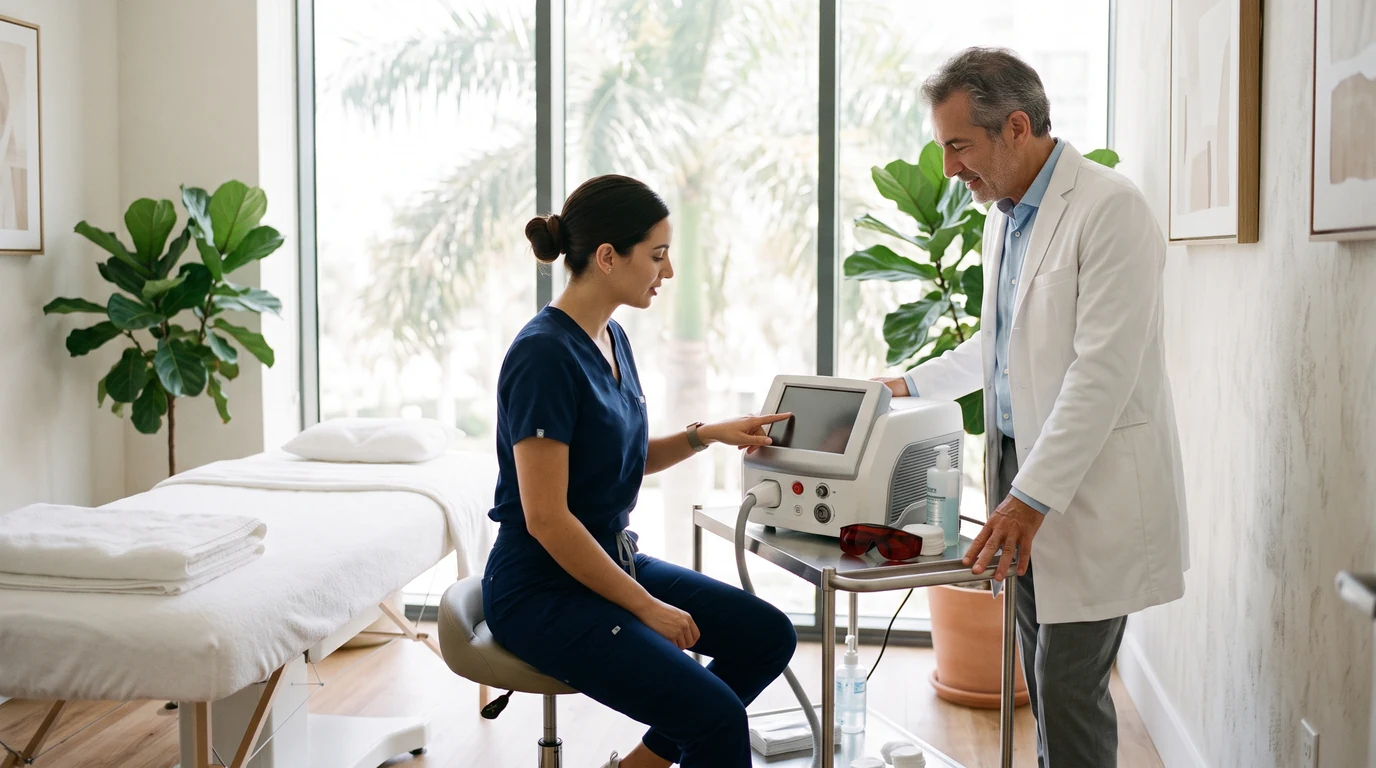
Training alone is not enough. The rule also requires that the electrologist operate under the direct supervision and responsibility of a physician. That physician must be properly trained in hair removal, and licensed under chapter 458 or chapter 459 of the Florida Statutes. Laser hair removal by an electrologist in Florida is a supervised act, permanently. There is no experience threshold that graduates you out of it.
The rule then defines what direct supervision means, and this is where the widely repeated version goes wrong. It is satisfied in one of two ways. Either the physician is on the premises where the laser hair removal is done. Or the physician supervises by means of telehealth, as defined in section 456.47(1)(a) of the Florida Statutes.
Only if the telehealth option is used do the extra conditions attach. The supervising physician must be located within 150 miles of the electrologist. The arrangement must also allow continuous synchronous communication between the two.
The correction worth making. You will hear the 150 mile radius quoted as a blanket rule for laser hair removal in Florida. It is not. It is the distance condition that applies specifically when the physician supervises remotely by telehealth. A physician standing in the clinic satisfies direct supervision without reference to any radius. Getting this backwards cuts both ways. Practices reject workable supervision arrangements, or they assume a remote arrangement is compliant when it fails the continuous synchronous communication test.
Two details deserve attention when you build the arrangement. Florida law defines telehealth as covering synchronous or asynchronous telecommunications technology, and expressly excludes email messages and facsimile transmissions. But this rule narrows that further by demanding communication that is continuous and synchronous. A physician who is reachable by phone if something goes wrong is not supervising by telehealth within the meaning of this rule.
Which credential do you actually need?
Most confusion in Florida hair removal comes from treating three separate authorities as one job. They are not interchangeable, and no single credential covers the whole menu.
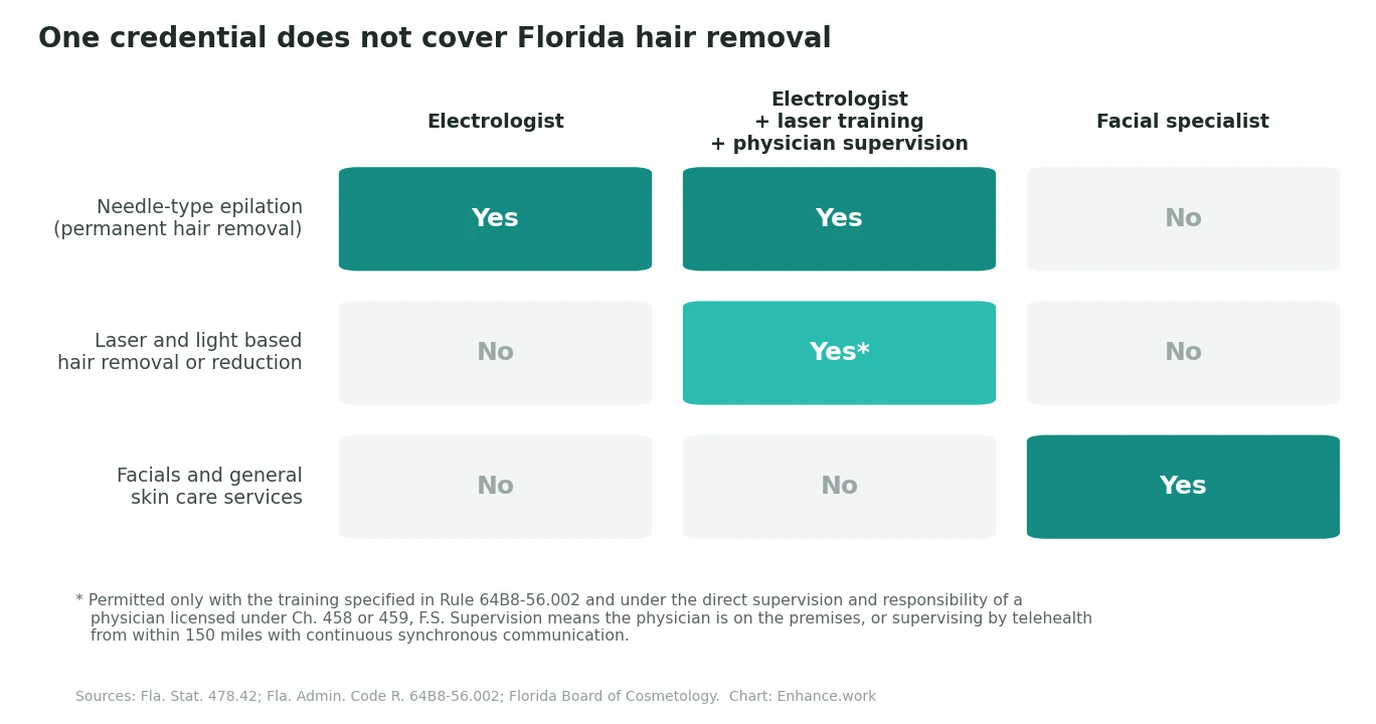
In short: a clinic wanting to offer both permanent removal and facials needs two credentials on the schedule, not one versatile hire. And a clinic wanting laser hair removal delivered by an electrologist needs a supervising physician from day one. Not added later when someone asks. Practices comparing staffing options should also look at what the laser technician route in Florida covers and how its device training differs from the electrology pathway into the same equipment. That is the esthetics half of the picture. See the facial specialist registration that Florida issues in place of an esthetician license carries a scope that stops short of anything reaching living tissue.
Do you need a facility license as well?
Yes. And it is a separate track from your personal license. Section 478.51 provides that no electrology facility may operate without a facility license issued by the department. The license has to be displayed conspicuously inside the facility and produced on request. The board adopts rules covering the licensure and operation of these facilities, including personnel, safety and sanitary requirements. On application the department may investigate the proposed facility, and an initial inspection applies.
If an application fails to meet the requirements, the department must deny it in writing and list the specific requirements that were not met. The applicant may reapply. Sanitation and safety standards for delivering electrolysis carry their own rule in chapter 64B8-56 of the administrative code.
The consequence for candidates is simple. Working as an employee inside someone else's licensed facility is administratively simple. Opening your own room means running two licensing processes at once. The facility one involves an inspection, and you do not control when it happens.
How do you renew, reactivate or verify an electrolysis license?
Section 478.50 sets biennial renewal, at fees established under section 478.55. Three details in that section catch people out.
- Delinquency is automatic. A license not renewed at the end of the biennium reverts to delinquent status by operation of the statute. Nobody has to act for that to happen.
- Reactivation is a defined process. The board adopts rules setting procedures, criteria and fees for reactivating an inactive license, and section 478.55 caps the reactivation fee at $100.
- Your address is a filing obligation. A licensee must file the address of the primary place of practice with the department before practising, and must notify the department of any change beforehand.
Verification runs through the Department of Health's public license lookup, which matters to two audiences at once. Candidates use it to confirm their own status before accepting work. Employers should use it before scheduling anyone on a laser. The consequences of an unlicensed or delinquent practitioner sit with the practice as much as with the individual. Checking a credential takes under a minute and is the cheapest compliance step available to a Florida clinic.
What does the license cost to hold?
Section 478.55 sets ceilings rather than prices, and adds that the department may not charge more than the actual cost of implementing the chapter. Application, initial licensure, renewal, reactivation and facility inspection are each capped at $100. Renewal and facility inspection run biennially. The examination fee is capped at $300. Confirm the current published figures with the department, since the board sets the actual amounts by rule and they can be lower than the caps.
So the regulatory cost of holding this credential is small and predictable. The real money in electrology is equipment and training, which is where candidates consistently under budget.
Sources
- Florida Statutes, section 478.49 (leg.state.fl.us)
- Fla. Admin. Code R. 64B8-53.002, Curriculum Standards for Electrolysis Training Programs (law.cornell.edu)
- Florida Statutes, section 478.42 (leg.state.fl.us)
- Fla. Admin. Code Ann. R. 64B8-56.002 - Equipment and Devices; Protocols for Laser and Light-Based Devices (law.cornell.edu)
- Electrologist - Florida Department of Health (floridahealth.gov)
- Florida Statutes, section 456.47 (leg.state.fl.us)
- Florida Statutes, section 478.51 (leg.state.fl.us)
- Florida Statutes, section 478.50 (leg.state.fl.us)
- Florida Statutes, section 478.55 (leg.state.fl.us)
Frequently asked questions
Who issues the electrolysis license in Florida?
The Florida Department of Health, through the Division of Medical Quality Assurance and the Electrolysis Council, under chapter 478 of the Florida Statutes. Esthetics and cosmetology credentials come from a different agency, the Department of Business and Professional Regulation.
Do you need an electrology license to do laser hair removal in Florida?
An electrologist is the non-physician credential the rules address directly. Rule 64B8-56.002 lets a licensed electrologist perform laser and light based hair removal. Two conditions apply: the set training is complete, and a properly trained physician gives direct supervision. Physicians and other licensed health professionals operate under their own practice acts, which are outside chapter 478. Nurses are the most common source of confusion here. Note that the scope of practice question for aesthetic RNs in Florida is governed by an entirely separate set of rules.
Does the supervising physician have to be in the room?
Not necessarily. Direct supervision is met if the physician is on the premises, or supervises by telehealth. If it is by telehealth, the physician has to be within 150 miles of the electrologist and there must be continuous synchronous communication between them.
Can a facial specialist or esthetician get an electrolysis license by adding hours?
No. Electrology is a separate license from a different agency with its own programme and its own examination. Esthetics hours do not transfer toward it, and the facial specialist registration confers no electrology authority.
How often does an electrolysis license renew?
Biennially, under section 478.50. A license that is not renewed by the end of the biennium automatically reverts to delinquent status. Reactivation is a separate process with its own fee.
Does my license cover the room I work in?
No. Under section 478.51 an electrology facility needs its own license from the department, displayed on site. Board rules cover personnel, safety and sanitation, and an initial inspection applies. Employees working inside an already licensed facility are covered by that facility's license.
Read the rule, not the shorthand
Almost every wrong answer about hair removal licensing in Florida comes from compressing a conditional rule into a slogan. The 150 mile radius becomes a universal requirement instead of a telehealth condition. The electrolysis license becomes a laser license instead of a credential that permits laser only with added training and a supervising physician. The Department of Health becomes DBPR because that is where every other beauty credential lives.
So check three things before you build a plan or a service menu around this. Confirm which agency holds your credential and file there. Confirm which of the two training pathways in rule 64B8-56.002 you actually satisfy, rather than assuming your programme covered it. And if laser is part of the plan, settle the supervision arrangement in writing before the first appointment. That is the one requirement with no experience exemption, and no way to retrofit it after an inspection. Everything else about this license is inexpensive and administrative. That part is not.