
A med spa onboarding checklist runs in four blocks: before day one, week one, day thirty and day ninety. Verify the license on the state's own system before the first shift, and pay for training time: federal rules exclude it from hours worked only when all four criteria are met, and typical med spa onboarding fails at least three.
Most med spa onboarding advice is a list of nice intentions: welcome them warmly, set expectations, check in at thirty days. None of it answers the question owners actually get stuck on. Are the two days of shadowing and technique practice before a new hire touches a paying client hours you owe money for? That question has an answer in federal regulation, and it is not the answer most practices assume.
Key Takeaways
- Training time is excluded from hours worked only when all four regulatory criteria are met. Typical med spa onboarding fails at least three of them, which makes it compensable.
- Verify the license on the state's own system before the first shift, not after. It takes a minute and it is the cheapest compliance step a practice has.
- Structure onboarding in four blocks: before day one, week one, day thirty, day ninety. Each has a different question it answers.
- A new provider is usually a cost for the first several weeks. Plan the ramp deliberately rather than hoping the column fills.
- The onboarding failures that cost you the hire are almost always things the candidate noticed in week one and nobody addressed.
Do you have to pay a new hire for training and orientation?
Usually yes. And the reasoning is not close. The federal rule is specific, and it is written as an exclusion with four conditions rather than as a general permission.
29 CFR 785.27. Attendance at lectures, meetings, training programs and similar activities "need not be counted as working time" only if these four criteria are met:
- Attendance is outside of the employee's regular working hours;
- Attendance is in fact voluntary;
- The course, lecture, or meeting is not directly related to the employee's job; and
- The employee does not perform any productive work during such attendance.
All four. Not three. Now run a normal med spa orientation against them.
Is it voluntary? The regulation closes this door firmly. Attendance is not voluntary if it is required by the employer, and it is not voluntary in fact "if the employee is given to understand or led to believe that his present working conditions or the continuance of his employment would be adversely affected by nonattendance." A session a new hire cannot skip and still start is not voluntary, whatever the invitation email called it.
Is it unrelated to the job? Training is directly related when it is "designed to make the employee handle his job more effectively as distinguished from training him for another job, or to a new or additional skill." Teaching a new esthetician your protocols, your devices and your charting is the definition of making them handle their job more effectively.
Is any productive work happening? If the hands-on portion involves real clients, live treatments, stocking rooms or covering a shift, productive work is being performed.
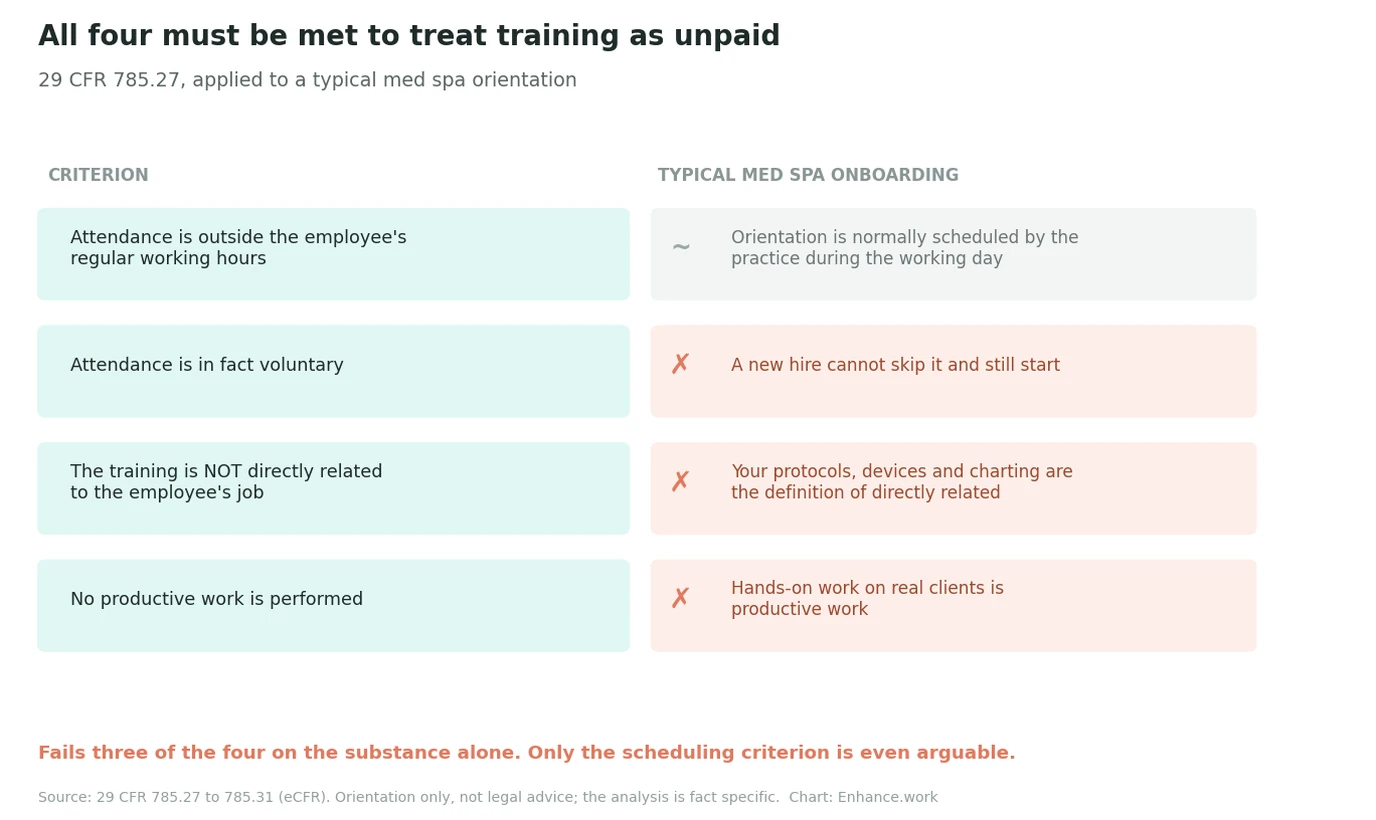
Typical med spa onboarding fails three of the four before you even reach the scheduling question. The narrow exceptions exist and are worth knowing: time spent at an independent school or college the employee attends on their own initiative after hours is not hours worked, and an employer-run programme that corresponds to courses offered by independent bona fide institutions of learning can fall outside hours worked when attendance is genuinely voluntary and outside working hours, even if it is job related and employer paid. Neither of those describes a Tuesday morning orientation you scheduled.
This is orientation, not legal advice, and the analysis is fact specific. But if your current practice is unpaid orientation, take that to an employment attorney this week. It is not an item for the annual review.
What has to happen before the first shift?
Onboarding is the last stage of a longer process, and how well it goes depends on decisions made earlier. It helps to see it inside the full picture of staffing a med spa in Florida, from sourcing candidates through to keeping them past the first year.
Four things. None of them are welcome gifts.
- Verify the license yourself. Do not accept a photograph of a wall certificate or a line on a resume. Look the person up on the state's public license verification system and confirm the credential is active, in the right profession, and not delinquent. Record the date you checked.
- Settle classification before the offer, not after. Whether this person is an employee or a contractor changes payroll, supervision and liability, and it is not a preference you get to pick.
- Put the compensation in writing with its definitions. Base, commission percentage, what the percentage is calculated on, whether any draw is recoverable, and what triggers a change.
- Confirm the supervision chain for anything that needs one. If the role touches procedures that require physician oversight or a delegation arrangement, that has to exist on paper before the first appointment, not once someone asks.

The classification question ripples through everything else in this list. That is why the distinction between a 1099 contractor and a W2 employee at a Florida med spa has to be settled before the first shift rather than at tax time.
What does a med spa onboarding checklist actually include?
Four blocks. Each answers a different question.
Two notes on using this. Sign off matters more than coverage: a device training that nobody initialled did not happen as far as an inspection or an incident review is concerned. And the day ninety block has to include a genuine two way conversation. A provider who has decided to leave usually decided somewhere between week three and week six.
The written policies underneath the checklist belong in their own document rather than in the onboarding flow. a Florida med spa employee handbook is where the standing rules live so that onboarding can stay a sequence of actions rather than a reading assignment.
How do you train a new provider without losing revenue?
Accept the maths first. A new provider costs money before they make it. Practices that pretend otherwise rush someone onto a full column, then deal with the results.
Three approaches keep the cost bounded. Stage the service menu. Start the new hire on the treatments with the shortest learning curve and the lowest complication risk, and add the higher-ticket or higher-risk services as sign offs accumulate. Pair rather than shadow, meaning the trainee performs under observation instead of watching, because passive shadowing burns two salaries and teaches slowly. And book deliberately light for the ramp period rather than leaving gaps to chance, so the schedule reflects the plan instead of exposing it.
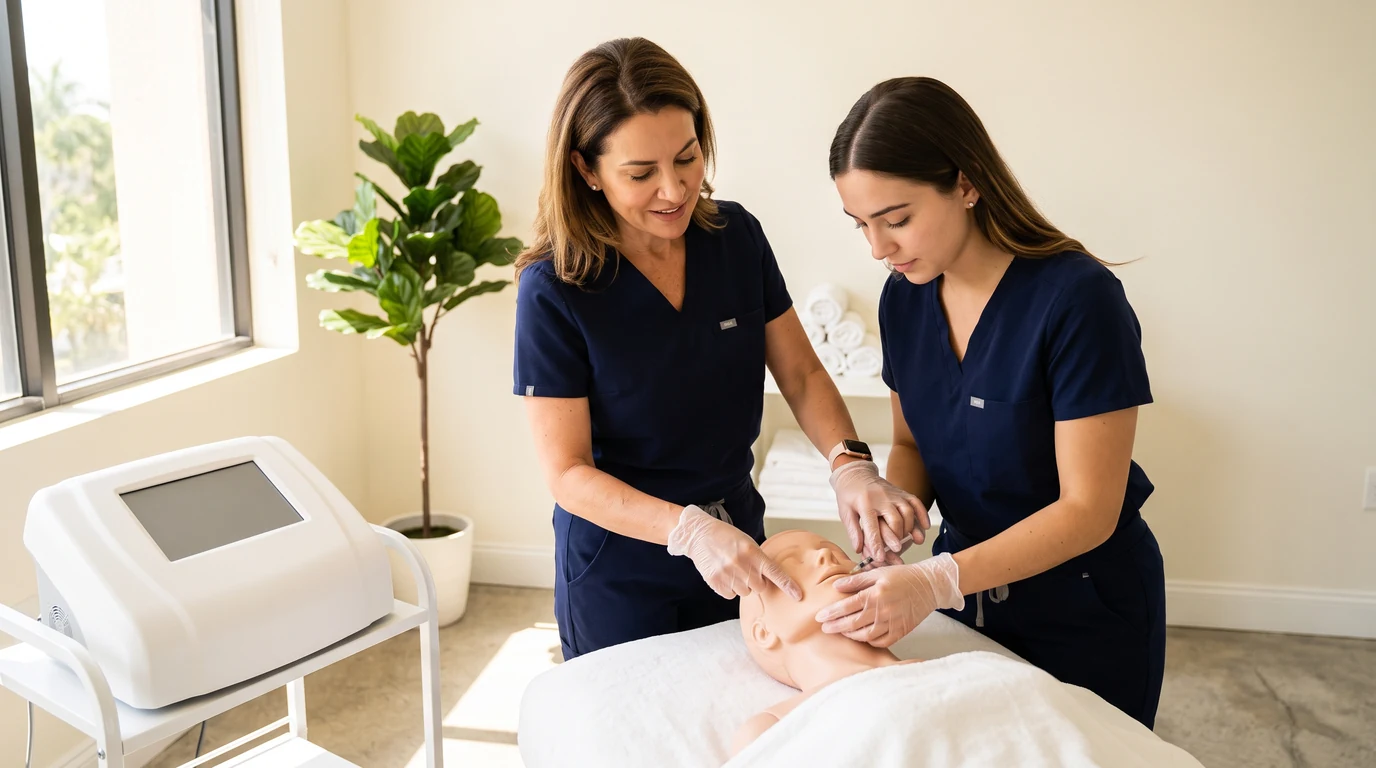
One caution from the section above. If the trainee is performing treatments on real clients during this period, that is productive work, and the training question is settled: those are paid hours.
What does a bad onboarding look like from the new hire's side?
These are the things people describe when they explain why they left a practice within the first few months. None of them are expensive to fix.
- Unpaid orientation, or paid hours that quietly do not appear on the first cheque.
- A compensation structure that was described verbally and turns out to work differently in practice.
- No named person to ask. New providers who have to guess who owns a question stop asking, which is a clinical risk before it is a culture problem.
- A column that never fills, with no explanation of whose job it is to fill it.
- Being put on devices or services without documented training because the schedule needed covering.
The pattern is consistent. Almost every item is a communication failure rather than a resource failure. That is good news, because it means the fix is a conversation and a document rather than a budget.
The pay item recurs most, and it is worth getting right before the hire starts rather than explaining afterwards. a med spa commission structure that is written down with its definitions removes the single most common reason new providers feel misled in their first month.
How long until a new med spa hire is profitable?
We do not hold reliable first party data on ramp time across South Florida practices, and a number invented for this article would be worse than none. What can be said is how to work out your own, which is more useful anyway.
Add up what the hire costs you per month during the ramp. Wages including all those paid training hours, payroll taxes, the supervising provider's time diverted from their own column, and any product consumed in practice. Then set against it the revenue their column actually produces, net of the commission you pay on it. The month those two lines cross is your break even. Run it for the last two people you hired. You will have a real ramp assumption for the next one, specific to your service mix and your booking rate rather than borrowed from an industry article.
The diverted senior provider hours are the cost owners most often leave out, and they are frequently the largest single item.
How does onboarding affect turnover?
The connection runs one way. Onboarding does not create loyalty. But it is where a new hire forms their read on whether the practice is organised and honest, and that read is difficult to reverse later. A provider spends week one being told the pay works one way, then month two discovering it works another. They have already started looking, regardless of what you do at the six month mark.
Retention has its own levers well beyond the first ninety days. reducing turnover at a Florida med spa depends on factors that keep operating long after the onboarding checklist is complete. Onboarding simply decides whether those levers are working on a good first impression or against a bad one.
It also pays to remember that the filtering starts earlier than the offer. The questions you ask a candidate during a med spa interview determine how much of your onboarding is teaching and how much is correcting.
Sources
- 29 CFR 785.27, General (ecfr.gov)
- 29 CFR 785.28, Involuntary attendance (ecfr.gov)
- 29 CFR 785.29, Training directly related to employee's job (ecfr.gov)
- 29 CFR 785.30, Independent training (ecfr.gov)
- 29 CFR 785.31, Special situations (ecfr.gov)
- FL DOH MQA Search Portal (mqa-internet.doh.state.fl.us)
- Licensing Portal - License Search (myfloridalicense.com)
Frequently asked questions
Is unpaid orientation legal at a med spa?
Rarely. Under 29 CFR 785.27, training time is excluded from hours worked only if all four criteria are met: outside regular hours, genuinely voluntary, not directly related to the job, and no productive work performed. A required orientation covering your own protocols fails at least the second and third, and often the fourth. Have counsel review your specific arrangement.
Do I have to pay an injector for device or product training?
Apply the same four criteria. Training that you require, on equipment they will use in your practice, is directly related to the job and not voluntary, which points to compensable time. Training the person independently seeks out at an outside school on their own initiative after hours is treated differently under 29 CFR 785.30.
What should be in the first week of med spa onboarding?
Everything that makes the person safe to practise in your building: protocols, contraindications, charting, documented device training with sign off, emergency procedures, and a named escalation contact. Revenue expectations belong at day thirty, not day three.
Should I use a 90 day probationary period?
A ninety day review point is useful as a structured checkpoint for both sides. Be careful with the label, since calling it probationary can imply something about employment status that you did not intend. Have your handbook language reviewed rather than copying a template.
How do I verify a Florida licence before someone starts?
Use the state's public verification system for the profession in question: the DBPR licensee search for cosmetology and facial specialist registrations, and the Department of Health MQA search for nursing and electrology. Note that not every aesthetic credential sits with the same agency: cosmetology and facial specialist registrations come from the Department of Business and Professional Regulation, while nursing and electrology come from the Department of Health. Check the right one and record the date.
How long should med spa onboarding take?
Safety and compliance items belong in week one without exception. Full independence depends on the service menu and the person's prior experience. That is why the checklist is organised around sign offs and review points rather than a fixed number of days.
Start with the question nobody puts in the template
Onboarding templates are easy to find and largely interchangeable, which is why having one changes so little. The parts that decide whether a hire works out are the ones templates leave out. Whether the training hours are paid. Whether the licence was verified by you rather than asserted by them. Whether the compensation on the offer letter means the same thing to both parties. And whether anyone owns the new person's questions in week one.
Take the four criteria in 29 CFR 785.27 and hold your current orientation against them honestly. If it fails, fix that before you redesign anything else. It is the only item on this page that carries legal exposure rather than a retention cost. Then build the rest around sign offs and two review points. That is a complete onboarding process, and it fits on one page.