
Key Takeaways
- Who can perform laser hair removal in Florida? Only a licensed electrologist with the laser and light based qualification, and only under the direct supervision and responsibility of a physician.
- Estheticians and cosmetologists cannot fire a hair removal laser in Florida. Their license does not cover it, and hiring one for that role puts the supervising physician's license at risk.
- Direct supervision means the physician is on the premises, or supervising by telehealth from within 150 miles with continuous synchronous communication.
- One physician may supervise no more than four electrologists at any one time. That single sentence in the rule is a hard ceiling on how fast a clinic can scale laser services.
- Every patient's initial consultation must include an examination and assessment by a physician, and a signed six point written protocol must sit on the premises with a copy filed with the Department of Health.
- Florida licenses the profession under the phrase permanent hair removal, but the devices are FDA cleared for permanent hair reduction. Market the service accordingly.
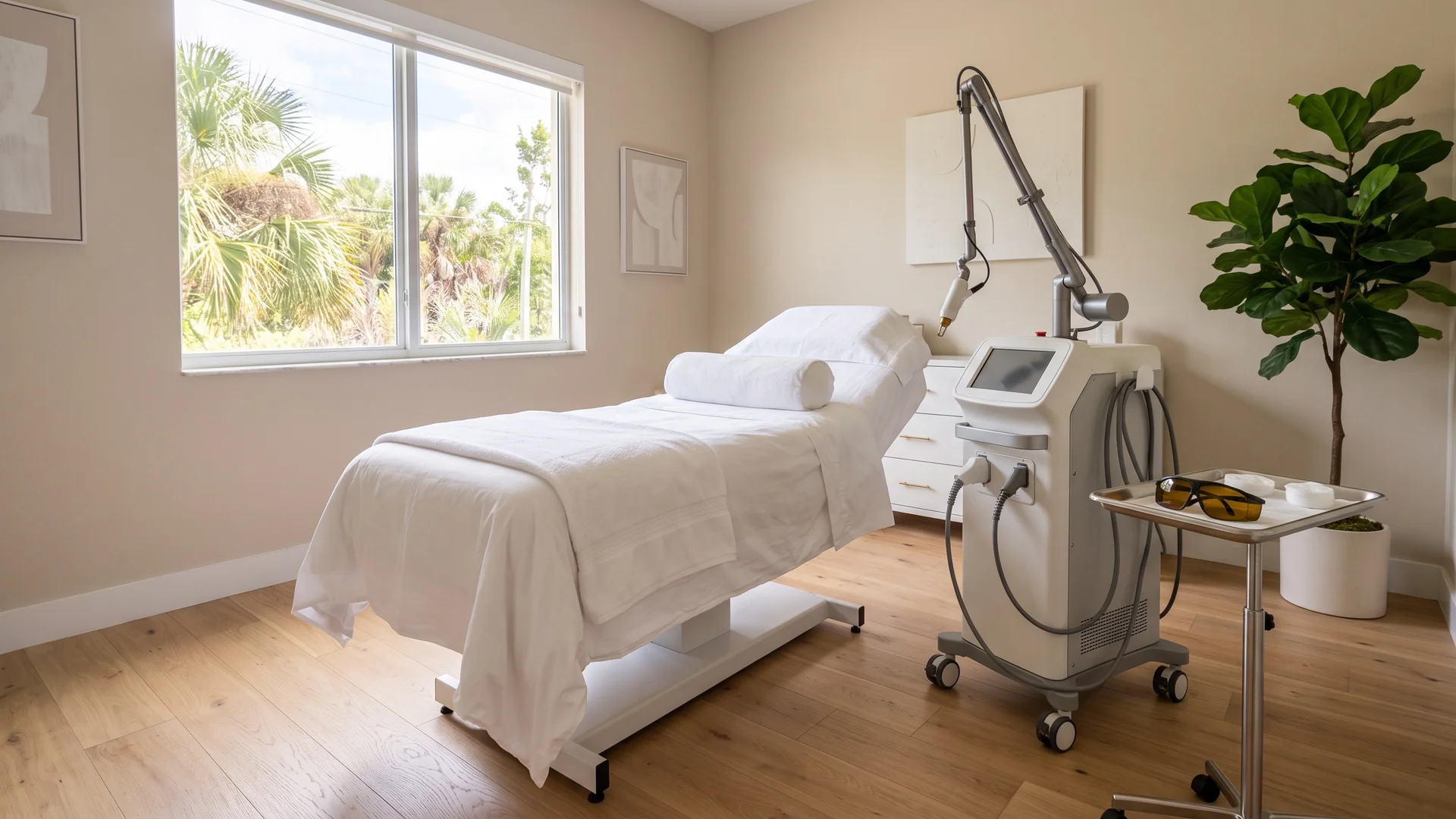
A South Florida laser treatment room. Who is legally allowed to stand behind that device is narrower than most owners assume.
In Florida only a licensed electrologist with the laser and light based qualification may perform laser hair removal, and only under the direct supervision and responsibility of a physician. Estheticians and cosmetologists cannot. The physician must be on the premises or supervising by telehealth from within 150 miles, and may supervise no more than four electrologists at once.
Most articles about laser hair removal licensing in Florida are written for the person who wants the job. This one is written for the person who signs the paycheck.
The distinction matters more than it sounds. A candidate who gets the credential wrong loses a job offer. A clinic that gets it wrong exposes the supervising physician to board discipline and undercuts the assumption behind its liability coverage. Some have been operating illegally for months without knowing. Florida regulates this narrowly, and the governing rule is specific enough that there is little room to argue after the fact.
Here is what the statute and the rule actually require, and what each requirement means for hiring.
Who can perform laser hair removal in Florida under the law?
A licensed electrologist who holds the laser and light based qualification, working under the direct supervision and responsibility of a physician. That is the short answer, and for non physician staff it is the only answer.
Florida law defines electrolysis as the permanent removal of hair using devices approved by the Board of Medicine and cleared by the FDA. Rule 64B8-56.002 of the Florida Administrative Code took effect on March 11, 2021. It lists exactly which devices the Board approves: needle type epilators, and FDA cleared laser or light based hair removal devices. Both sit under the electrologist's scope. Neither sits under anyone else's.
One point of language matters for how your clinic markets the service. The statute uses the phrase permanent removal to define the profession, but that is a licensing definition, not a clinical claim. Laser and light based devices are cleared by the FDA under the standard of permanent hair reduction, meaning a stable long term decrease in the number of terminal hairs rather than the elimination of every follicle. A 2023 network meta-analysis in the Journal of Cosmetic and Laser Therapy found meaningful but incomplete long term reduction across device types, and hormonal drivers plus follicular miniaturization mean most patients need maintenance sessions. Advertising permanent removal of all hair is a claim your devices are not cleared to support, and it is the kind of language that draws complaints.
The supervision requirement comes from statute rather than rule. Florida Statute 458.348(2) covers all protocols for laser or light based hair removal performed by anyone who is not a physician. It requires that person to be appropriately trained. It also requires them to work only under the direct supervision and responsibility of a physician licensed under Chapter 458 or 459.
Read that clause carefully. Two words carry the weight. Not just supervision. Supervision and responsibility. The physician is not a name on a form. The rule attaches ongoing, personal, inspectable duties, and we will get to what those are.
Training is not open ended either. Rule 64B8-56.002(2) sets two qualifying paths. The first is a laser and light based course of 30 hours under Rule 64B8-52.004, up to 15 hours of it home study, followed by the Society for Clinical and Medical Hair Removal test for certification as a Certified Medical Electrologist. The second is a combined programme that meets the 320 hours of Rule 64B8-53.002, followed by a Board approved licensure exam covering both epilator and laser modalities. A third condition gets routinely overlooked. The electrologist may use only the devices on which they were trained. A tech trained on a diode platform is not automatically cleared to run your Nd:YAG.
What does direct supervision actually require?
The supervising physician must be on the premises where the laser hair removal is being performed, or supervising by telehealth from within 150 miles with continuous synchronous communication. Those are the only two configurations the rule allows.
The telehealth option is the part that gets misquoted most often, so it is worth stating precisely. The 150 mile radius is not a general distance limit on medical supervision in Florida. It is a condition attached specifically to telehealth supervision of an electrologist under Rule 64B8-56.002(2)(c). If your physician is in the building, the number is irrelevant. If your physician supervises remotely, two requirements apply at once. The physician must be within 150 miles, and the supervision must allow continuous synchronous communication.
Continuous and synchronous is a higher bar than reachable. A physician who answers a phone call when something goes wrong is not conducting continuous synchronous supervision. For multi location operators this is usually the decisive constraint. A medical director in Miami clears Fort Lauderdale and West Palm Beach on distance easily. Being genuinely available in real time to every site running a laser at that moment is the harder part.
One more restriction sits quietly in the rule. An electrologist previously disciplined by the Board of Medicine is not eligible for telehealth supervision at all. That changes only when the Board permits it by order. So an experienced hire with a disciplinary history may require an on site physician even where your other staff do not.
Can an esthetician or cosmetologist perform laser hair removal in Florida?
No. Neither license authorizes laser hair removal in Florida, and this is the single most expensive staffing mistake in the state's aesthetics sector.
The confusion is understandable. Estheticians are licensed by the Department of Business and Professional Regulation under the cosmetology board. Electrologists are licensed by the Department of Health under the Board of Medicine. Two agencies, two boards, two scopes. Laser hair removal is a medical act in Florida. That is why it sits with the medical board, and why it carries a physician supervision requirement that facials do not.
Plenty of excellent South Florida laser techs hold both credentials, for good commercial reasons. But the esthetician license is not what makes them legal at the laser. The electrologist license is. Watch for one specific resume pattern: an esthetician license paired with a manufacturer's training certificate from a device rep. That combination does not clear anyone to treat patients. For the full picture of what an esthetician license does and does not cover in this state, what a licensed esthetician can legally do in Florida, the hours the state actually requires, and where the scope of that license stops covers the boundary in detail.
The exposure here does not fall on the employee. It falls on the clinic and on the supervising physician, whose license is the one attached to the protocol.
Can an RN or nurse practitioner do laser hair removal in Florida?
This is the one genuinely unsettled question in Florida laser law, and any source that gives you a confident one word answer is overstating the clarity of the statute.
Here is the tension. Florida Statute 458.348(2) requires direct supervision for laser hair removal by anyone who is not a physician. But a different subsection of the same statute exempts physician assistants and advanced practice registered nurses from a particular supervision requirement when they perform laser hair removal exclusively. Two provisions, one statute, opposite directions. Whether PAs and APRNs remain bound by the direct supervision standard is genuinely unclear.
The Florida legislature tried to fix this. House Bill 1321 and Senate Bill 1328 were both filed in the 2024 session to resolve the discrepancy. SB 1328 would have explicitly exempted PAs and APRNs from both subsections when performing laser hair removal exclusively. HB 1321 went further, extending the same treatment to RNs and LPNs. Both bills died in committee on March 8, 2024. The ambiguity they were written to fix is still on the books.
There is also a practical limit worth knowing. Even had they passed, both bills applied only to facilities offering laser hair removal as their exclusive service. That describes almost no medical spa. Nearly every South Florida clinic offers at least one other medical treatment alongside it.
The operational takeaway is straightforward. Where the law is unresolved, the conservative posture is the defensible one. Build the service around licensed electrologists with a properly documented supervising physician. Then get written guidance from a Florida healthcare attorney before relying on a nursing credential alone. If your nursing staff is already handling injectables, the treatments an aesthetic RN can and cannot legally perform in Florida and the supervision each one requires maps that scope separately.
How many laser techs can one physician supervise?
Four. Rule 64B8-56.002(6) states plainly that no physician is authorized to supervise more than four electrologists at any one time, whether in person or by telehealth.
This is the sentence that turns a compliance question into a staffing model. It is almost never discussed in material aimed at Florida operators. The ceiling is hard. No exception for telehealth, none for part time staff, none for multi location groups. Four electrologists per physician, counted concurrently.
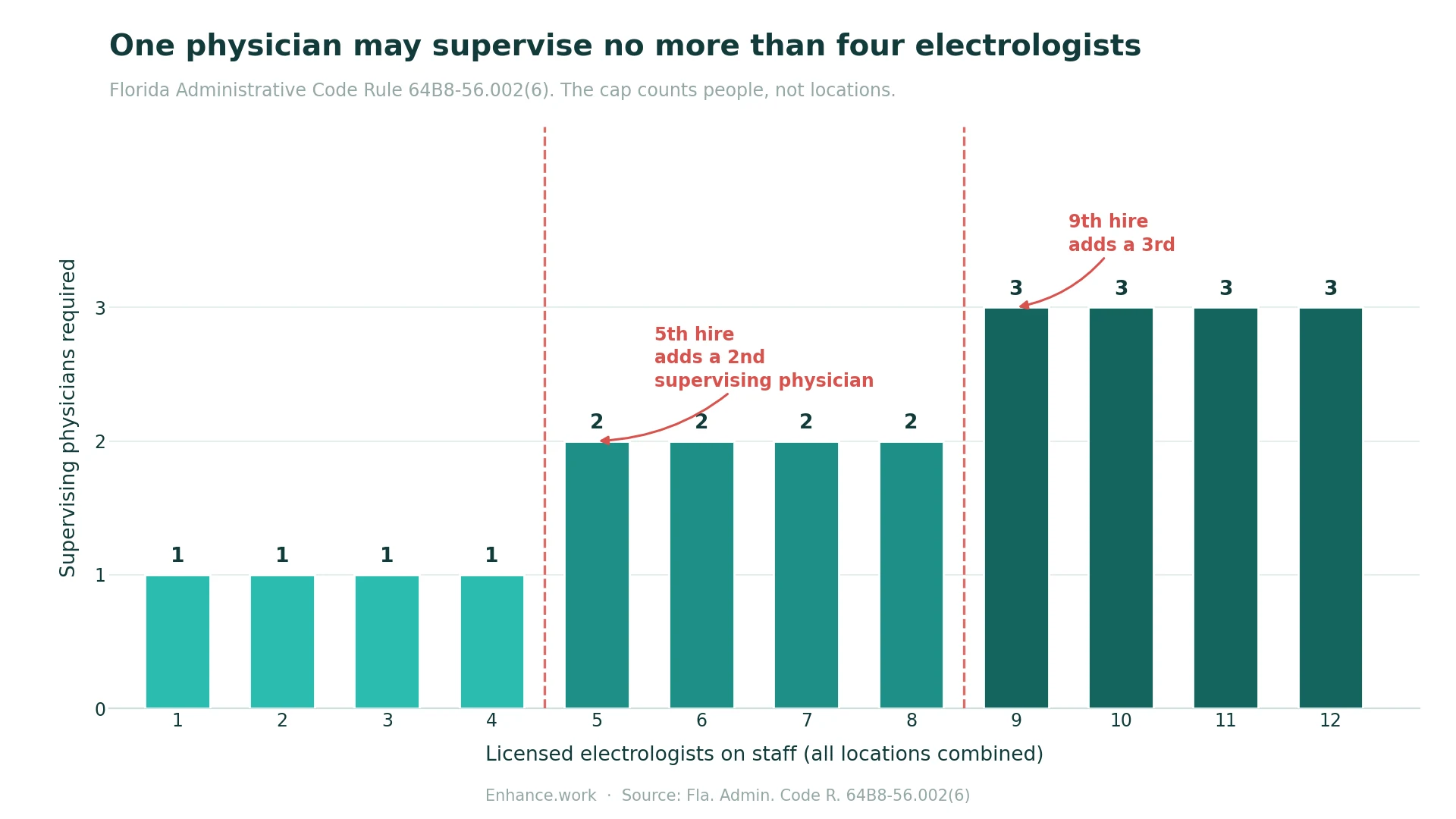
The 4:1 ceiling in Rule 64B8-56.002(6) means every fifth electrologist requires a second supervising physician.
Work through what that does to a growth plan. A clinic running three electrologists has room for one more under its existing medical director. The fifth hire does not cost you a salary. It costs a salary plus a second supervising physician relationship, with its own protocol, its own filing, and its own semiannual inspections. The marginal cost of that fifth tech jumps well above the fourth. It stays high until the second physician is loaded toward capacity.
The same math applies across locations. Physicians are capped on people, not on sites. A medical director covering three clinics with two electrologists each is at six, and over the limit. How the staff are distributed makes no difference. Groups that grow by opening rooms rather than adding headcount often cross this line without noticing, because no single location looks out of compliance.
If you are building the org chart around this, what a Florida med spa medical director is actually responsible for and what the role costs to fill properly covers the other side of that relationship, and how Florida med spas structure staffing between agency, in house, and specialized recruitment sets it in the wider hiring picture.
One requirement sits on the premises rather than on any person. Under Florida Statute 478.51, an electrology facility may not operate without a facility license issued by the Department of Health, displayed conspicuously on site. An initial inspection follows within 60 days of licensure, and renewal inspections occur at least once per biennium. The license cannot be transferred to a new owner, and relocating requires department approval. If you are buying an existing laser practice, that non transferability is worth knowing before closing.
What documentation has to be on the premises?
A written protocol, developed jointly by the supervising physician and the electrologist, signed and dated, kept in a readily available location where the electrologist practices, with one copy held by the physician and one copy filed with the Department of Health.
The Department of Health protocol checklist reproduces the rule text, and Rule 64B8-56.002(4)(a) specifies six things that protocol must address. This is not a template you can download and sign, because several of the points require decisions specific to your clinic and your devices:
- The medical conditions under which individuals may receive laser or light based hair removal treatment.
- The specific conditions, and the procedure for identifying them, that require direct evaluation or consultation by the physician.
- Treatment of routine minor problems arising during or from the procedure.
- Health issues or other conditions that would disqualify a particular patient from being treated under telehealth supervision.
- Safety limits and processes ensuring that direct supervision by telehealth is conducted safely.
- Detailed emergency procedures, including the procedures to follow when supervision is being conducted by telehealth.
Two administrative details carry real consequences. The on site protocol must be readily available for inspection by agents of the Department of Health. That means findable by whoever is working when an inspector arrives, not filed in an owner's office. The parties must also notify the Department within 30 days of ending their professional relationship. When a medical director resigns, that clock starts immediately. It runs alongside a more urgent problem: your electrologists cannot legally treat patients until a new supervising physician is in place.
The supervising physician also carries recurring duties. Under Rule 64B8-56.002(3), the physician must review and inspect the electrologist's techniques, procedures, and equipment on assuming the role and semiannually after that. The physician must also ensure the electrologist receives semiannual training in infection control, sterilization, and emergency procedures. These are calendar obligations, not onboarding tasks. The physician is the one who has to show they happened.
Does a physician have to see the patient first?
Yes. Rule 64B8-56.002(4)(c) requires the written protocol to include and require that the initial consultation with each patient includes an examination and assessment by a physician licensed under Chapter 458 or 459.
This one reshapes the booking flow, and clinics frequently design around it by accident. Does your online scheduler let a new laser patient book straight into a treatment slot with a tech? Then the workflow itself is non compliant. The physician examination has to happen at the initial consultation. It belongs in the first appointment, not on a form the patient signs at reception.
It is worth understanding what that examination is actually for, because clinics that treat it as a signature step tend to perform it badly. Excess terminal hair can be a symptom rather than a cosmetic complaint. Polycystic ovary syndrome accounts for roughly three of every four hirsutism cases, and rapid onset with signs of virilization can point to an androgen secreting tumor. A 2024 systematic review in JAMA Dermatology examined laser and light based therapy for hirsutism in women with PCOS and underlined that treating the hair without addressing the endocrine driver produces disappointing results. The physician is also the person who should catch a pigmented lesion in the treatment field before a laser is fired at it, and who should identify photosensitizing medication such as oral retinoids or tetracyclines. None of that is something a technician is licensed to assess, which is precisely why the rule puts a physician in that appointment.
Operators already running a compliant intake for injectables usually have the muscle for this. The logic parallels the good faith exam requirement. If that process is not built yet, what Florida law requires from a good faith exam and how med spas structure the initial patient evaluation is the closest working model, though the two requirements come from different places and should be documented separately.

The semiannual review is the supervising physician's obligation, and the documentation has to live where an inspector can find it.
Who can operate a hair removal laser in Florida, by credential
The table below summarizes where each credential stands. The RN and APRN rows reflect the unresolved statutory tension described above. Read them as a prompt to get legal guidance, not as a green light.
What this means when you are hiring
Four things change in a hiring process once these rules are on the table.
Verify the license, not the certificate. A manufacturer's training certificate proves a candidate attended a device course. It does not establish licensure. Florida electrologist licenses are verifiable through the Department of Health's license lookup. That check takes under a minute. Do it before the offer, not after. The license is also cheap to hold: section 478.55 caps the application fee at $100 and the examination fee at $300.
Ask which devices they trained on, and get it in writing. The rule limits an electrologist to those devices, so a candidate's device history is a compliance fact rather than a nice to have. Running a platform they have never trained on? Budget that training before they treat a patient.
Count your supervision capacity before you post the role. Know how many electrologists your current physician already supervises, across every location. If the hire would be number five, the real cost of the role includes a second supervising physician relationship.
Build the protocol into onboarding, not after it. The protocol is joint by definition, so it cannot be finalized before you know who the electrologist is. Draft it, sign it, file it with the Department of Health, and place it on the premises during the first week. Set the semiannual training calendar at the same time. For the wider sequence, a med spa onboarding checklist covering everything from before day one through the first ninety days is the framework this drops into.
→ which recurring training requirements apply to laser staff and how often each one has to be repeated maps the recurring obligations by role.
Sources
- Florida Administrative Code, Rule 64B8-56.002 (flrules.org)
- Florida Statutes, section 458.348 (flsenate.gov)
- House Bill 1321 (2024) - The Florida Senate (flsenate.gov)
- Senate Bill 1328 (2024) - The Florida Senate (flsenate.gov)
- Florida Statutes, section 478.51 (flsenate.gov)
- Department of Health protocol checklist (floridahealth.gov)
Frequently asked questions
Do you need a license to do laser hair removal in Florida?
Yes. Florida requires an electrologist license with the laser and light based qualification, issued by the Department of Health under the Board of Medicine. There is no standalone laser technician license in Florida, and no certificate from a device manufacturer or training company substitutes for the state license.
Can estheticians use lasers in Florida?
No. An esthetician license does not authorize laser hair removal in Florida. Laser hair removal falls under the Board of Medicine and requires an electrologist license with physician supervision. Many working laser techs hold both credentials, but it is the electrologist license that makes the treatment lawful.
Does the supervising physician have to be in the building?
Not necessarily. The physician may be on the premises, or may supervise by telehealth provided they are located within 150 miles of the electrologist and the supervision allows continuous synchronous communication. The 150 mile figure applies only to the telehealth option, not to supervision generally.
How many electrologists can one physician supervise in Florida?
No more than four at any one time, whether supervision is in person or by telehealth. The cap is set by Rule 64B8-56.002(6) and applies to the physician across all locations, so a medical director covering several clinics counts every electrologist toward the same limit.
Can an RN do laser hair removal in Florida?
The law is genuinely unclear. One subsection of Florida Statute 458.348 requires direct physician supervision for non physicians, while another exempts PAs and APRNs performing laser hair removal exclusively. Bills filed in 2024 to resolve the conflict died in committee, so the ambiguity remains. Clinics should get written guidance from a Florida healthcare attorney rather than assume.
What has to be filed with the Department of Health?
A copy of the written protocol jointly developed and signed by the supervising physician and the electrologist. A second copy stays with the physician and a third must be readily available on the premises for inspection. The Department must also be notified within 30 days if the professional relationship ends.
Build the staffing model around the rule
The regulation governing laser hair removal in Florida is unusually prescriptive. That turns out to be useful. It tells you which license to hire for, how far your supervising physician can be, how many people that physician can cover, and what has to be signed and filed. There is very little grey area to manage.
What trips clinics up is treating it as paperwork to sort out later, rather than as a constraint on the org chart. The four to one ceiling belongs in the growth plan, not the compliance binder. It changes what a fifth laser hire actually costs. Owners who map supervision capacity before posting the role hire faster. They also avoid the far worse alternative: discovering a gap after the tech is already treating patients.
If you are hiring licensed electrologists or building out a laser service line in South Florida, Enhance.work connects Florida med spas with credentialed aesthetic professionals whose licenses are verified before they reach your inbox. 🎯
This article explains Florida licensing and supervision requirements for general informational purposes and is not legal advice. Regulations change, and individual circumstances vary. Consult a Florida healthcare attorney before making staffing or compliance decisions.