
A licensed esthetician is a state credentialed skin care professional authorized to perform non invasive treatments such as facials, waxing, and lash and brow services. The credential is issued by a state cosmetology board, not by a school or a product brand. Florida is the exception, because it registers facial specialists instead.
Key Takeaways
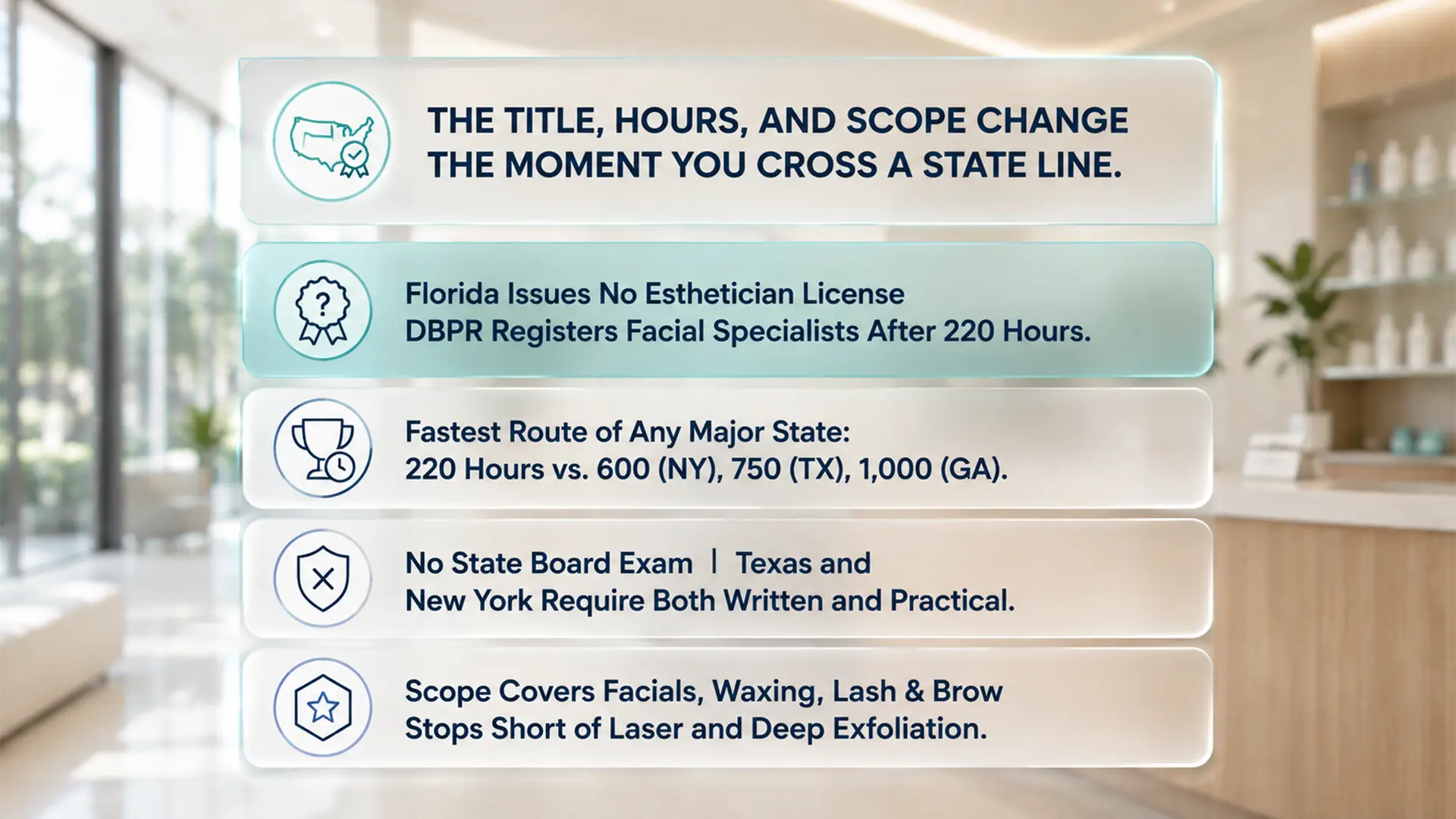
- A state board grants the credential, which is why the title, the hours, and the permitted services change the moment you cross a state line.
- Florida does not issue an esthetician license at all. The Department of Business and Professional Regulation issues a facial specialist registration after 220 hours of training.
- Florida is the fastest route of any major state: 220 hours against 600 in New York, 750 in Texas, and 1,000 in Georgia.
- Florida requires no state board examination for the facial specialist registration, while Texas and New York require both a written and a practical exam.
- The scope covers facials, waxing, brow threading, lash and brow tinting, and lash extensions, and stops short of laser hair removal and deeper exfoliation.
A licensed esthetician works under a state issued credential that sets out exactly which skin treatments are allowed and where they can be performed.
The facial specialist registration is not the only skin and hair credential Florida issues, and the contrast is sharper than most candidates expect, because becoming an electrologist in Florida takes fewer classroom hours than this registration yet requires passing a written state examination.
What a licensed esthetician actually is
The credential is issued by a state government board and authorizes work on the surface of the skin. The authority comes from a state statute, which is why the title, the required training hours, and the list of permitted services all change the moment you cross a state line. No private academy, certification body, or skin care brand can grant it, no matter how the course is marketed.
Aesthetician and esthetician mean the same thing. In the United States the two spellings describe one identical credential. The spelling with the leading a tends to show up in clinical and medical spa settings, while the shorter spelling is the one written into the statutes themselves, Florida included. Neither version signals extra training, a higher scope of practice, or better pay on its own.
The credential is a legal permission, not a skill rating. Passing the hour requirement tells an employer that the state allows you to touch a client's skin for money. It says nothing about whether you are good at chemical peels or how many clients you can retain. That gap between legal permission and demonstrated skill is exactly where hiring decisions in South Florida get made.
It is also worth being precise about what the credential is not. It is not a medical license. Estheticians work on the outermost layers of the skin, and anything that reaches the living tissue underneath belongs to a different credential with a different regulator. For the wider view of how these credentials stack against one another, see the full map of med spa career paths and what each credential actually lets you do.
Why Florida does not issue a licensed esthetician license
Florida does not issue an esthetician license. The credential does not exist under that name anywhere in Florida law. What the state issues instead is a facial specialist registration, granted by the Department of Business and Professional Regulation, and the training requirement is 220 hours. When a Florida school, job listing, or clinic advertises a Florida esthetician license, it is describing this registration using a name the state never adopted.
The number comes straight from statute. Chapter 477 of the Florida Statutes governs cosmetology and its specialties, and section 477.0201(1)(b)2 sets the 220 hour minimum for facial specialty registration. Two words in that arrangement carry more weight than most candidates realize.
Registration, not license. Florida licenses cosmetologists and it licenses salons. Facial specialists are registered, and a registered specialist may only provide services inside a salon that itself holds a Florida license. The credential travels with the person, but the permission to charge a client only exists inside a licensed establishment. That single condition rules out most independent mobile facial work in the state.
No state examination. Texas and New York both require candidates to sit written and practical board exams before they can work. Florida requires neither for this registration. The official DBPR checklist states it without hedging: "You do not have to take the Florida cosmetology examination for this registration." You can read the requirement in context on the Florida Board of Cosmetology frequently asked questions page, which sets out the 220 hour requirement and confirms that no state examination applies to the facial specialist registration.
One consequence catches career changers by surprise. A cosmetologist already licensed in Florida carries facial authority inside that license and does not need a separate facial specialist registration to perform facials. The registration exists for people who want the skin work without the full cosmetology program behind it.
This article defines the credential and its limits. If you have already decided to pursue it and want the paperwork sequence, the training providers, and the real costs, follow the step by step route to earning your Florida facial specialist registration instead.
What a licensed esthetician can and cannot legally do
In Florida a facial specialist may perform facials and skin care treatments, massage of the head, face, scalp and neck, eyebrow threading, lash and brow tinting, lash extensions, and body waxing. Laser hair removal and deeper exfoliation sit outside the registration. This is the single most searched question about the credential and the one almost no state page answers directly.
Permanent makeup is one service the esthetics license never covers; see the state-by-state permanent makeup license requirements, with the agency, the statute and whether estheticians qualify.
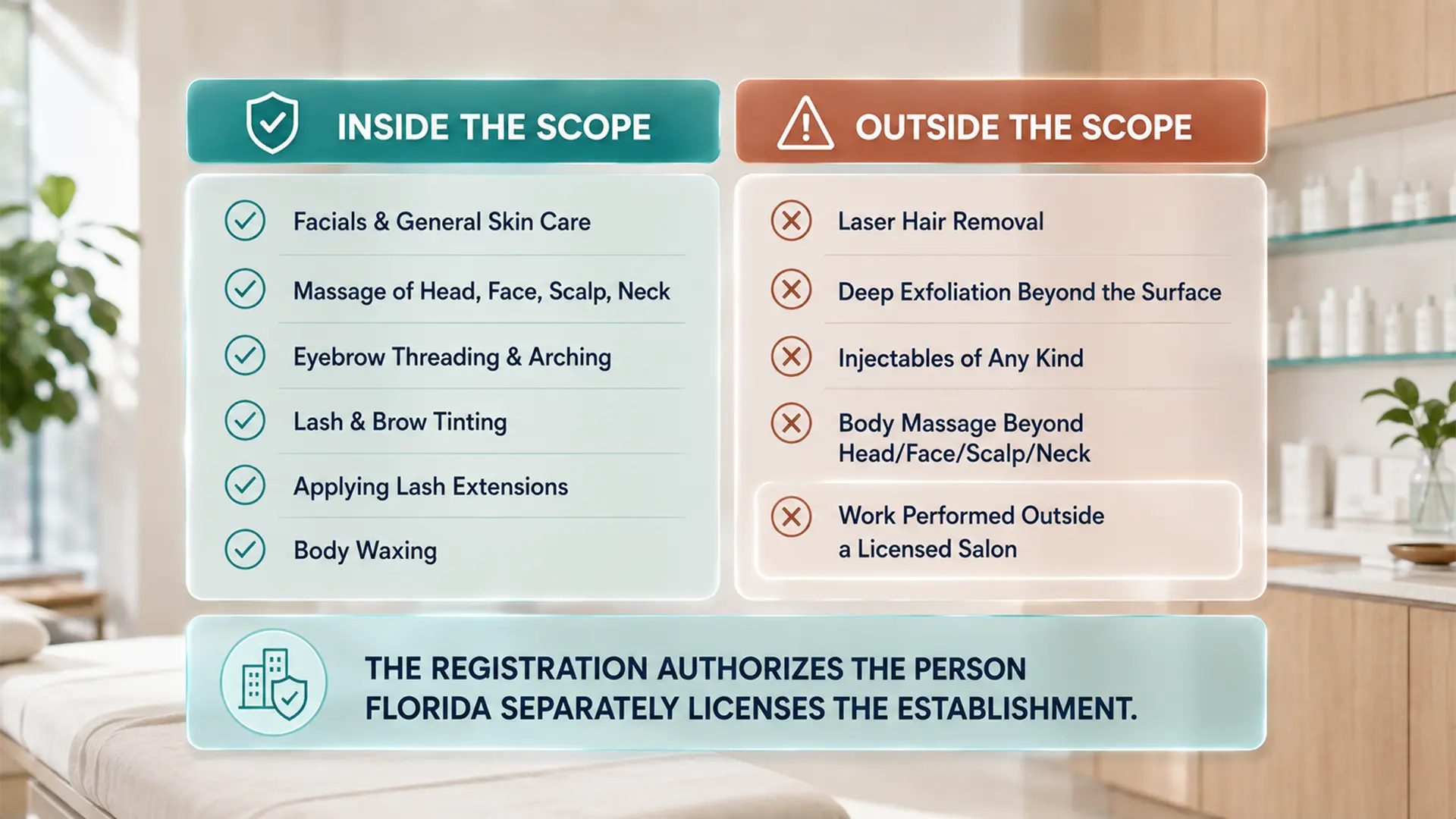
The last row is the one that costs people money. A registration authorizes the person, and Florida separately licenses the establishment. Renting a chair in an unlicensed space, or running facials out of a home studio that never filed as a salon, puts the registration itself at risk no matter how clean the technique is.
In practice the boundary matters most around devices. Med spas in Miami and Fort Lauderdale run laser and energy based platforms constantly, and those machines belong to a different regulatory track. A facial specialist working in that setting typically handles the skin care side of the treatment plan while a differently credentialed provider operates the device.
Facials, waxing, and lash and brow work sit squarely inside the Florida facial specialist scope of practice.
Training hours by state: how Florida compares
Training requirements are set state by state, and the spread is wider than most candidates expect. Florida asks for 220 hours. New York requires a 600 hour approved course. Texas sets 750 hours. Georgia sets 1,000 hours, split into 250 hours of theory and 750 hours of practical application, and will not let a student finish in under nine months.
Hours are only half of the comparison, because some states let you earn them at work. Our esthetician apprenticeship guide lists the states with a paid apprenticeship route, their hour rules and the supervision each board demands.
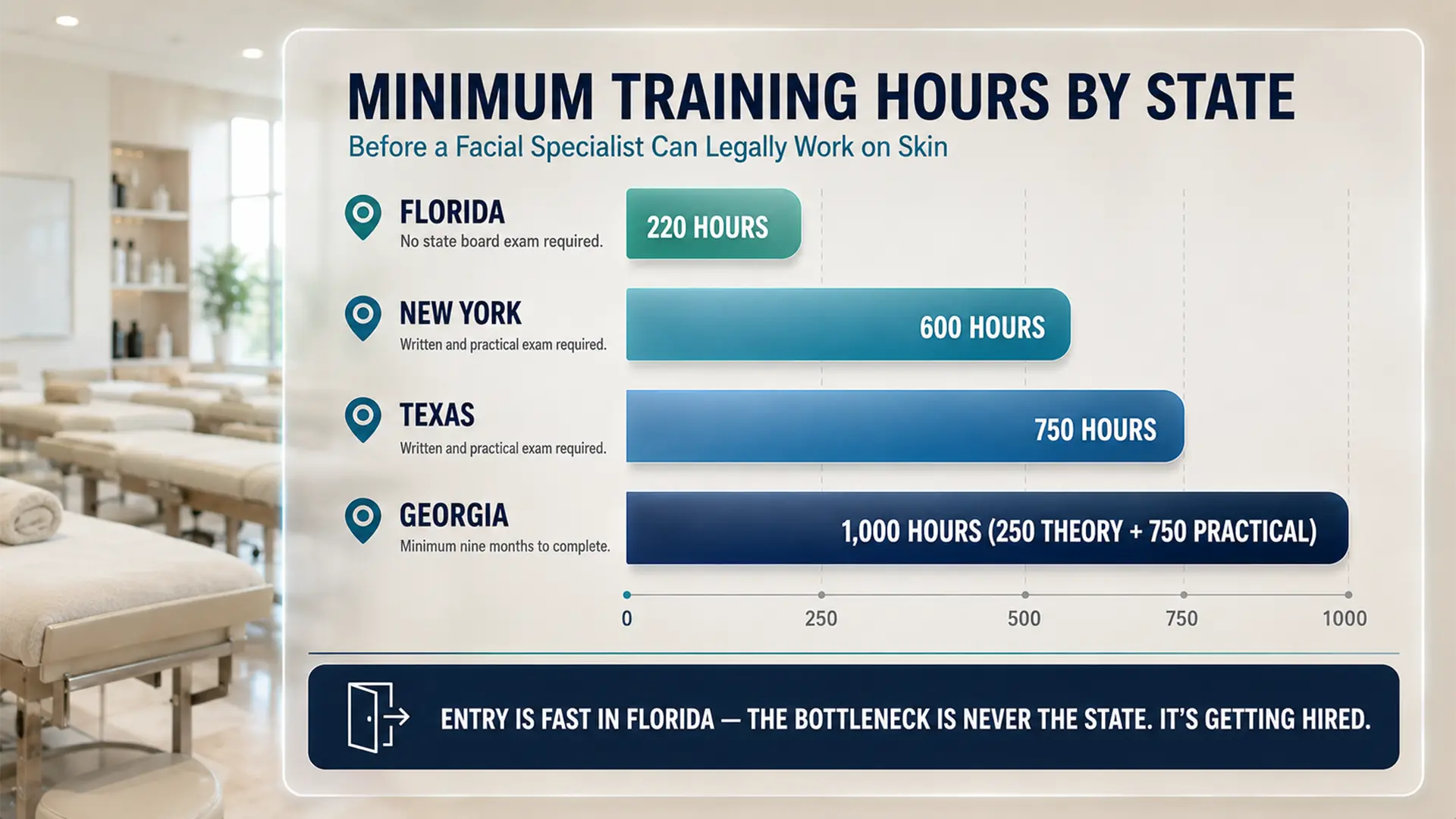
Minimum training hours required before a facial specialist can legally work on skin, compared across four state boards.
Florida requires 78 percent fewer hours than Georgia, and it is the only one of these four states with no board exam attached. That combination is the reason the credential functions differently here than it does elsewhere. Entry is genuinely fast, so the bottleneck for a new graduate is never the state. It is getting hired.
There is a second order effect worth naming. Because the barrier to entry is low, the Florida market fills with newly registered specialists every year, and employers respond by screening on things the state does not measure: hands on hours with real clients, retail attachment, rebooking rates, and comfort with the specific product lines a clinic already sells. A low hour requirement makes the credential easy to get and makes everything after it more competitive.
Licensed esthetician vs medical esthetician vs aesthetic nurse
These three titles get used interchangeably in job listings, and they are not interchangeable at all. Only two of them are credentials the state recognizes.
Peels are where these roles split most clearly; this chemical peel certification guide explains which peel depths an esthetician may legally perform in each state shows where the line falls.
Licensed esthetician, or facial specialist in Florida: a state credential covering non invasive surface level skin work. This is a regulated title with a defined scope.
Medical esthetician: not a separate Florida credential. It describes an esthetician who works inside a medical or clinical setting, usually alongside physicians and nurse injectors, and who has added training on post procedure care, clinical protocols, and stronger product lines. The legal scope is unchanged. The setting, the expectations, and usually the pay are not. The route into that setting is covered in how a licensed esthetician moves up into medical esthetics inside a clinical setting.
Aesthetic nurse: a registered nurse or advanced practice nurse working in aesthetics, licensed by the Florida Board of Nursing rather than by DBPR. Entirely different regulator, entirely different scope, and the only one of the three that can approach injectables.
Reading a job listing correctly saves a lot of wasted applications. A posting for a medical esthetician is almost always asking for the DBPR facial specialist registration plus clinical experience. A posting that mentions injectables is asking for a nursing license and is not open to estheticians regardless of how the title is written.
How to verify a Florida facial specialist registration
Every Florida registration is public and searchable, which matters to three groups: clients confirming who is treating them, clinic owners checking a candidate before an offer, and specialists confirming their own record is current and correctly spelled.
The same record shows whether the registration is current. Our guide to esthetician continuing education explains the two Florida renewal groups, the ten mandatory hours and what happens when the deadline is missed.
The DBPR license search accepts a last name, a first name, a city, or the registration number itself. Searching by last name plus city is usually the fastest way to resolve a common name. A valid result shows the registration type, its status, and its expiration. If a search returns nothing, the person may be registered under a maiden or legal name that differs from the one they use professionally, so it is worth checking both before concluding anything. Start at the official DBPR page explaining how to verify a Florida license or registration, which links directly into the public license search portal.
If a record looks wrong or a name will not resolve, the DBPR Customer Contact Center can confirm status directly at 850.487.1395. For an employer this is a two minute call that prevents a genuinely expensive hiring mistake.
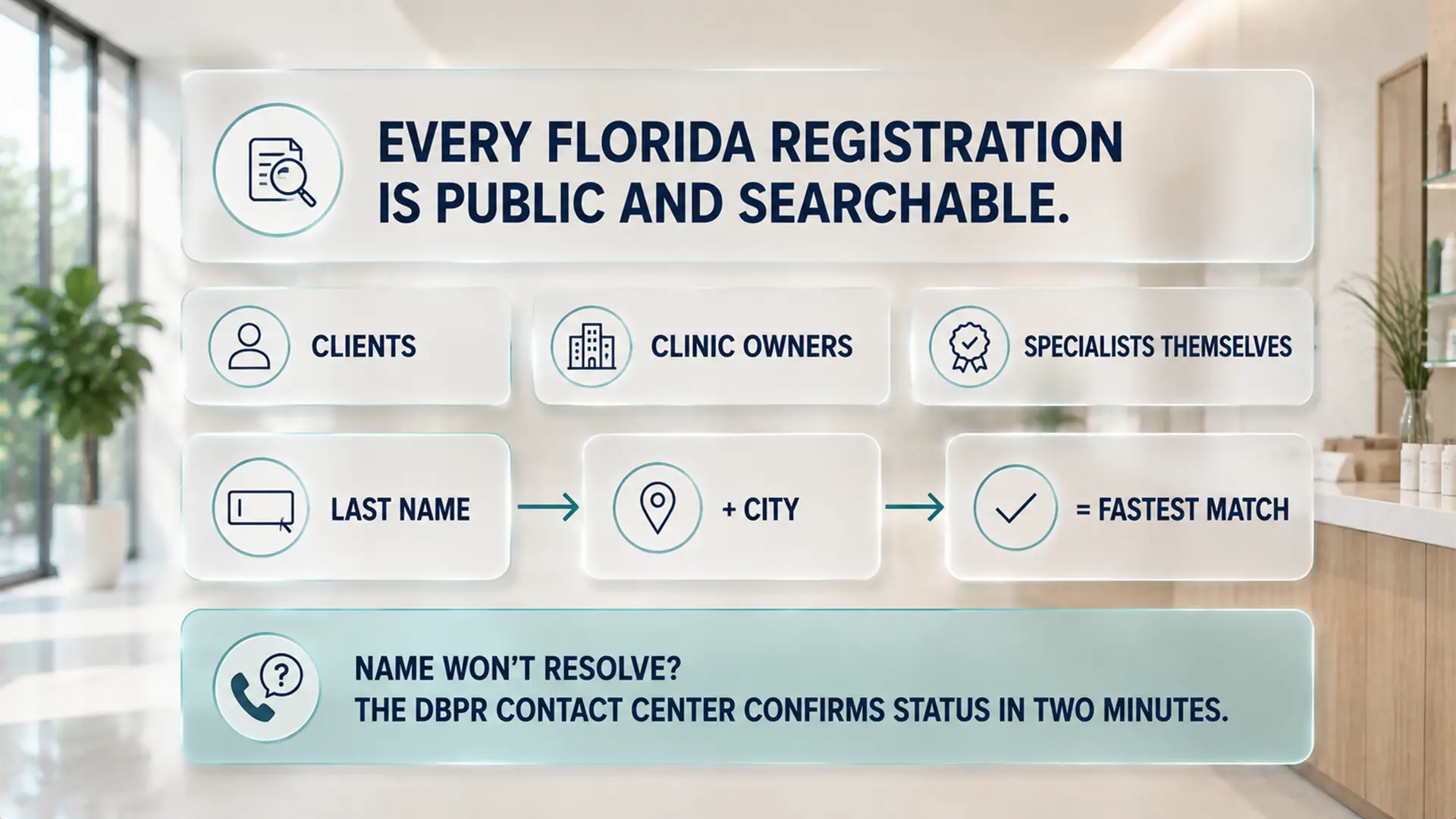
South Florida clinics routinely verify a facial specialist registration through the public DBPR portal before extending an offer.
Where the credential leads: pay and hiring in Florida
The registration opens a wider range of workplaces than most candidates picture. Day spas and salons are the traditional entry point. Med spas, dermatology practices, and plastic surgery offices are where the pay ladder actually goes, because those settings bill higher value treatment plans and expect the skin care side to be handled properly. Resort and hospitality spas across Miami, Fort Lauderdale, and Palm Beach form a third track with its own seasonal rhythm.
Compensation separates along the same lines. The gap between a specialist at a neighborhood day spa and one running post procedure care in a clinical setting is significant, and it widens with retail performance and client retention rather than with years alone. For current figures by metro and setting, see what licensed estheticians actually earn across Florida metros in 2026.
One practical note on the South Florida market. Because the state requirement is only 220 hours, a registration alone rarely differentiates a candidate here. What does: documented hands on hours, familiarity with the product lines a clinic already carries, and bilingual client communication, which in Miami is close to a baseline expectation rather than a bonus.
If you are weighing this credential against the clinical nursing route before committing to either, our comparison of the esthetician and aesthetic nurse paths sets out scope, licensing time, cost and earning ceiling side by side.
Sources
- Cosmetology - FAQs - MyFloridaLicense.com (www2.myfloridalicense.com)
- MyFloridaLicense.com - License efficiently. Regulate fairly (www2.myfloridalicense.com)
- Florida Statutes, section 477.0201 (flsenate.gov)
- Florida Statutes, section 477.013 (flsenate.gov)
Frequently asked questions
What is a licensed esthetician?
A licensed esthetician is a state credentialed skin care professional authorized to perform non invasive treatments including facials, waxing, and lash and brow services. The credential is granted by a state cosmetology board, which is why the requirements differ from state to state. A school certificate or a brand training course is not a license.
Does Florida issue a licensed esthetician license?
No. Florida issues a facial specialist registration through DBPR after a minimum of 220 hours of training. There is no credential in Florida law called an esthetician license, so any school or employer advertising one is referring to the facial specialist registration.
What does LE stand for after an esthetician's name?
LE stands for Licensed Esthetician. You will also see LE and LMT together when someone also holds a massage therapy license. In Florida the accurate abbreviation is FS, for facial specialist, though many professionals still use LE because clients recognize it.
What is the difference between an aesthetician and an esthetician?
In the United States there is no difference in credential. The two spellings describe the same state authorization. The spelling with the leading a is more common in clinical and medical spa settings, while the shorter spelling appears in the statutes, Florida's included.
How many hours do you need to become a licensed esthetician?
Between 220 and 1,000 hours depending on the state. Florida requires 220, New York requires 600, Texas requires 750, and Georgia requires 1,000. Florida has the shortest requirement of the four and is the only one that attaches no state board exam to it.
What can a licensed esthetician legally do?
In Florida the scope covers facials and skin care treatments, massage of the head, face, scalp and neck, eyebrow threading, lash and brow tinting, lash extensions, and body waxing. Laser hair removal, deeper exfoliation, and anything reaching living tissue fall outside it. All services must be provided in a licensed salon.
Do you need a state exam to become a facial specialist in Florida?
No. The DBPR checklist states that you do not have to take the Florida cosmetology examination for this registration. That sets Florida apart from Texas and New York, which both require candidates to pass a written and a practical examination before working.
How do I verify that an esthetician is licensed in Florida?
Use the public DBPR license search, which accepts a last name, first name, city, or registration number. The result shows the registration type, its status, and its expiration date. If a name does not resolve, check for a maiden or legal name, or call the DBPR Customer Contact Center at 850.487.1395.
Can a licensed cosmetologist perform facials in Florida?
Yes. A Florida cosmetology license already includes facial authority, so a licensed cosmetologist does not need a separate facial specialist registration to perform facials. The registration exists for people who want to do skin work without completing a full cosmetology program.
The credential is smaller than people think, and that is the real opening
Worth reading alongside this: how the medical aesthetician job title relates to the Florida registration you actually hold, and why the two are not the same thing at all.
Most of the confusion around this title comes from treating it as one national qualification. It is not. It is fifty separate state decisions, and Florida made an unusually permissive one: 220 hours, no board exam, and a registration rather than a license, with the requirement that the work happen inside a licensed salon.
That should reframe how you plan. If the state can be satisfied in a few months and without an exam, the credential is not the hard part and it is not what will distinguish you. The hard part is everything the state does not measure: real hours on real skin, the judgment to know where your scope ends, and a track record an employer can verify. Candidates who understand that from day one stop treating the registration as a finish line and start treating it as the entry ticket it actually is.