
September 25, 2026 · 11 min read
This article is for general educational and career information only. It is not legal or medical advice. Scope-of-practice rules change and differ by state: confirm with your state board before you act.
Key Takeaways
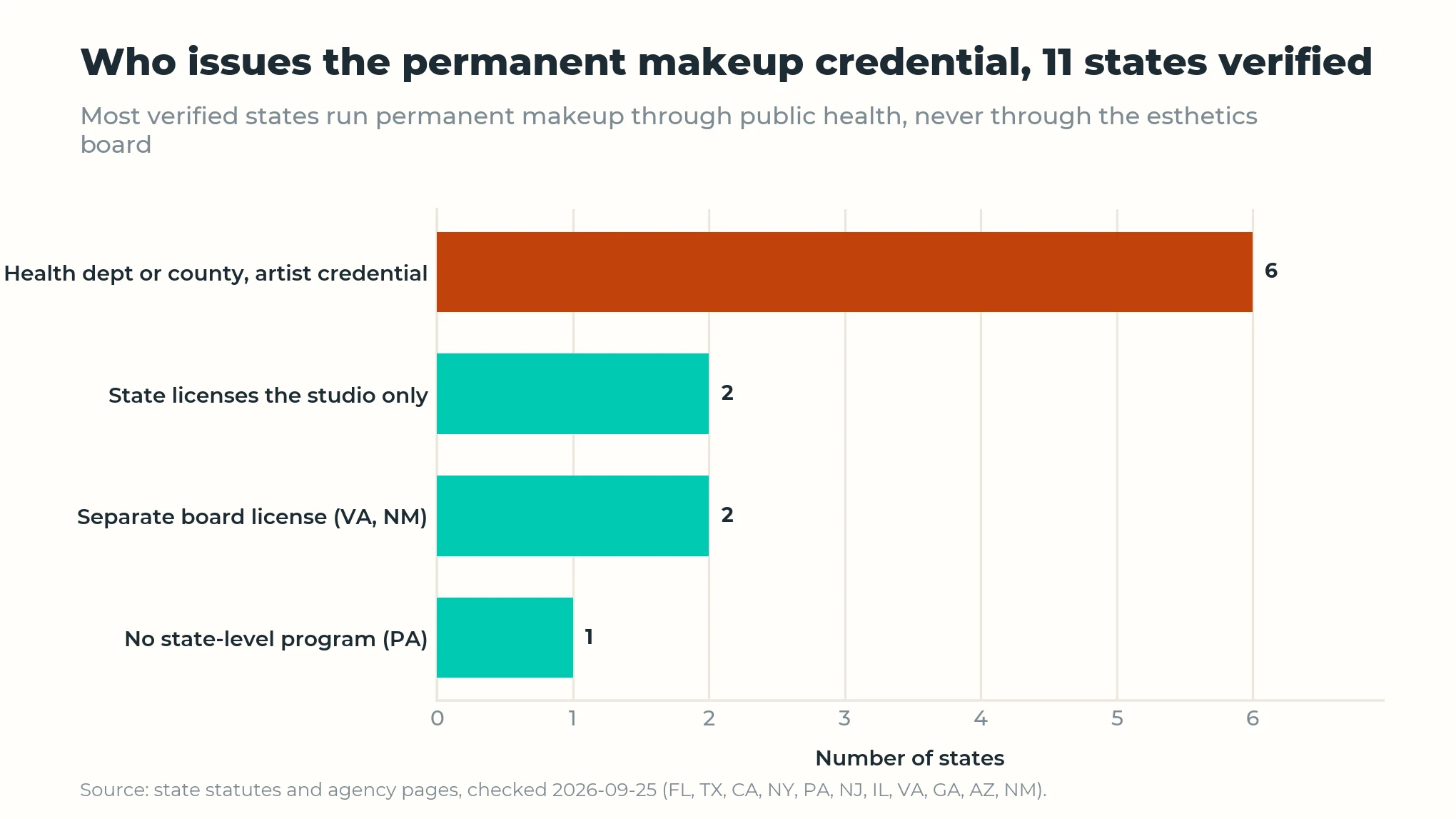
- A permanent makeup license comes from a health department or a county body-art program in most of the states we checked, not from an esthetics board.
- In every one of the 11 states we verified, an esthetics license alone does not authorize permanent makeup, microblading, or pigment microneedling.
- Virginia and New Mexico are the exceptions: each issues a separate Permanent Cosmetic Tattooer or Permanent Cosmetic Practitioner license through a licensing board, not a health department.
- Pennsylvania has no state-level PMU license at all; its Board of Cosmetology has said the practice sits outside cosmetology, and any credential comes from the county.
- Verified course prices for PMU training range from $500 to $3,000, but a course certificate is a different document from your state's license.
A permanent makeup license is not an esthetics credential in any of the 11 states we checked. Most states issue it through a health department or a county body-art program. That program treats microblading and pigment work as a form of tattooing. Two states run their own license through a licensing board. Two states license only the studio. One state has no state-level program at all. Your license, not the training certificate, makes the work legal.
Do you need a license to do permanent makeup?
Yes, in each state we checked, though the issuer changes. Florida's rule is the clearest we found. Its cosmetology code defines "medical purposes" to include "any form of bodily intrusion into the orifices, skin, muscles, or any other tissues". The code adds that it "includes but is not limited to skin perforation by any means, including the application of permanent makeup". That places the work "beyond the scope of a cosmetology license and full and facial registrations" (Fla.
Admin. Code R. 61G5-18.00015, the Florida Department of Health's licensing page for tattooing, which also covers microblading and permanent cosmetics). In practice, Florida licenses the work as tattooing. The Department of Health handles it, not the board.
Other states reach the same result through other agencies. Some use a state health department. Some use a county body-art program. Two states use a licensing board with its own permanent-cosmetics track. Texas shows the health-department route in its plainest form. Its state agency licenses the workplace itself, not the artist.
The main source is the Texas Department of State Health Services page on licensing requirements for tattoo and body-piercing studios, which also covers permanent makeup studios. So a Florida facial specialist registration and a tattoo license go to two other agencies. New here? See how to become an esthetician in Florida, from school hours to the facial specialist registration. The table below lists what we could check for each.
Permanent makeup license requirements by state
Who licenses permanent makeup, state by state
| State | Regulating agency | License or credential | BBP training required | Fee (state, where published) | Does an esthetics license cover it? | Statute or rule |
|---|---|---|---|---|---|---|
| FL | Florida Dept. of Health (tattoo license); DBPR/cosmetology board excludes PMU | Tattoo Artist License, covers microblading and pigment microneedling | Yes, DOH-approved BBP course, 70% passing score | $60 state fee + county fees (new); $85 reactivation | No | Fla. Stat. §§381.00771-.00791; FAC 61G5-18.00015 |
| TX | Texas Dept. of State Health Services (DSHS) licenses the studio; no individual state artist license | Tattoo studio license (facility only) | Not verified | Not verified | No | Health & Safety Code Ch. 146; 25 TAC Ch. 229, Subch. O |
| CA | County health department, under the state Safe Body Art Act; not the cosmetology board | Body Art Practitioner registration, renewed annually | Not verified | Set by each county or city enforcement agency; no flat state fee | No | Health & Safety Code §§119300-119328 |
| NY | County/local health department (varies by county); NYC also runs its own infection-control course; state esthetics board excludes PMU | County/local tattoo license; NYC Infection Control Training (NYC only) | Not verified | Not verified | No | Gen. Bus. Law Art. 15; local codes vary |
| PA | No dedicated state regulator; counties handle tattoo certification | None at the state level; local only (Philadelphia example: $40, 3-year renewal) | Not verified | Not verified | No, per secondary source (2025 Board order) | 49 Pa. Code §7.77 |
| NJ | NJ Dept. of Health, via local health department approval; not the cosmetology board | Local health department permit; no single state license | Not verified | Not verified | No | N.J.A.C. 8:27 |
| IL | Illinois Dept. of Public Health; not the cosmetology board | Body Art Establishment registration (facility, not individual) | Not verified | $500 facility fee + $50 per station | No | 410 ILCS 54; 77 Ill. Admin. Code 797 |
| VA | Virginia Board for Barbers and Cosmetology (DPOR) | Permanent Cosmetic Tattooer / Master Permanent Cosmetic Tattooer license | Not verified | Not verified | No, its own license category | 18VAC41-50 |
| GA | Georgia Dept. of Public Health, county-administered | Body Art certificate (separate Microblading track) | Yes: BBP, First Aid, CPR certificates, plus Hepatitis B status | Not verified | No documented statement found | Ga. Rule Ch. 511-3-8 |
| AZ | County or city health departments; no statewide artist license | Local permit where the county requires one | Not verified | Set locally | No | A.R.S. 13-3721 (state law on minors and sterile practice); county codes |
| NM | NM Regulation and Licensing Dept., Board of Body Art Practitioners | Permanent Cosmetic Practitioner license | Not verified | Not verified | No, its own license category | 16.36.9 NMAC; NMSA 1978 ch. 61, art. 17B |
Can an esthetician do permanent makeup?
No, not on an esthetics license alone, in any of the 11 states we checked. Florida places the work under "bodily intrusion," "beyond the scope of a cosmetology license". New Jersey and Illinois say the same about their own boards. New Jersey's guidance states plainly that the work "is not regulated by the New Jersey State Board of Cosmetology and Hairstyling". Illinois says "permanent makeup procedures do not fall under the license of cosmetology or esthetics".
Virginia and New Mexico took a new path. Each built its own board-issued Permanent Cosmetic Practitioner or Tattooer track instead of routing PMU through a health department. See the primary text of 16.36.9 NMAC, the New Mexico rule that creates the Permanent Cosmetic Practitioner license. Even there, an esthetics license still does not cover the work.
An esthetics license can still matter to an employer. It is just not the legal right to do the work. One esthetician told of a New York City school's own entry bar on Reddit. The school listed it as "Esthetics or Cosmetology License, 80-Hour Permanent Makeup and Microblading Certification, 10 Mentor-Approved Procedures".
That is the school's own sign-up rule, not a New York State or city law. We did not find a matching statewide or citywide hour rule. Treat rules like that one as a school's own choice, apart from what your state actually requires.
For the full picture, see what a licensed esthetician is, what the license covers, and why permanent makeup sits outside that scope in every state checked.
Is microblading permanent makeup under the law?
Yes, at least where we could check the exact wording. Florida's rule states: "Microblading, permanent cosmetics, and ONLY micro-needling using pigments, dyes, or ink are considered a form of tattooing in the state of Florida". That last phrase is the detail worth reading twice: Florida draws its line at pigment.
Micro-needling without pigment is its own, non-tattooing act. Once pigment, dye or ink goes under the skin, the state treats it as tattooing. That is the same license as any other permanent makeup work. So Florida has no other microblading license to apply for. The microblading license is the tattoo artist license.
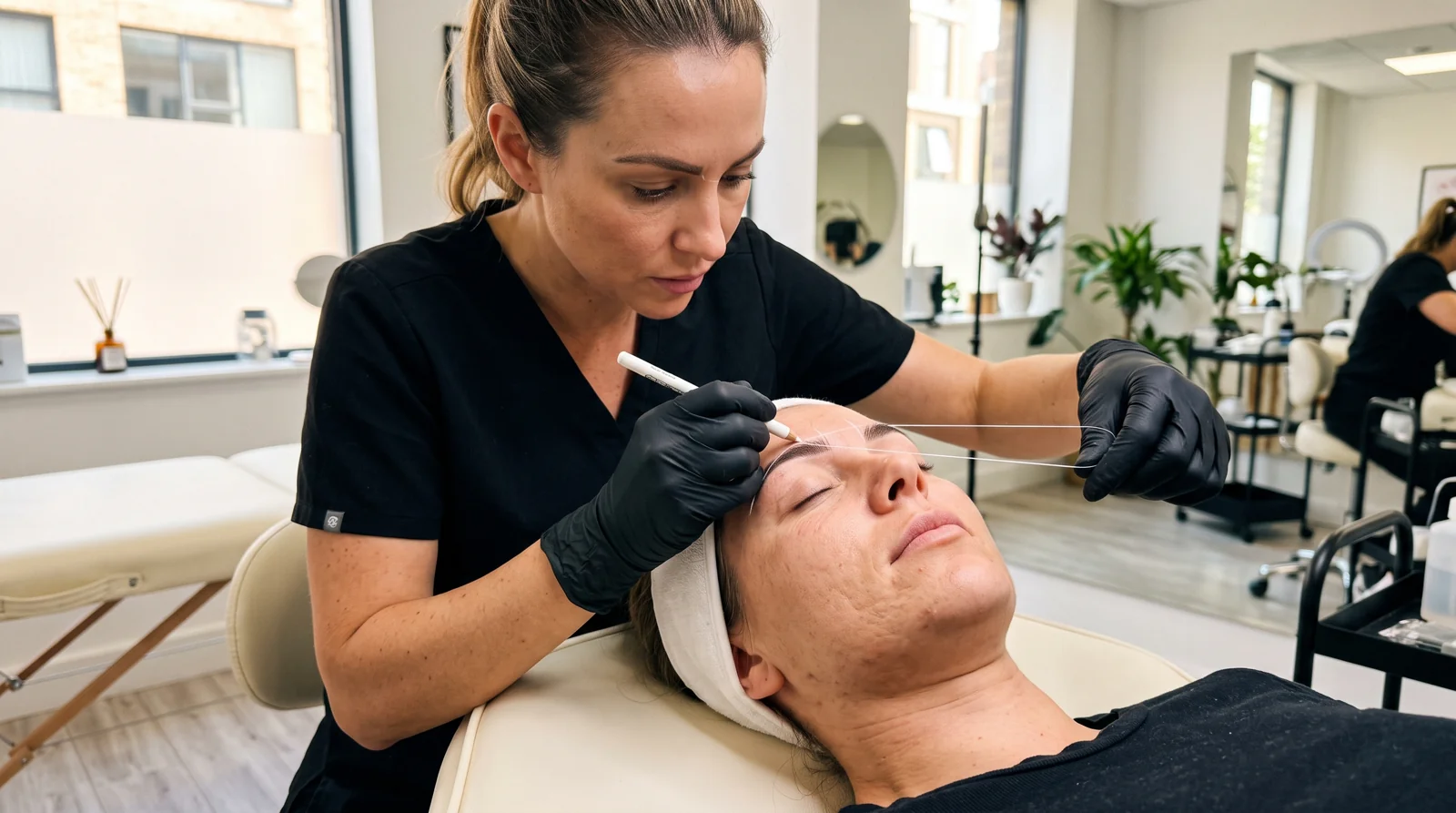
That pigment line also explains why microblading, ombre brows and lip blush sit under the same license track as tattoos. This holds in the states we checked. Plain microneedling for skin texture does not. For the no-pigment side, see what a microneedling certification proves, who may legally perform it, and how it differs from procedures that implant pigment.
How much does permanent makeup license training cost, and how long is it?
Checked course prices span $500 to $3,000, and the hours behind that price vary a lot. AMA Academy in Houston lists its microblading course at $3,000 per student over 2 days. It also lists an advanced nano brows and lip blush course at $2,000 over 2 more days. Texas Lasers prices its Semi-Permanent Makeup Specialist course at $2,100, run across two days.
Those two days add up to roughly 14.5 class hours by the posted schedule. LISA OM Academy in Dallas lists its microblading Platinum Package at $500 to $3,000. That package includes a "100 Hours Certificate of Completion". It adds 2 days of live training and 6 months of online refresher access.
None of these certificates is the license itself. A course can teach the technique. Only the agency named in the table above can make it legal for you to perform.
What does the FDA regulate in permanent makeup?
Less than most people assume, and none of it touches your state license. The FDA's fact sheet states: "FDA considers the inks used in intradermal tattoos, including permanent makeup, to be cosmetics". It is direct about what that does not include. It states: "Although a number of color additives are approved for use in cosmetics, none is approved for injection into the skin".
On quality, it adds a blunt warning: "Many pigments used in tattoo inks are not approved for skin contact at all. Some are industrial grade colors" (the FDA's fact sheet on tattoo and permanent makeup inks, including its warning on unapproved industrial-grade pigments).
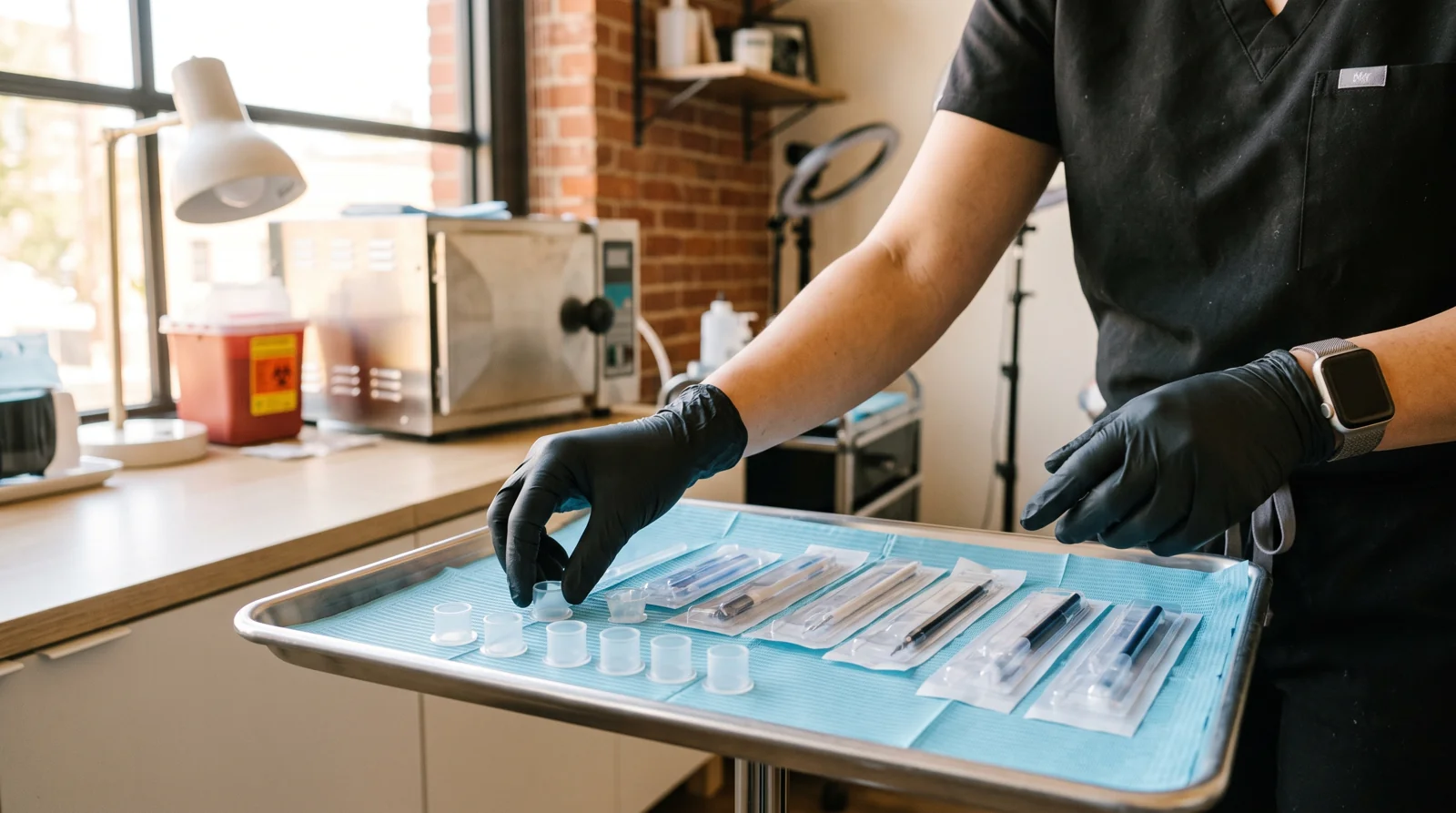
The agency has also recalled tattoo and PMU ink products over the years for microbial contamination. It most recently flagged the issue in 2019. Congress also expanded the FDA's cosmetics powers in 2022 through the Modernization of Cosmetics Regulation Act (MoCRA). That law added powers over adverse-event reporting and recalls that reach the tattoo ink industry. None of that is a license or a substitute for your state's rules.
What risks should a PMU artist be trained to recognize?
Pigment placed under the skin can trigger reactions years later, so a course should cover more than technique. A 2023 case report found a delayed granulomatous reaction after microblading (Ibraheim, The American Journal of Dermatopathology, PMID 37130196). It shows that the immune system can react to implanted pigment long after the procedure. A 2022 case report, not involving pigment, found delayed facial granulomas after microneedling.
In that case, a topical vitamin C product was applied before (Heck, SAGE Open Medical Case Reports, PMID 35693923). That is a reminder that anything pushed through punctured skin can cause a reaction. A 2024 case series went further. It linked microblading-site reactions to an underlying case of systemic sarcoidosis in two patients (Merzel Sabovic, Journal of Medical Case Reports, PMID 38654341). A pigment reaction that looks local can be the first visible sign of a body-wide disease.
Pigment can also interact with medical equipment. One case report found a tattoo-induced skin "burn" feeling during an MRI scan. The patient was a professional athlete (Ross, Sports Health, PMID 23016039). A 2002 survey covered 135 people with permanent cosmetics who had an MRI. Only 1.5% felt any problem, mild tingling or burning. So the risk is real but rare at the group level (Tope, Journal of Magnetic Resonance Imaging, PMID 11836774).
Also, unclean technique carries its own risk of infection. Researchers traced an outbreak of nontuberculous mycobacterial skin infections to tattoo shops. One cluster was in Miami-Dade, Florida (Griffin, Clinical Infectious Diseases, PMID 30452604). None of this is treatment advice. It is a reason to ask any course how it teaches sterile technique and client screening. Ask, too, what to do when a reaction shows up weeks or months later.
Does a PMU license help you get hired at a med spa?
A license is the floor a med spa has to clear before it can let you touch a client. A course certificate on top of it shows you can already run the routine. Bring two documents to any application. One is the credential that allows the work in that state. The other, where you have one, is a dated course certificate showing hours and provider.
PMU usually sits next to other paid add-ons on an esthetician's resume. For how those add-ons fit after licensing, see the medical esthetician programs in Florida and the add-on certifications that raise pay after the license.
Sources and how we checked them
- Florida: floridahealth.gov tattoo and PMU licensing page (linked above); Fla. Stat. §§381.00771-.00791 at flsenate.gov/Laws/Statutes/2024/381.00771; FAC 61G5-18.00015 as reproduced at regulations.justia.com.
- Texas: dshs.texas.gov/tattoo-body-piercing-studios/licensing-requirements-tattoo-body-piercing-studios.
- California: the Safe Body Art Act (AB 300) at leginfo.legislature.ca.gov.
- New York: dos.ny.gov/esthetics and health.ny.gov/community/body_art.
- Pennsylvania: pa.gov/agencies/dos, Board of Cosmetology page.
- New Jersey: nj.gov/health/ceohs/phfpp/body_art and the NJDOH Microblading Guidance PDF.
- Illinois: dph.illinois.gov, body art establishments page.
- Virginia: law.lis.virginia.gov, 18VAC41-50 (Tattooing Regulations).
- Georgia: dph.georgia.gov/environmental-health/body-art.
- Arizona: azleg.gov, A.R.S. 13-3721; permits are issued at county level.
- New Mexico: rld.nm.gov, rule 16.36.9 NMAC PDF (secondary summary; primary text pending).
- FDA: "Tattoos & Permanent Makeup: Fact Sheet" (linked above).
- Course prices: ama.academy, texaslasers.com/courses/permanent-makeup, lisaom.com/dallas-tx-microblading-pmu-training.
- Research: PMID 37130196, 35693923, 38654341, 23016039, 11836774 and 30452604, each at pubmed.ncbi.nlm.nih.gov/
.
All checked 2026-09-25.
Frequently asked questions
How do you get a permanent makeup license?
Identify which agency licenses PMU in your state: a health department, a county body-art program, or, in Virginia and New Mexico, a licensing board. Complete a bloodborne pathogens course and any other required training, then apply directly to that agency.
Do you need a license to do permanent makeup?
Yes, in every one of the 11 states we verified. The issuing agency differs, but none lets you perform permanent makeup, microblading, or pigment microneedling without a license or local registration.
What license do you need to do permanent makeup?
In most states checked, a tattoo or body-art license issued by a health department or county program. Virginia and New Mexico instead issue a distinct Permanent Cosmetic Tattooer or Permanent Cosmetic Practitioner license.
Can I do permanent makeup with an esthetician license?
No, not in any of the 11 states verified. An esthetics license covers services like facials and skin treatments; permanent makeup is licensed separately, usually as a form of tattooing.
How much does a permanent makeup license cost?
State fees we verified are modest where published: Florida charges $60 for a new tattoo artist license plus county fees, while California fees are set by each county or city agency and renewed annually. Training costs more, from $500 to $3,000 in the courses we verified.
Can you get a permanent makeup license online?
No state we verified issues the license itself online. Some schools sell an online or hybrid portion of coursework, but the hands-on practical and the application still happen in person or directly with the agency.
Is a tattoo license the same as a permanent makeup license?
Often, yes. In Florida, the tattoo artist license covers permanent makeup because the law defines it as a form of tattooing. Texas and Illinois license the studio rather than the individual artist, and Arizona leaves permits to counties. Virginia and New Mexico instead created a separate, PMU-specific category.
How do I look up a permanent makeup license?
Start with the agency named in the table above: a health department's licensing search, a county body-art registry, or, in Virginia and New Mexico, the licensing board's lookup. Local county registries, not a state cosmetology board search, hold most of these credentials.
The credential sits outside the esthetics board
Across each state checked, the pattern holds. The license comes from a health department, a county body-art program, or, in two states, its own licensing-board track. It never comes from the esthetics license alone. Virginia is the clearest example of that separate-board path: its rule builds the Permanent Cosmetic Tattooer category directly into Virginia tattooing regulations under 18VAC41-50 that create the Permanent Cosmetic Tattooer license category, issued by the same board that licenses cosmetologists, but as its own credential. Confirm your state's agency and its rules before you spend on a course. That way the training leads to a credential you can legally use.