Key Takeaways
- There is no medical aesthetician license anywhere in the United States. It is a job description, not a credential, and no state board issues one.
- Florida registers a facial specialist, and that registration takes 220 hours of training under Fla. Stat. 477.0201, not the 260 hours repeated across most training sites.
- Florida law defines the entire practice of cosmetology as treatment "for aesthetic rather than medical purposes," which is precisely why the word medical in the job title carries no legal weight.
- Because the title is unregulated, schools can sell a medical aesthetician certificate without lying. It just does not expand what you are legally allowed to do.
- Your scope does not expand because a physician is in the building. Florida Board of Cosmetology rule 61G5-18.00015 puts every form of bodily intrusion, laser and IPL included, outside the registration entirely, and a supervising physician does not move that line.
- What a medical practice can add is work a physician delegates to you as their assistant. That is a separate legal basis from your registration, and it is worth understanding before you accept a job that assumes otherwise.
- Employers screen for the license, the device hours, and who signed off on your protocols. The title on your resume is the least useful thing on it.
The job is real and well paid. The credential behind the job title is the part almost nobody explains correctly.
Search for medical aesthetician and you will get eight results from schools selling a medical aesthetician certificate, and two from Reddit. One of those Reddit threads is titled, more or less, that there is no such thing as a medical esthetician in the United States.
The Reddit thread is closer to correct than the eight schools above it. That is an unusual thing to be able to say about a search result, and it is worth understanding why it happened, because the gap between those two answers is costing people money on both sides of the hiring table.
We run a marketplace that places skincare professionals into Florida clinics. We do not sell training, which means we have no reason to blur this. What follows is what the title actually means, what the state actually registers, and what a hiring manager is actually looking at when your resume says medical aesthetician.
What is a medical aesthetician?
A medical aesthetician is a licensed skincare professional who works in a medical setting, such as a dermatology office, a plastic surgery practice, or a medical spa, performing treatments under the authority of a supervising physician. The role usually involves chemical exfoliation, facials, dermaplaning, extractions, and pre treatment and post treatment skin conditioning for patients undergoing clinical procedures. Job postings often add microneedling and laser to that list, which is where Florida draws a hard line that the sections below set out.
That is the job. Note what the definition does not contain: a license called medical aesthetician. The person holding the job is a licensed esthetician, or in Florida a registered facial specialist. Medical describes where they work and who supervises them. It does not describe a credential they hold.
Is "medical aesthetician" an actual license?
No. No state board in the United States issues a medical aesthetician license, and no state statute defines the term. It is an occupational description that grew out of the market, the way front desk lead or lead injector did. It is genuinely useful shorthand. It is simply not a legal category.
Florida is a clear example because the statute is unusually blunt about it. Florida Statute 477.013 defines cosmetology as the mechanical or chemical treatment of the head, face, and scalp for aesthetic rather than medical purposes. The state defines the entire profession by excluding medical purposes from it. A title that welds the word medical onto that profession cannot, by construction, be a Florida credential.
Florida does protect job titles when it wants to. Statute 477.014 states that no person other than a duly licensed cosmetologist may use the name or title of cosmetologist. There is no equivalent sentence anywhere in Florida law protecting medical aesthetician, medical esthetician, or clinical esthetician. Anyone can print any of them on a business card.
This is why the schools ranking at the top of that search are not committing fraud. A medical aesthetician certificate is a real certificate of completion for a real course. It just is not a license, it is not required by any state, and it does not enlarge what you are permitted to do to a patient.
What Florida actually registers instead
Florida does not license estheticians the way most states do. It registers specialists, and the skincare specialty is the one you want.
Statute 477.013(6)(c) defines the facials specialty as the massaging or treating of the face or scalp with oils, creams, lotions, or other preparations, and skin care services. To register for it, Statute 477.0201 requires a certificate of completion for 220 hours of training focused primarily on sanitation and safety.
That 220 hour figure is worth pausing on, because a large share of the training industry publishes 260 hours instead. The statute says 220 for the facials specialty. It says 180 hours for the nails and pedicure specialties, and 400 hours if you want to register for all three at once. If a school quotes you a number, check it against the statute rather than the brochure.
| Florida credential | Statutory hours | What it covers | Where the number comes from |
|---|---|---|---|
| Facial specialist (skin care) | 220 | Facials, skin care services, the core medical aesthetician job | Fla. Stat. 477.0201(1)(b)2 |
| Nails or pedicure specialty | 180 | Manicuring and pedicuring only, no skin care | Fla. Stat. 477.0201(1)(b)1 |
| All three specialties combined | 400 | Facials plus nails plus pedicure | Fla. Stat. 477.0201(1)(b)3 |
| Full cosmetologist license | 1,200 | Hair, plus everything a specialist can do | Fla. Stat. 477.019(2)(c) |
| "Medical aesthetician" | Does not exist | Not a Florida credential at any hour count | No statute |
Registration renews with the board, and Statute 477.019 lets the board require up to 10 hours of continuing education biennially for licensees and registered specialists. Ten hours every two years is the entire ongoing state obligation. Everything else you take is voluntary, which is exactly why the certificate market is so crowded.
Does Florida have a master esthetician license?
No. A handful of states, including Washington, Utah, Virginia, and the District of Columbia, created a master esthetician tier above the basic license. Florida did not. If you trained in one of those states and moved here, see what a master esthetician credential is, which states actually issue one, and how it translates when you relocate to a state that does not recognize the tier.
Medical aesthetician vs esthetician: what actually differs
If the credential is identical, the honest question is what separates the two jobs. Three things do, and none of them is the license.
The supervising physician. In a medical practice there is a physician who owns the clinical protocols, and some procedures are delegated to you under that authority. In a day spa there is not. This is what changes between the two settings, and it is worth being precise about what it does and does not change.
The legal basis for the work. This is the one most job postings get wrong. Rule 61G5-18.00015 defines medical purposes as any form of bodily intrusion into the skin or other tissues, and names skin perforation by any means, laser and IPL, ultrasound and HIFU, plasma pen, Hyaluron pen and injections as beyond the scope of a cosmetology license and full and facial registrations. That line does not move because a physician is on site. If you perform any of it in a medical practice, you are doing so as that physician's delegate, not as a facial specialist, and your registration is not what authorizes it.
The patient. A day spa client is choosing a facial. A dermatology patient is being managed for a condition, and your treatment is one part of a plan somebody else wrote. The clinical documentation burden is completely different.
| Day spa esthetician | Medical aesthetician | |
|---|---|---|
| State credential | Facial specialist registration | Facial specialist registration (identical) |
| Supervising physician | None | Required, owns the protocols |
| Typical work | Chemical exfoliation, facials, dermaplaning, waxing | The same, plus pre and post procedure skin conditioning, and anything further only as a physician delegated task |
| Documentation | Service notes | Patient chart inside a medical record |
| Who sets the protocol | The spa | The physician |
| Florida hours to start | 220 | 220 |
The practical reading of that table is that the transition from spa to clinic is a hiring decision, not a schooling decision. You do not go back to school to become a medical aesthetician. You get hired into a medical practice, and then you are one. Which is also why where medical esthetician jobs in Florida actually sit and which practice types hire for them most often matters more to your career than any certificate you can buy.
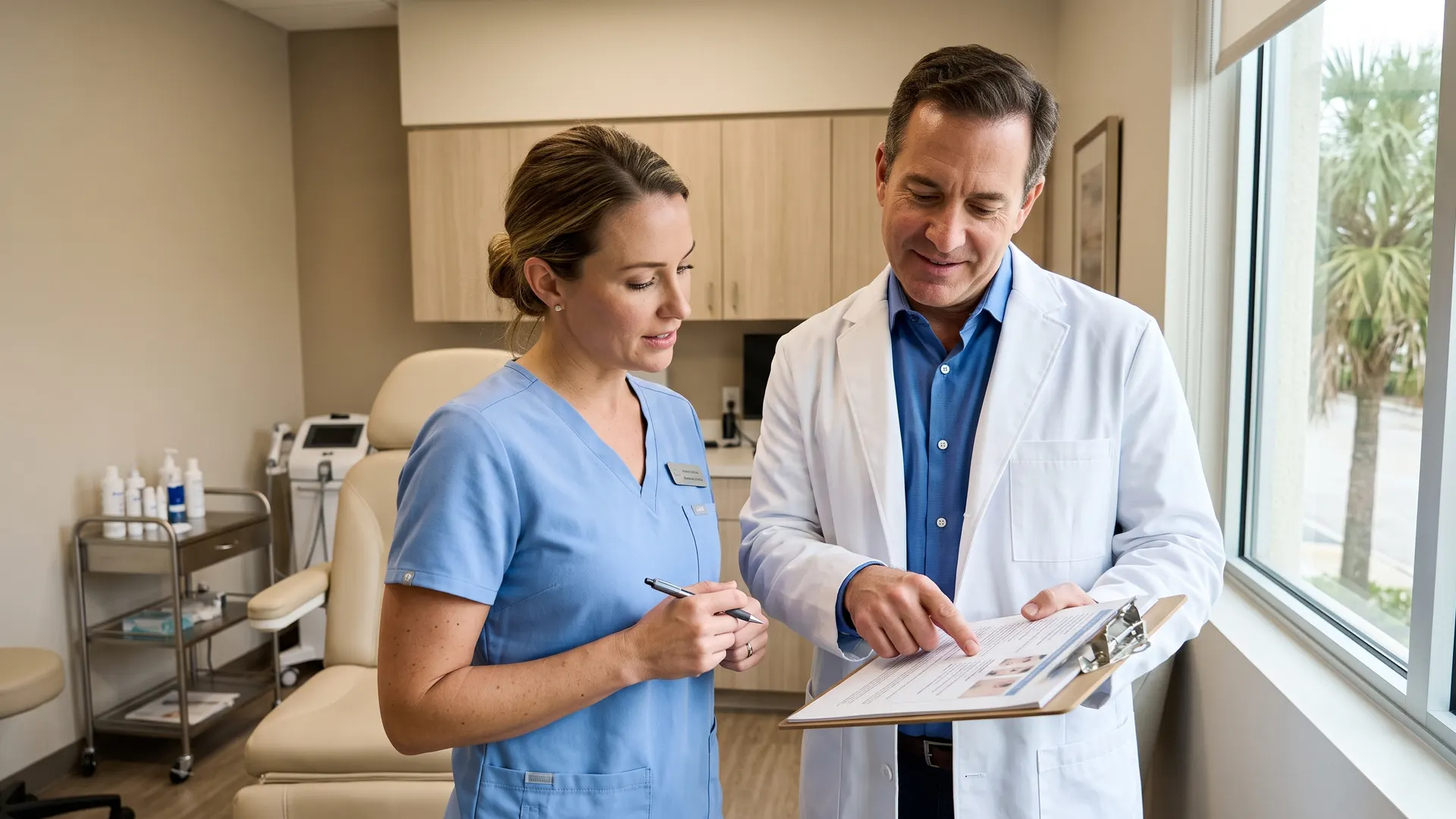
The supervising physician is the actual difference between the two jobs. Not the training certificate.
Do you have to be a nurse to be a medical aesthetician?
No, and the confusion here is costing people entire career detours. A medical aesthetician is a skincare professional. A nurse working in aesthetics is a different role on a different license under a different board.
The two get conflated because both work in the same building, and because the injector role sits with nursing. If your goal is to inject, you need a nursing or advanced practice credential, and the honest comparison is in how the registered nurse and esthetician paths actually diverge in Florida and which one leads to the work you want. If your goal is skin, you do not need nursing at all, and adding it would be an expensive way to reach a job you could already hold.
One boundary matters more than any other. Energy based devices are not a skincare specialty question in Florida, they are a medical delegation question, and the rules are strict about who may operate them and how closely a physician has to supervise. Before you accept a role that includes laser work, read who can legally perform laser hair removal in Florida and exactly what direct physician supervision requires of the clinic and of you.
What does a medical aesthetician do day to day?
The treatment list is narrower than the marketing suggests and the non treatment work is wider. A realistic week looks like this.
Treatments inside the registration. Chemical exfoliation, facials, extractions, manual exfoliation including dermaplaning with a number 10 blade, hydrafacial style devices, LED, and skin conditioning before and after clinical procedures. Rule 61G5-18.00015 names dermaplaning explicitly, so that one is settled.
Treatments that are not inside it. Microneedling is defined in the same rule as a multi needled device creating microchannels 0.25 to 2.5 mm deep, and the rule states plainly that this piercing of the skin is beyond the scope of a registered facial specialist. Laser and IPL are named too, which is consistent with who can legally perform laser hair removal in Florida and why the operator has to be an electrologist or licensed medical personnel under direct supervision. Job postings advertise these constantly. That does not make them part of your registration.
Consultations. Skin analysis, building a treatment course, and setting expectations for patients who arrived expecting one appointment to fix something that will take six.
Charting. Real clinical notes in a real medical record, because your work sits inside a physician supervised plan.
Retail and rebooking. This is the part nobody advertises and the part that most affects your pay. In most Florida med spas, product sales and treatment course rebooking are where compensation above base actually comes from.
Where medical aestheticians work, and who supervises them
Four settings dominate, and they are not interchangeable employers.
Microneedling is the procedure where this line gets tested most often. Our guide to microneedling certification maps which licences may legally use the device state by state and what a med spa checks before the certificate.
Dermatology practices offer the most clinical exposure and the most structured supervision, usually with the tightest protocols and the least commission upside. Plastic surgery practices lean heavily on pre operative and post operative work and tend to pay steadily. Medical spas pay the widest range because compensation is tied to production. Wellness and concierge clinics are the newest entrant and the most variable.
In every one of them, a physician sits behind the protocols. What differs is how present that physician is and how much of your day is delegated versus independent. That is the single question worth asking hardest in an interview, and the questions Florida med spas ask candidates and the ones candidates should be asking back about supervision and protocols covers how to ask it without sounding adversarial.
What employers screen for when the title means nothing
Here is the part that only makes sense once you accept that the credential is unregulated. If the title proves nothing, hiring managers have to look at something else, and they do. In our placements, four things carry the weight.
An active, verifiable registration. Checked directly against the Florida DBPR licensee database, not taken from a resume. This is binary and it is the first filter.
Device hours on specific equipment. Not "microneedling experience" but which device, how many treatments, and who trained you on it. Clinics buy specific machines and need someone who has touched that machine.
Who signed your protocols. A candidate who can describe the supervising physician relationship at their last job, and what was delegated versus independent, is telling a clinic they will not create a compliance problem.
Retention and rebooking numbers. If you know your rebooking rate, say it. Almost no candidate does, and it is the number that predicts revenue.
Notice that a medical aesthetician certificate appears nowhere on that list. It is not that certificates are worthless. It is that they are not evidence of anything a clinic is trying to verify.

License verification, device hours, and who signed the protocols. The certificate is not on the list.
What medical aestheticians earn
Pay tracks the setting and the compensation structure far more than the title. Across Florida med spas, base rates run roughly 18 to 26 dollars an hour, with the spread driven by practice tier and by whether the role carries commission. The full picture, including how commission structures actually work and what top earners do differently, is in our breakdown of what medical estheticians earn in Florida and why the practice tier moves pay more than the city does.
For a national baseline outside Florida, the occupational category to look at is the Bureau of Labor Statistics wage data for skincare specialists under SOC code 39-5094. Note that it covers every practice setting, from day spas to dermatology, so the medical end of the range sits well above the published median.
One structural point that matters more than any hourly figure. Because the title is unregulated, it is not a lever you can pull for a raise. Adding the word medical to your resume does nothing. Adding a documented device competency, a rebooking rate, and a laser delegation history does.
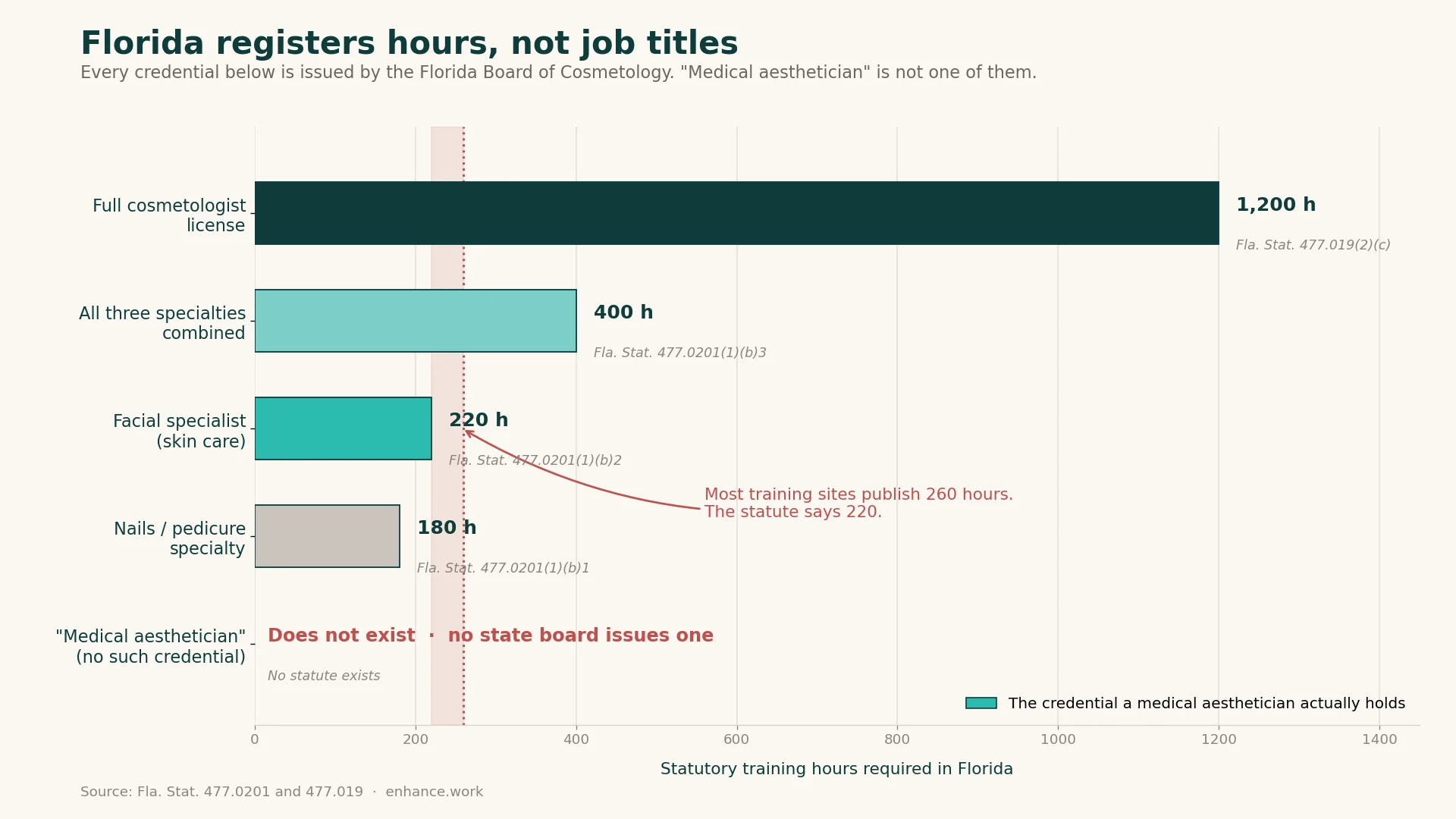
Florida statutory hours by credential. The medical aesthetician bar is absent because the credential does not exist.
There is a further clinical end to this work, built around patients whose skin is compromised by treatment or surgery: our guide to paramedical esthetics covers oncology support, scar and post surgical care, and what the role may decide alone.
Frequently asked questions
Is a medical aesthetician the same as a medical esthetician?
Yes. The spellings are interchangeable in American usage and neither is a license. Aesthetician is more common in job postings and esthetician is more common in state statutes, which is why Florida registers a facial specialist and never uses either word as a credential.
Do you need a license to be a medical aesthetician in Florida?
You need a Florida facial specialist registration, which requires 220 hours of training under Fla. Stat. 477.0201. You do not need, and cannot get, a license called medical aesthetician.
Is a medical aesthetician certificate worth it?
It can be worth it as training and it is never worth it as a credential. Judge the course on whether it puts your hands on a specific device you want to work with. Do not pay for it expecting it to expand your legal scope or satisfy a state requirement, because it does neither.
Can a medical aesthetician do Botox?
No. Injectables sit with nursing and medical licensure in Florida, not with the skincare specialty, regardless of any certificate. No amount of aesthetician training changes that.
How long does it take to become a medical aesthetician?
The state requirement is 220 hours of training, which most Florida programs run in roughly three to six months depending on schedule. Getting hired into a medical setting afterward is the longer part. The full step by step is in our guide to becoming a medical esthetician including the licensing steps, the programs, and how to move from a spa role into a clinical one.
Can a physician delegate microneedling or laser to a facial specialist in Florida?
A physician may delegate tasks to trained personnel acting as their assistant, and that is a question for the Board of Medicine rather than the Board of Cosmetology. What rule 61G5-18.00015 settles is the other half: your facial specialist registration does not authorise it, so the registration is not the answer if anyone asks who allowed you to do it. Get the delegation, the training and the supervision arrangement in writing before you touch the device, and have a Florida healthcare attorney look at it if the practice cannot produce one.
Can a medical aesthetician work without a physician?
They can work as an esthetician in a non medical setting. They cannot perform the medical end of the work, which is exactly the part that makes the job a medical aesthetician job, without a supervising physician behind the protocols.
Chase the setting, not the title
The reason this search returns eight schools and two Reddit threads is that the schools have a product to sell and the honest answer does not require one. There is no medical aesthetician license. There is a 220 hour Florida facial specialist registration, a supervising physician, and a set of device competencies you accumulate on the job.
That is better news than it sounds. A credential you cannot obtain is also a credential nobody can gatekeep. The distance between a spa esthetician and a medical aesthetician is one hiring decision, and the things that close it are verifiable license status, hands on device hours, and a clean account of how you have worked under supervision before.
If you hold a Florida facial specialist registration and want to move into a clinical setting, Enhance.work connects licensed skincare professionals with South Florida dermatology practices, plastic surgery offices, and medical spas that are actively hiring. 🎯
This article summarizes Florida licensing law for general informational purposes and is not legal advice. Statutes and board rules change. Confirm current requirements with the Florida Board of Cosmetology and the Department of Business and Professional Regulation before making a career or hiring decision.