
September 25, 2026 · 11 min read
This article is for general educational and career information only. It is not legal or medical advice. Scope-of-practice rules change and differ by state: confirm with your state board before you act.
Key Takeaways
- A chemical peel certification is a private course certificate, not a state license; no state issues one as a credential.
- Peel depth, not the certificate, decides what you may legally perform: every state reviewed keeps superficial peels inside the esthetician license and treats medium and deep peels as medicine.
- Colorado is the outlier: it requires 24 hours of cosmeceutical coursework before any licensee, esthetician or cosmetologist, may perform chemical resurfacing exfoliation at all.
- Four verified courses run $449 to $600 for 8 to 24 hours; entry rules vary, and a certificate never replaces the license your state requires.
- Even superficial peels carry measured risk: Fitzpatrick type VI skin showed higher odds of side effects overall (OR 5.14), and deep phenol peels need cardiac monitoring during the procedure.
A chemical peel certification is a private course certificate. No state issues one as a license. Peel depth decides what you may do by law. Every state keeps superficial peels inside the esthetician's scope. Medium and deep peels reach the dermis. States treat those as medicine. Colorado is the exception. It requires 24 hours of coursework before any licensee may peel at all.
Do you need a certification to do chemical peels?
Not by law, in most states. You need a license that covers the depth of peel you plan to do. You also need training on the product line your employer uses. A private certificate shows that training. It does not expand your license.
Colorado is different here: it needs training, not a depth cap. The rule reads: "before a licensed cosmetologist or esthetician may perform chemical resurfacing exfoliation." The rule bars action outright until then: "prohibited from using or performing any chemical or manual resurfacing exfoliating devices". See how to choose a medical esthetician program in Florida and which add-on certifications like peels are worth sequencing after licensing for the same order: license first, course after.
One esthetician summed up the rule on Reddit. It matches Colorado's rule: "you have to have an esthetician license and then you can get certification in chemical peels".
What depth of chemical peel can an esthetician do, by state?
Each state's own words. "Not verified" means the primary text was not confirmed this session, left blank rather than estimated.
Peel depth lines by state, in the rule's own words
| State | Depth line (verbatim) | Numeric cap | Citation |
|---|---|---|---|
| Florida | No peel-specific clause; the line is functional: "any form of bodily intrusion into the orifices, skin, muscles, or any other tissues of the body" (a medical purpose, beyond a cosmetology license) | None stated | FL Admin. Code 61G5-18.00015 |
| Texas | "The use of any product, preparation or procedure that comes into contact with or penetrates the dermis layer of the skin is prohibited." | None stated | 16 TAC §83.112(c) |
| California | "Giving facials... by the use of hands, esthetic devices, cosmetic products, antiseptics, lotions, tonics, or creams... that do not result in the ablation or destruction of the live tissue." | None stated | Cal. Bus. & Prof. Code §7316(c)(1) |
| Colorado | "Completion of twenty-four hours of cosmeceutical coursework is required before a licensed cosmetologist or esthetician may perform chemical resurfacing exfoliation." | 24 hours of coursework required, not a depth cap | 4 CCR 731-1, Rule 1.9 |
| Ohio | "does not penetrate below the stratum corneum when used as directed" | Solution at 30% or less, pH not less than 3 | Ohio Admin. Code 4713-8-04 |
| Illinois | "stimulating the stratum corneum of the epidermis"; "Estheticians are prohibited from using techniques, products, and practices intended to affect the living layers of the skin." | None stated | 225 ILCS 410/3A-1 |
| North Carolina | "Licensed cosmetologists and estheticians are prohibited from using a product, device, machine or technique or any combination of the same, which penetrates the client's skin beyond the epidermis." | None stated | N.C. Gen. Stat. §88B-2(11a); 2022 ruling |
| New York | "A light (superficial) chemical peel that removes the outer layer of skin (epidermis)" | Not verified | NY Dept. of State scope chart |
| Arizona | Not verified | Not verified | Not verified |
| New Jersey | Not verified | Not verified | Not verified |
North Carolina puts a number on the agent side of the line. Estheticians there may use several acids, capped by strength: "trichloroacetic acid less than 20%". That cap is a legal line, not a clinical measure. Do not mix it up with the depth groups below. Texas works the same way.
the Texas Department of Licensing and Regulation rule text barring estheticians from any procedure that penetrates the dermis covers any product or step, not peels alone. A TDLR-licensed esthetician cannot reach the dermis, no matter what a certificate says.
What are superficial, medium and deep peels?
Peels fall into three depth groups, based on how strong the agent is. A 2010 expert-group review sets the terms. It reads: "The usual classification of chemical peels comprises superficial, medium and deep peels."
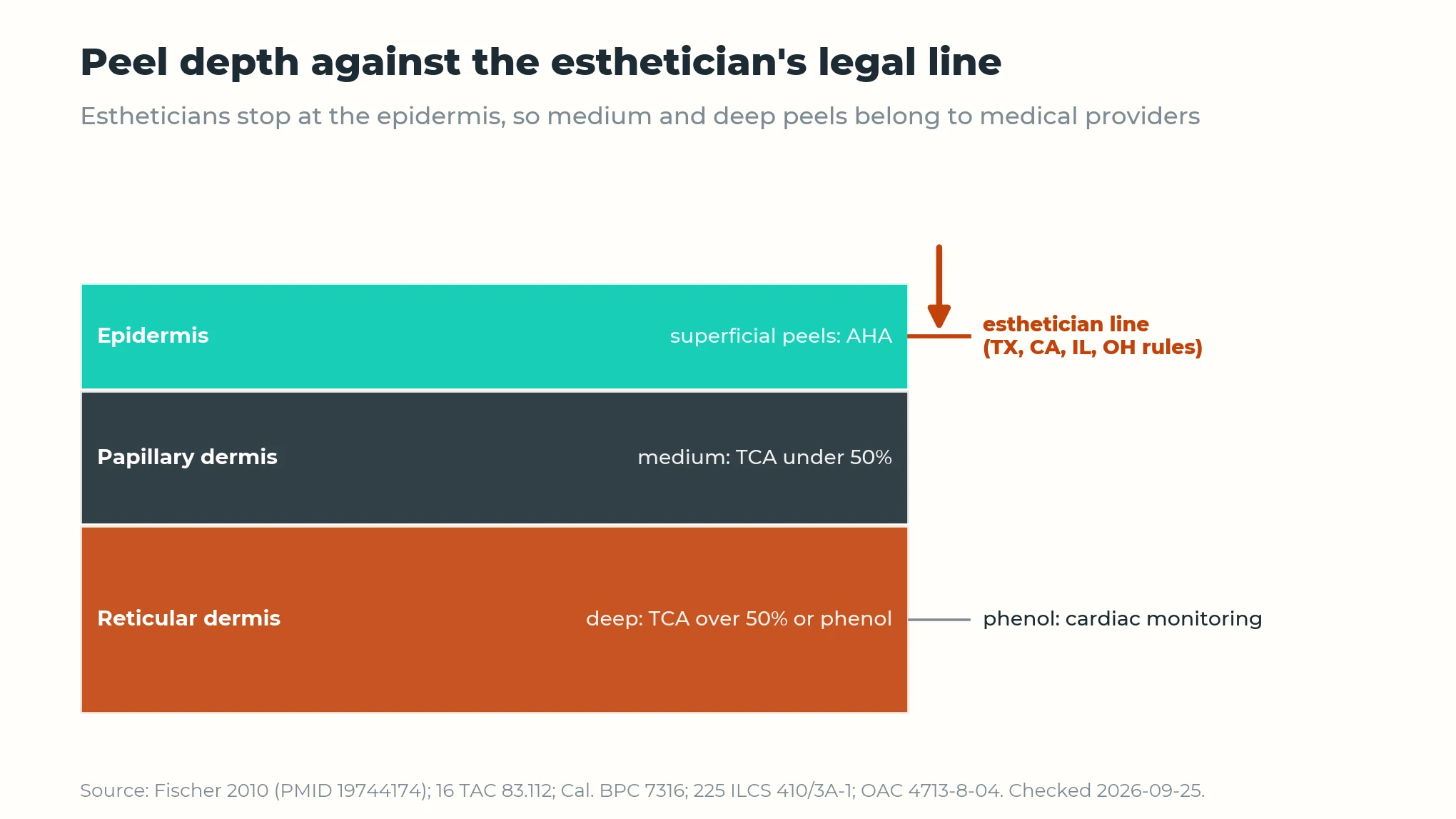
A 2019 International Peeling Society review agrees on the same two groups. It does not add new numbers. The review ties depth to outcomes and problem risk: "the number of complications that can occur." It also covers "appropriate indications for these treatments."
Salicylic acid and Jessner's solution are common surface-tier agents. But no course source gave a number for either this session. Ask any course that names a number and says where it comes from.
What are the risks a chemical peel certification course must train you to spot?
A 2018 study found real problems even with superficial peels. Out of 473 treatments, 18 (3.8%) had a problem, short term or long term. The most common were crusting (2.3%), dark spots after inflammation, called postinflammatory hyperpigmentation (1.9%), and redness (1.9%). Darker skin carried more risk. The odds ratio was 5.14, with a 95% confidence interval of 1.21 to 21.8 (P = .0118). A course worth paying for teaches Fitzpatrick typing first.
Deep peels, the tier that includes phenol formulas, carry a different risk. A 2007 case series makes the point directly: "The most important potential complication of deep peels is cardiotoxicity." The numbers back it up.
Doctors watched patients' hearts the whole time. Doctors treated 181 patients during the study. Of those, 12 (6.6%) had a cardiac arrhythmia during it. Doctors then gave 8 patients 100 mg of IV lidocaine to control it. That is why deep peels sit with a physician.
A 2020 review frames the same checklist across peels, lasers and dermabrasion. It reads: "The most common of these include infection, hypopigmentation, hyperpigmentation, and scarring." "This includes understanding the extent of each patient's issues (Glogau scale) and Fitzpatrick type." Ask whether that scoring is part of a course's plan.
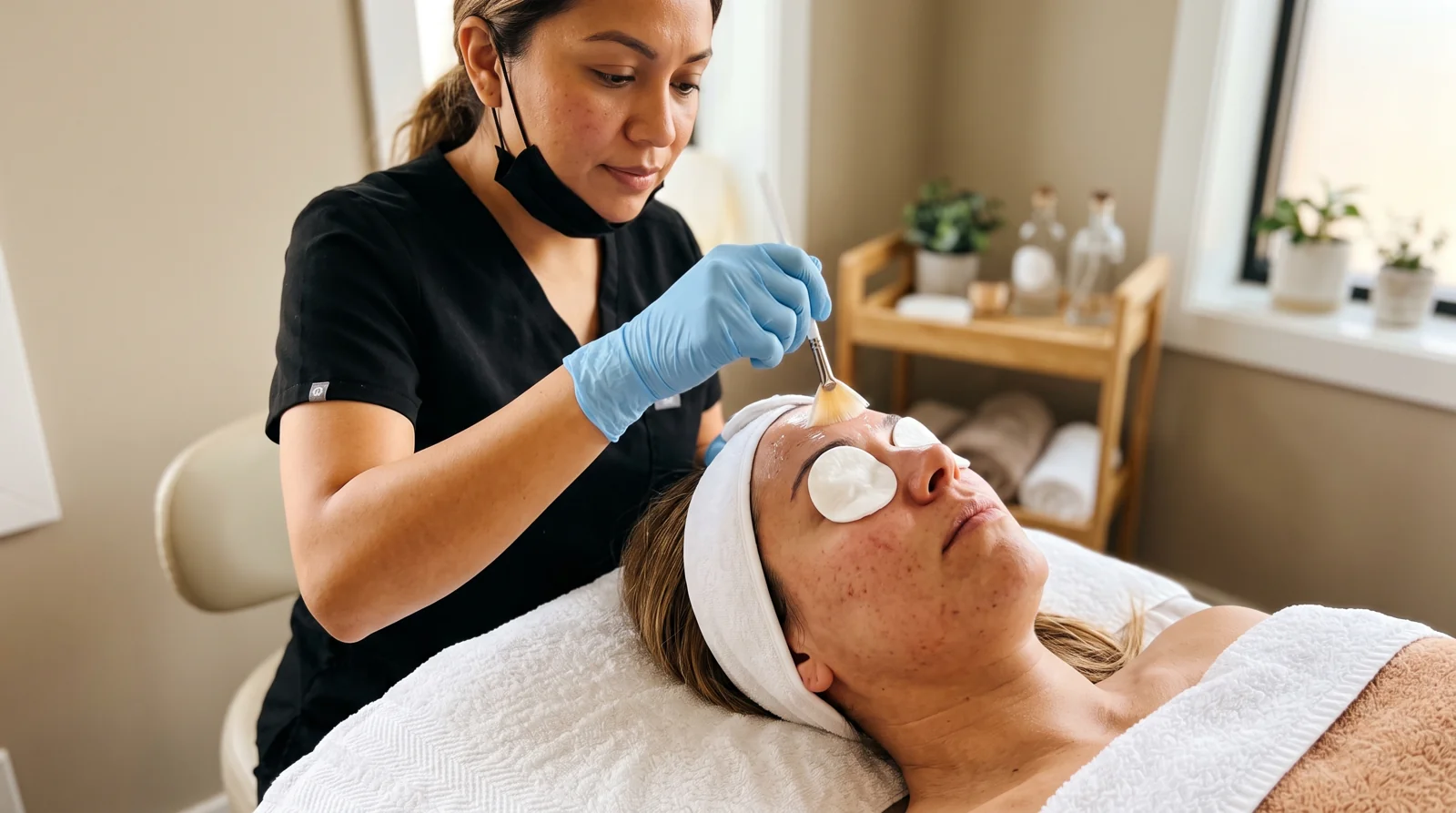
What does the FDA say about peel acids?
The FDA's label rules cite the Cosmetic Ingredient Review (CIR) Expert Panel. This is an outside safety panel. It splits store products from salon products by strength and pH. These are safety conclusions, not federal limits set by the FDA. For glycolic and lactic acid at the store level: "are safe for use in cosmetic products at concentrations <=10%, at final formulation pH >=3.5." For salon use, the threshold moves: "safe for use in salon products at concentrations <=30%, at final formulation pH >=3.0". Full text: the FDA guidance on labeling cosmetics that contain alpha hydroxy acids, including the salon-use concentration and pH thresholds.
The FDA also recommends a consumer warning. It reads: "This product contains an alpha hydroxy acid (AHA) that may increase your skin's sensitivity to the sun". It also advises: "Use a sunscreen, wear protective clothing, and limit sun exposure while using this product and for a week afterwards." Ohio's own rule caps salon peels at 30%. Its pH floor is 3. That is close to the CIR salon figure.
How much does chemical peel certification cost?
We checked price and hours for four courses right on each provider's own page.
Chemical peel courses, prices as published
| Provider | Price | Hours | Format | Eligibility |
|---|---|---|---|---|
| Colorado Aesthetics Academy (Denver, CO) | $600 | 24 hours (3 days x 8 hours) | In person | Must already hold an esthetician, cosmetologist, RN, NP, PA, or MD license |
| LaVida AI (Houston, TX) | $595 | 8 hours (4 online, 4 in-person) | Hybrid | Not stated as requiring a prior license |
| Texas Laser and Aesthetics Training Academy (Austin, TX) | from $500 | 8 hours | In person | Esthetician or cosmetology license "strongly recommended," not mandatory |
| Academy of Skin & Beauty | $449 | 1 day, about 8 hours; exact CE-hour count not stated | In person | Must be a licensed esthetician, cosmetologist, RN, or NP |
None of these four schools calls its certificate a license. Colorado Aesthetics Academy calls its own credential "advanced certification within your existing scope". That is a paper layered on top of a license you already hold. It does not swap out your license. Peels are rarely the only add-on priced this way. what a microneedling certification proves, who can legally perform it, and what med spas check before hiring for that add-on runs the same math for a device-based service.
Brand training or independent course?
Searches also surface named product lines, like Circadia, PCA and Milady, along with other schools. A brand course trains you on that brand's formulas. An outside course, like the four checked above, teaches depth control and how to manage problems across agents. Circadia and Dolly Monroe Beauty Academy both offer named peel courses.
We could not check their price or hours. They appear only as brand-course examples, not in the pricing table. A device-brand cert works the same way: what a Hydrafacial certification actually is, what it costs, and how a device-brand add-on differs from a chemical peel course shows what that brand path buys instead.
Ask either type: does it teach Fitzpatrick and Glogau scoring, or mainly one company's product line?
What do med spas check before letting you peel?
Employers check three things. The license must cover the depth offered. The hire needs hands-on practice with the clinic's routine. And a supervisor or a written rule must cover anything past the surface tier. what a licensed esthetician's license actually covers, and why superficial peels sit inside it while deeper peels do not lays out that scope line in more detail.
Sources and how we checked them
- Florida: Florida Administrative Code Rule 61G5-18.00015 on medical purposes and bodily intrusion for cosmetology licensees.
- Texas: the Texas rule barring estheticians from any procedure that penetrates the dermis, 16 TAC section 83.112.
- California: California Business and Professions Code section 7316, defining the practice an esthetician license covers.
- Colorado: 4 CCR 731-1 Rule 1.9, requiring 24 hours of training before chemical resurfacing exfoliation.
- Ohio: Ohio Administrative Code Rule 4713-8-04, capping esthetician chemical peels at 30% and a pH of 3 or higher.
- Illinois: 225 ILCS 410/3A-1, the Illinois statute defining esthetics and its stratum corneum limit.
- North Carolina: the North Carolina Board's declaratory ruling on esthetic scope and its 20% TCA threshold.
- New York: the New York scope of practice chart naming the light superficial chemical peel category.
- FDA: the FDA guidance on labeling AHA cosmetics, including the salon-use concentration and pH thresholds and the FDA's alpha hydroxy acids ingredient page with its recommended consumer sunburn alert label.
- Research: the 2010 review classifying superficial, medium and deep peels by agent and concentration, the 2019 International Peeling Society review of superficial and medium-depth peeling principles, the 2007 case series on cardiac arrhythmia and cardiac monitoring during deep chemical peels, the 2018 retrospective study of superficial peel complications by Fitzpatrick skin type and the 2020 review of complications across chemical peels, lasers and dermabrasion procedures.
- Courses: Colorado Aesthetics Academy's 24-hour chemical peel training course in Denver, Colorado, LaVida AI's 8-hour hybrid dermaplaning and chemical peel training course in Houston, Texas, Texas Laser and Aesthetics Training Academy's 8-hour chemical peel training course in Austin, Texas and Academy of Skin & Beauty's one-day chemical peel training course for licensed estheticians, checked 2026-09-25.
Frequently asked questions
Do you need a certification to do chemical peels?
Not legally in most states; your license authorizes the treatment, not a certificate. Colorado is the exception, requiring 24 hours of coursework before any licensee may perform chemical exfoliation.
Can estheticians do chemical peels?
Yes, at the superficial depth, in every state reviewed. Medium and deep peels reaching the dermis are treated as medicine and fall outside an esthetician license.
What qualifications do I need to do chemical peels?
An esthetician, cosmetology, or medical license covering your state's depth line, plus training on your employer's protocol. A certificate documents training; it does not expand your license.
How do I get certified in chemical peels?
Through a school course, usually after you already hold a license. The four verified courses here run $449 to $600 for 8 to 24 hours.
Is there a free or online chemical peel certification?
None of the four verified courses is free. LaVida AI's is closest to online, pairing 4 hours of self-paced lecture with 4 hours of hands-on practice; no fully online course was verified.
How much does chemical peel certification cost?
Verified prices run $449 to $600 for 8 to 24 hours; two of the four require a prior license, and none replaces one. Brand-affiliated courses from Circadia or Dolly Monroe Beauty Academy exist, but price and hours were not verified.
What is a level 3 chemical peel?
"Level" numbering is a school marketing term, not a legal or clinical standard; the recognized categories are superficial, medium and deep. Ask which category a course's "level 3" falls under.
Can an esthetician do a TCA peel?
It depends on concentration and state. North Carolina permits TCA below 20% for estheticians; the medium and deep categories use higher concentrations that reach the dermis and fall outside an esthetician license.
Buy the course that trains to your state's line, not just to a brand name
A peel certificate is worth paying for once you know which depth your license covers. Read your state's line first, then choose a course that teaches Fitzpatrick and Glogau scoring, names the depth of every agent it uses, and drills what to do when a peel goes wrong.