
Here is how to become an electrologist in Florida: complete a council approved program of 320 hours, 120 academic and 200 clinical under Rule 64B8-53.002, pass a written state examination and apply to the Department of Health, not to the Department of Business and Professional Regulation. The widely quoted 120 hours is only the academic subtotal.
Electrology is the least understood licensed credential in aesthetics, and the number everyone quotes about it is wrong. Search for the training requirement and you will keep meeting 120 hours. That figure is real, but it is only the academic half of the programme. A council approved Florida electrolysis programme runs 320 hours under the Board of Medicine curriculum rule, 120 of academic instruction plus 200 of clinical application. That is more training than Florida asks of a facial specialist, not less, and unlike the facial specialist route it ends in a state examination. The short route into skin care in Florida is esthetics. Electrology is the thorough one.
Key Takeaways
- A council approved Florida electrolysis programme is 320 hours: 120 of academic instruction and 200 of clinical application, set by Rule 64B8-53.002. The widely quoted 120 hour figure is only the academic subtotal.
- Electrology asks for more training hours than the 220 hour facial specialist registration, and unlike that route it also requires passing a written state examination.
- Electrology is licensed by the Department of Health, not by the Department of Business and Professional Regulation. That single difference sends most applicants to the wrong agency first.
- You cannot practise or call yourself an electrologist in Florida without an active license. Open your own room and the facility needs its own license and inspection too.
- Statutory fee caps are modest. The real cost of entry is equipment and training, not the state.
Training alone does not settle what you may operate. The credential itself sits in a different rulebook. What it authorises, the separate facility licence, and the exact supervision conditions attached to laser are covered in the Florida electrolysis license and its laser rules spell out what the credential permits and the physician supervision that has to be in place first.
What does an electrologist actually do?
An electrologist performs permanent hair removal. Permanently. That word is doing legal work here, not marketing work. Florida defines the practice narrowly and the wording matters, because it is what separates electrology from every neighbouring credential in a med spa.
Florida Statutes section 478.42 defines electrolysis or electrology as "the permanent removal of hair by destroying the hair-producing cells of the skin and vascular system, using equipment and devices approved by the board which have been cleared by and registered with" the federal device authority.
Read the two conditions in that sentence separately, because together they explain the whole credential. The first is permanence. Electrology is not hair reduction or hair management. It is destruction of the structure that grows the hair. The second is device clearance. The equipment has to be board approved and federally cleared. That is a medical device standard, not a cosmetology standard. It is the reason electrology sits under the Department of Health rather than with the cosmetology board.
In practice this means an electrologist works one follicle at a time with a probe, using galvanic, thermolysis or blend methods, on hair that laser cannot treat. That includes grey, white, red and fine blonde hair, where laser has no pigment target to absorb its energy. It also includes work many candidates never consider until they are in the field, such as gender affirming hair removal and pre surgical clearance. That work is steady, referral driven and rarely price shopped.
Maybe your interest is the device side of aesthetics more broadly rather than permanent removal specifically. Compare the adjacent route before you commit, because the Florida path to working with lasers and light based devices in a med spa runs through different rules and a different equipment budget than electrology does.
How to become an electrologist in Florida: what does the state require?
Section 478.45 of the Florida Statutes sets out the criteria the board must certify before the department issues a license. There are seven, and they are unusually concrete for a licensing statute:
- A completed application with the application fee set under section 478.55.
- Background screening under section 456.0135.
- At least 18 years of age.
- Good moral character.
- A high school diploma or a high school equivalency diploma.
- No act committed in any jurisdiction that would be grounds for discipline as an electrologist in Florida.
- Successful completion of the academic requirements of an electrolysis training program, not to exceed 120 hours, and the practical application of that program as approved by the board.
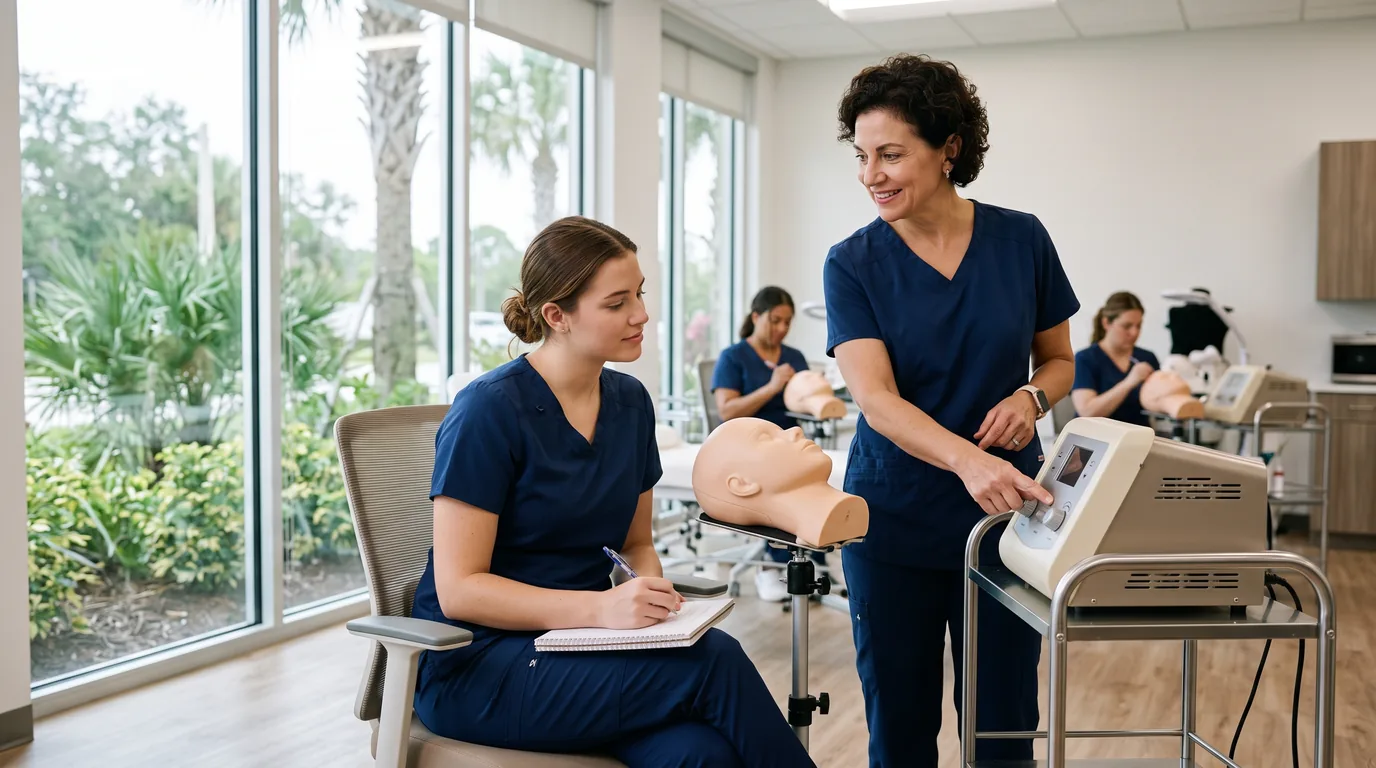
That last clause is the one candidates misread most often. The statute writes 120 hours as a ceiling on the academic component, not as a total programme length. The practical application sits alongside it and is approved separately by the board. So a compliant Florida programme is not simply 120 hours long. Ask any school to break out the academic hours from the supervised practical hours. Get it in writing that the practical component carries board approval. A school that cannot separate those two numbers on request is telling you something.
Then there is the gate that the esthetics routes do not have. Section 478.45(2) requires every applicant to pass a written examination developed by the department, or a national examination the board has approved. The statute says the exam tests professional skill and judgment in electrolysis techniques and methods, not just recall. Section 478.45(3) allows an approved national examination to stand in for part of the state exam. Section 478.45(5) requires the department to run licensure examinations at least twice a year. Two sittings a year is a real scheduling constraint. Miss one and you are waiting months, so work backwards from the exam calendar when you plan your programme end date.
How does electrology compare with the facial specialist route?
This is the comparison that decides the question for most people, and it is almost never published side by side. Florida treats these two credentials in opposite ways.
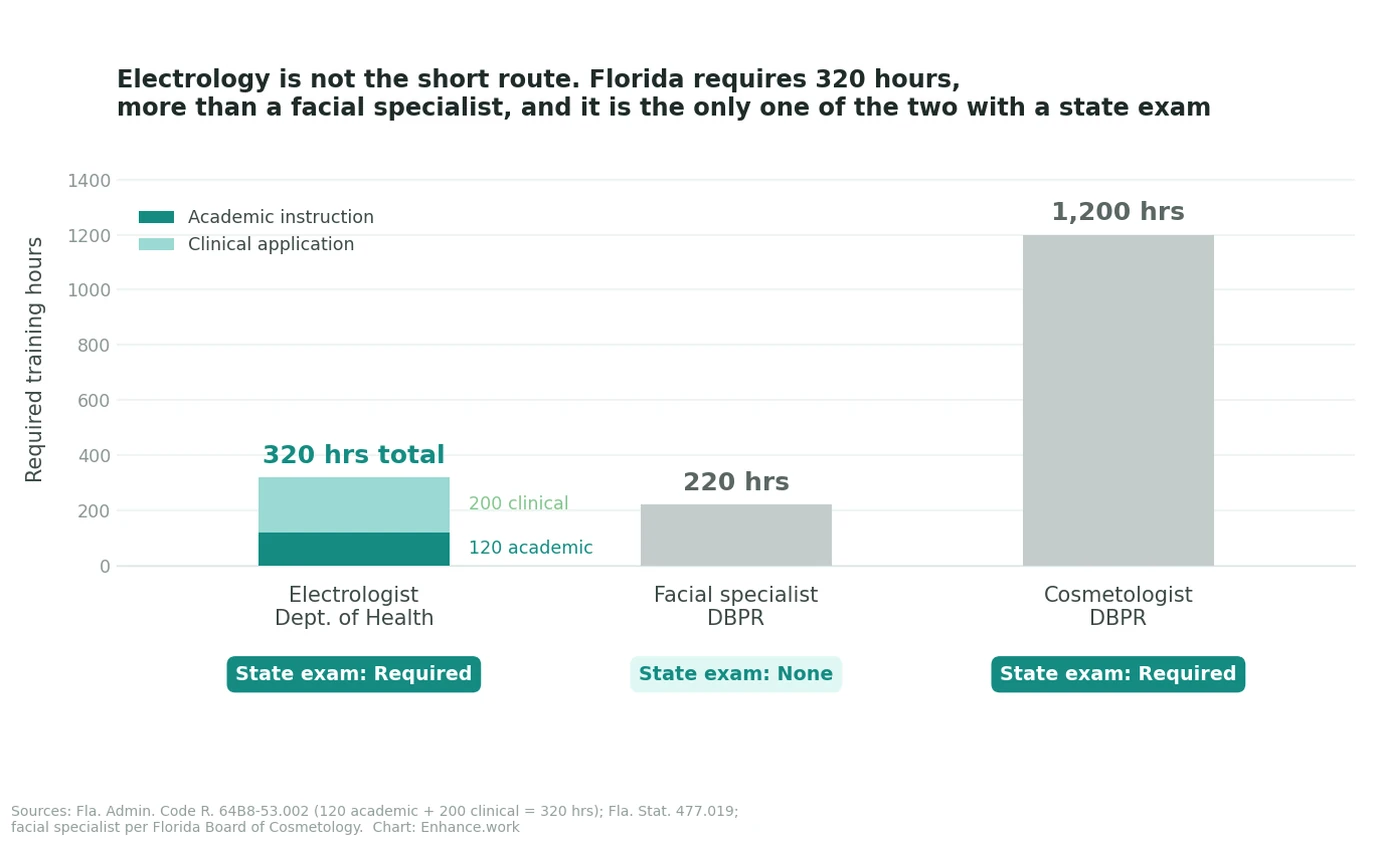
Two agencies, two philosophies. The cosmetology board regulates esthetics primarily through seat time, and for the facial specialist registration it does not attach an examination at all. The Department of Health uses both. It requires a longer programme weighted heavily toward supervised clinical work, 200 of the 320 hours, and then a written examination on top. Notice where the balance sits. Two thirds of an electrology programme is hands on.
That reframes the usual question. Candidates ask which credential is easier, and the widely repeated 120 hour figure makes electrology look like the quick option. On the real numbers it is not. Electrology is longer, more clinical, and it ends in a pass or fail moment that esthetics does not have at all. Esthetics is the faster route into paid work in Florida. Electrology buys a narrower scope that no other credential in the state can perform. One more thing to know before you choose. Florida does not actually issue anything called an esthetician license, and what it registers instead carries a scope that stops well short of permanent hair removal.
Can an esthetician do electrolysis in Florida?
No, and this is the single most common misunderstanding in the field. Section 478.49 is unambiguous. No person may practise electrology or hold herself or himself out as an electrologist in Florida unless the department has issued a license and that license is active. There is no esthetics pathway into it. No add on module converts a facial specialist registration into electrology authority, and no credit is given for hours already completed in a cosmetology or esthetics programme.
The second half of that section is the part people forget. A licensee has to display the license conspicuously in the place of practice and produce it to the department or the board on request. Holding yourself out as an electrologist without the credential is itself the violation, independent of whether you ever treat a client. Advertising the service is enough.
So electrology is a second credential, not an upgrade. That distinction costs people months. For a working facial specialist that is not necessarily bad news. It is a short programme, it is regulated by a different agency, and it adds a service that the esthetics scope cannot reach. What it is not is a continuation of the path you are already on.
What does it cost to become an electrologist?
Separate the two cost layers. They are wildly different in size, and only one of them is fixed by law.
What the state can charge. Section 478.55 sets statutory ceilings rather than prices. The board establishes the actual fees by rule. The statute adds that in no case may the department charge more than the actual cost of implementing the chapter. The caps are:
Add those ceilings together and the entire regulatory cost of entering the profession, examination included, tops out in the low hundreds. Check before you budget. Confirm the current published amounts with the Florida Department of Health electrologist licensing pages before you budget, because the statute sets the maximum and the board sets the actual figure, which can be lower.
What the profession actually costs. This is where the money is, and the state does not control any of it. Tuition and equipment dominate. Practitioners discussing their own start up costs in public forums report tuition in the several thousands, and an epilator in the low to mid four figures. That puts the equipment line on par with or above the training itself. Treat those as anecdotes rather than benchmarks. The sample is small and self selected. But the shape is consistent, and it is the opposite of what candidates expect. People budget for the license and get surprised by the machine.
If you intend to work for yourself rather than for a clinic, section 478.51 adds a cost most candidates miss entirely. No electrology facility may operate without its own facility license from the department. The license has to be displayed conspicuously. The board sets rules for personnel, safety and sanitation. The department may investigate the proposed facility, and an initial inspection applies. That is a second licensing track running in parallel with your personal one, with its own application and its own fee.
How much do electrologists earn, and is it worth it?
Here we will be straight with you rather than fill the gap with a number. We do not know. We do not hold reliable first party pay data specific to Florida electrologists. The aggregator figures that dominate these searches blend electrologists with laser technicians, waxers and general estheticians. That makes them close to meaningless for planning a career. Publishing an average we cannot stand behind would be worse than publishing nothing.
What can be said is structural. Three things drive electrology earnings, and all three are visible before you enrol. Whether you are paid hourly by a clinic or keep a share of your own book. How much demand for permanent removal exists in your metro. And how much of your work is referral based rather than promotion driven. The referral segments hold price better than commodity hair reduction. That includes gender affirming care and pre surgical clearance, where no laser alternative competes on discount.
For a grounded sense of what device side hair removal pays here, the closer comparison is what laser technicians actually earn across Florida metros, broken down by setting and experience rather than by national aggregate. Read it as an adjacent benchmark and not as a substitute, since the credentials and the scope are different.
Who regulates electrology in Florida, and why does it matter?
Electrology sits with the Department of Health. Section 478.44 creates the Electrolysis Council under the supervision of the board, and its composition tells you a lot about how the profession is governed. The council has five members. Three must be licensed electrologists actively delivering electrolysis services in Florida for at least four consecutive years before appointment. They must not be affiliated with an electrolysis school, or with any manufacturer or supplier of electrolysis equipment. The remaining two are consumer members who have never been licensed electrologists, hold no financial interest in the practice, and are likewise unaffiliated with schools or equipment suppliers.
Those exclusions are deliberate and they are worth noticing as a candidate. The statute keeps schools and equipment vendors off the body that sets standards for the profession. Compare that with where you get most of your information when you start researching, which is schools and equipment vendors. It is a useful reminder to read the statute and the Department of Health pages before you read a programme brochure. The same caution applies to pay claims. It helps to compare what medical estheticians are actually paid at Florida med spas against the national averages the aggregator sites publish.
Practically, the agency split has a mundane consequence that costs people weeks. Applications, license verification and renewals for electrology go through the Department of Health, while esthetics and cosmetology credentials go through Business and Professional Regulation. If you already hold a facial specialist registration and assume your electrology paperwork lives in the same portal, it does not.
How does electrology fit into a med spa career?
Two patterns show up repeatedly in South Florida hiring. They point in different directions.
The first is the stacked credential. A facial specialist or laser technician adds electrology so the clinic can treat hair that its laser platform cannot. That makes the provider harder to replace, because the clinic loses a service line if they leave, not just a pair of hands. In a market where clinics compete for licensed staff, being the only person on the schedule who can clear white and grey hair is a durable position.
The second is the independent room. Electrology travels well into solo practice. The equipment is a one time purchase rather than a lease, the treatments recur by clinical necessity, and the referral channels are professional rather than promotional. The trade off is section 478.51 and the facility license that comes with running your own space.
What electrology is not is a shortcut into injectables or into medical aesthetics generally. Those are separate scopes tied to nursing and medical licensure, and no amount of electrology experience opens them. If your real objective is clinical aesthetics rather than hair removal, map the whole field before you spend a dollar. Note that the full range of med spa career paths in South Florida carries very different credential requirements and pay ceilings depending on which lane you enter.
Sources
- Fla. Admin. Code Ann. R. 64B8-53.002 - Curriculum Standards for Electrolysis Training Programs (law.cornell.edu)
- Florida Statutes, section 478.42 (leg.state.fl.us)
- Florida Statutes, section 478.45 (leg.state.fl.us)
- Florida Statutes, section 478.49 (leg.state.fl.us)
- Florida Statutes, section 478.55 (leg.state.fl.us)
- Electrologist - Florida Department of Health (floridahealth.gov)
- Florida Statutes, section 478.51 (leg.state.fl.us)
- Florida Statutes, section 478.44 (leg.state.fl.us)
Frequently asked questions
How long does it take to get an electrolysis license in Florida?
A council approved programme is 320 hours: 120 of academic instruction and 200 of clinical application, under Rule 64B8-53.002. Calendar length then depends on whether your school runs full time or part time. The binding constraint is often the examination rather than the coursework, because section 478.45(5) only requires the department to run licensure examinations twice a year. Plan your finish date around the exam calendar, not around the last day of class.
Can I do electrolysis as an esthetician?
No. Section 478.49 requires an active electrologist license from the Department of Health to practise electrology or to hold yourself out as an electrologist. A Florida facial specialist registration does not include it and does not shorten the path to it.
What qualifications do you need to do electrolysis?
Section 478.45 sets seven. You must be at least 18, hold a high school diploma or equivalency, pass background screening, and be of good moral character. You must have no conduct that would be grounds for discipline. Then complete a board approved 320 hour programme, 120 academic and 200 clinical, and pass the written examination.
Is there an exam to become an electrologist in Florida?
Yes. A written examination is mandatory. It is developed by the department, or it can be an approved national examination. The board may also adopt a national examination in place of part of the state exam. This is the clearest difference from the facial specialist registration, which carries no state examination.
Do I need a separate license to open my own electrolysis studio?
Yes. Section 478.51 requires a facility license from the department for any electrology facility, displayed conspicuously on site. Board rules cover personnel, safety and sanitation, and an initial inspection applies. Your personal license does not cover the premises.
Is being an electrologist worth it?
It depends on whether you want a service with no substitute or a service with volume. Electrology is the only method Florida defines as permanent removal, and it treats hair that laser physically cannot, which protects pricing. The trade offs are real. A longer programme than esthetics, an examination, a narrower service menu, and equipment cost that usually exceeds the licensing cost by an order of magnitude.
Fewer hours is not the same as an easier credential
If you are researching how to become an electrologist, the 120 hour figure is the number that draws you in and the number that misleads you. It is the academic subtotal, not the programme. Florida asks for 320 hours and puts 200 of them, nearly two thirds, into supervised clinical work. Then it makes you pass a written examination that the esthetics route never asks you to sit. Read those requirements as one design and the credential makes sense. Read the 120 alone and you will choose a career on a number that is missing its larger half.
So do it in this order. Confirm the current fees and application steps with the Department of Health rather than with a school. Ask any programme to split its academic hours from its board approved practical hours in writing. Find the next two examination dates before you enrol and work backwards from them. Then decide whether you want the credential with no substitute, or the one with more volume. In Florida those are genuinely different careers, not two steps on one ladder.