No state issues a microneedling license. A microneedling certification is a certificate from a training provider, and whether you may use it depends on the license underneath it and on your state's rules about needle depth. In Florida the facial specialist registration does not cover microneedling at any depth; registered nurses, nurse practitioners, physician assistants and physicians perform it under medical protocols. A med spa hiring you will check the license first and the certificate second.
Key Takeaways
- The FDA classifies microneedling devices for aesthetic use as Class II medical devices under 21 CFR 878.4430, with controls on needle length, maximum penetration depth and puncture rate. The FDA regulates the device; each state decides who may hold it, and most draw the line where the needle passes the epidermis.
- Florida's Board of Cosmetology defines microneedling as 0.25 to 2.5 mm microchannels and puts it beyond the scope of any cosmetology license or facial specialist registration. Texas, Pennsylvania, Wisconsin, Tennessee and California draw the same line in their own words.
- Certification courses run from a 6-hour class to a full day with live models and cost about $450 to $800 where prices are published. Most admit only licensed professionals.
- Online-only certificates teach theory. Med spas hire on documented hands-on device hours, the specific pen you trained on, and a supervising physician relationship.
- For nurses, the certificate is continuing education; the legal authority comes from the physician's protocol and the good faith exam, not from the course.
What is a microneedling certification, and what is it not?
It is proof that you completed a course. The provider sets the curriculum, the hours and the pass mark, prints the certificate and, in most cases, sells you the device. Nobody at a state board reviews it, and no state adds "microneedling" to a license because you hold one. That is not a criticism of the courses. Several of them are good. It is a statement about what the paper does.
What the certificate does not do is expand your scope of practice. Scope comes from the license: esthetician, cosmetologist, registered nurse, nurse practitioner, physician assistant, physician. Each state decides which of those licenses may puncture skin for cosmetic purposes and under what supervision. The certificate sits on top of that decision. If the license underneath cannot legally microneedle in your state, the certificate is a receipt.
The confusion is understandable, because course marketing uses the words "certified microneedling technician" as if that were a credential. Read it as "attended a class". Then ask the two questions that actually matter: can my license do this where I work, and will an employer count this training?
Who can legally perform microneedling?
Start with the device, because the states did. Under 21 CFR 878.4430 the FDA defines a microneedling device for aesthetic use as one that uses needles to mechanically puncture and injure skin tissue, and classifies it as a Class II medical device with special controls. Those controls require the manufacturer to specify needle length, geometry, maximum penetration depth and puncture rate, and to test that the device actually penetrates to the depth it claims. The rule excludes devices intended only to deliver topical products. In plain terms, once a needle is meant to injure living skin, it is a medical device, and the FDA lists these pens under product code QAI, "Powered Microneedle Device", with 26 devices authorized since SkinPen's De Novo decision in March 2018.
State boards took the same logic and applied it to people. A cosmetology or esthetics license is written around the outer layer of the skin. A device designed to injure tissue below it is, by definition, outside that license unless the state says otherwise. A few states say otherwise with a depth limit. North Carolina lets a licensed esthetician use an FDA-cleared device no deeper than 1 mm, which is a regulatory line rather than an anatomical one: measured facial epidermis is roughly 0.05 to 0.1 mm thick, so a 1 mm needle is well into the dermis. Most states do not draw that line at all. The table shows seven states where we read the rule or the board statement itself; every row links to the source, and every other state's answer lives on its own board website, not on a course provider's page.
| State | Can an esthetician perform microneedling? | What the source says | Source |
|---|---|---|---|
| Florida | Not permitted for cosmetologists or facial specialists | Rule 61G5-18.00015(2)(h) defines microneedling (0.25 to 2.5 mm microchannels) and places it beyond the scope of the license; (1)(b) lists skin perforation as bodily intrusion | Florida Board of Cosmetology rule |
| Texas | Regulated as medicine, not cosmetology | TDLR's "who regulates what" list sends microneedling questions to the Texas Medical Board | TDLR |
| Pennsylvania | Outside the scope of cosmetology | A 2022 Board consent agreement records that Botox, fillers and microneedling are outside cosmetology and may not be performed in a salon (49 Pa. Code 7.77) | PA State Board of Cosmetology |
| Wisconsin | Delegated medical procedure | Cos 2.025(2)(d) lists microneedling as a medical procedure a licensee may perform only as directed, supervised and inspected by a physician | Wisconsin Cos 2.025 |
| Tennessee | Cosmetic medical device; not aesthetics | The Department of Commerce and Insurance classifies microneedling devices as "cosmetic medical devices" under Tenn. Code Ann. 63-1-153(a)(1), so the procedure belongs in medical spas under medical authority, not in an aesthetics curriculum | TN Dept. of Commerce and Insurance |
| North Carolina | Permitted with a depth limit | Since July 25, 2022 the Board allows licensed estheticians to use FDA-cleared devices for dermaplaning and microneedling, with the microneedling device "not deeper than 1 mm", when the intent of the service is within the esthetics scope (the ruling itself says "FDA-approved") | NC Board declaratory ruling (PDF) |
| California | Outside the statutory definition of skin care | Business and Professions Code 7316(c) limits the practice of skin care to services "that do not result in the ablation or destruction of the live tissue", and the FDA defines a microneedling device as one that injures skin tissue | California BPC 7316 |
The medical literature explains why regulators are cautious. A 2024 review in Cureus of microneedling applications, techniques and outcomes catalogues the adverse events that follow poor technique or poor sterility, from prolonged erythema to infection and post-inflammatory hyperpigmentation, and a 2019 review of the dermatotoxicology of microneedles in humans sets out how needle depth and application frequency change the skin's response. A 2022 case report documents a delayed granulomatous reaction on the face after microneedling with a topical product driven into the dermis. None of that makes the procedure dangerous in trained hands. It explains why the training and the supervision are the regulator's concern rather than the certificate.
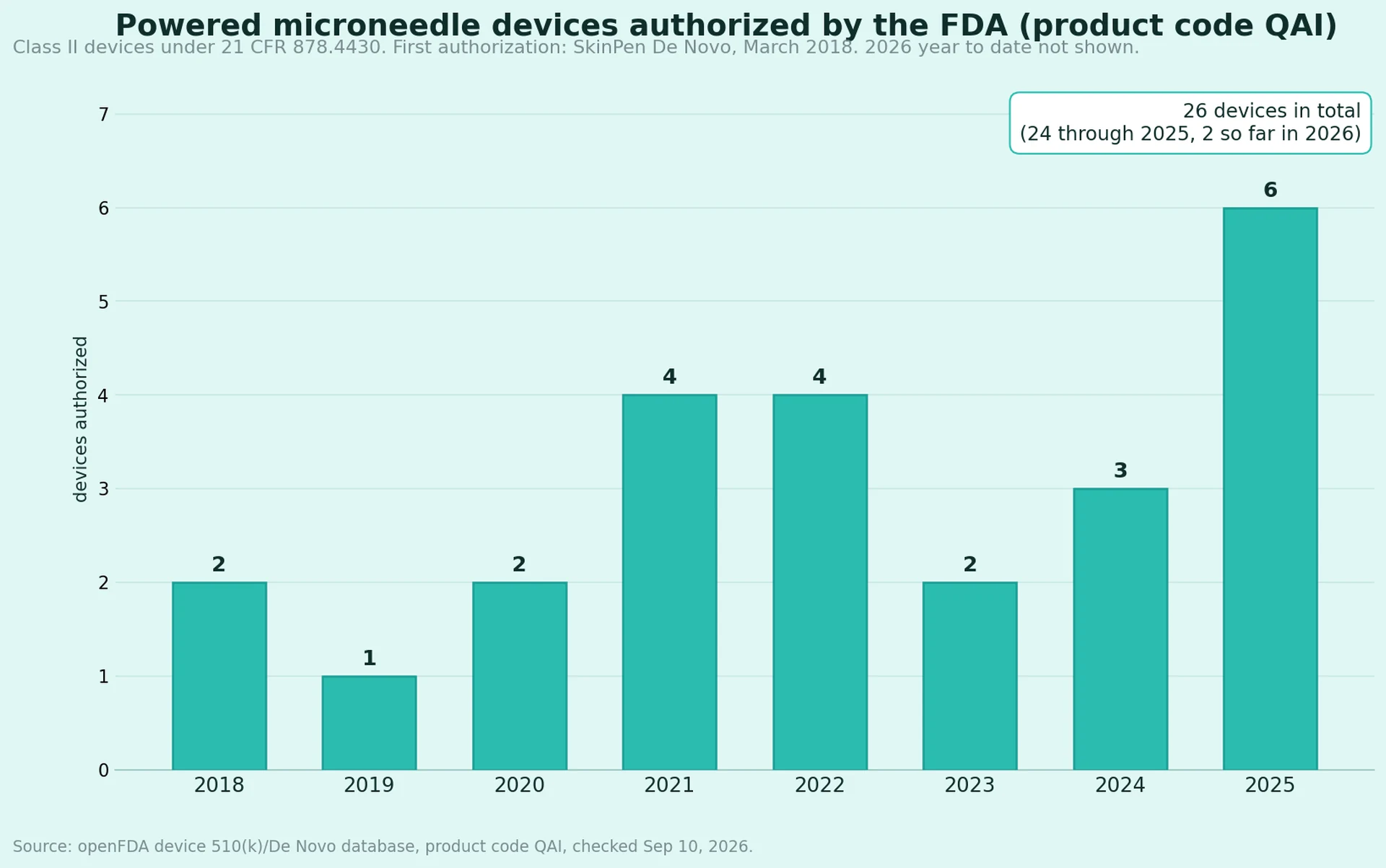
Powered microneedle devices cleared by the FDA under product code QAI, by decision year. Twenty-six devices have been authorized since SkinPen's De Novo decision in March 2018, six of them in 2025; every one is a Class II medical device. Source: openFDA device database, checked September 10, 2026.
Can estheticians do microneedling in Florida?
No, not on the facial specialist registration, and the Board wrote the answer into its own definitions. Rule 61G5-18.00015 of the Florida Administrative Code defines microneedling as a procedure using a multi-needled device to create microchannels 0.25 to 2.5 mm deep and states that this piercing of the skin is beyond the scope of a Florida licensed cosmetologist or registered full or facial specialist. The same rule lists skin perforation by any means, laser and IPL, HIFU, radiofrequency, plasma pen and FDA-approved medical devices as bodily intrusion outside the license. Microblading is out for the same reason.
Florida treats the procedure as medicine. Registered nurses and advanced practice providers perform it in med spas under a physician's protocols, which is why the same clinic that cannot let its esthetician touch the pen will hand it to an RN. A facial specialist who is hired as a medical assistant under Statute 458.3485 does not escape the cosmetology rule by changing job titles: the Board of Cosmetology prohibition follows the license, and the physician's delegation authority does not override it. In practice Florida med spas assign microneedling to licensed clinical staff, meaning an RN, APRN, PA or physician, and keep estheticians on pre and post care. Our guide to the medical aesthetician title in Florida explains what a facial specialist can legally do in a medical practice and where the physician's delegation begins and ends. If you are a Florida esthetician weighing a microneedling course, read that first. The course may be worth taking for a move to another state or for a future nursing license. It will not change what you may do in a Florida treatment room this year.
What does a microneedling course cover, and what does it cost?
The market is small, fragmented and mostly regional, because hands-on training has to happen somewhere. Here is what five providers publish about their programs. Prices and hours were read on each page on September 10, 2026; two of the five do not publish a price at all, which is itself useful information.
| Provider | Format | Length | Published price | Who they admit |
|---|---|---|---|---|
| Texas Laser Academy (Austin) | Online theory plus one in-person day in a working med spa, live models | 8 hours | From $800 | Esthetician or cosmetology license "strongly recommended" |
| Catherine Hinds Company (Massachusetts) | Online pre-study, lecture, demonstration, supervised hands-on with live models | One day | $450 | Licensed professionals only |
| Rise Aesthetic Institute | Theory plus hands-on practical | 6 hours | On request | Current nursing, esthetician or cosmetology license required |
| National Laser Institute | Classroom plus hands-on clinicals in a retail med spa, sold as an add-on day to a laser or injectables course | One day | On request | Bundled with medical aesthetics programs |
| MDPen | Manufacturer's virtual program, theory and device technique on its own pen | Self-paced online | On request | Device-specific; not a state credential |
A serious course covers skin anatomy to the dermis, device settings and needle depth by indication, contraindications, sterile technique and single-use cartridges, consent and aftercare, and supervised practice on live skin. Six to eight hours is enough to learn the protocol. It is not enough to be good at it, which is why the next two questions matter more than the certificate.
Is an online microneedling certification worth anything?
For theory, yes. For a job, rarely on its own. An online course can teach anatomy, indications and settings well, and a manufacturer's program will teach its own device thoroughly. What it cannot do is put a pen in your hand over living skin while someone who has done thousands of treatments watches your pressure and your pass pattern. Med spas know this, and hiring managers in South Florida say it plainly: they want to see hands-on hours on a named device, not a PDF. Our comparison of medical esthetician programs in Florida found the same pattern for every advanced modality: live-model clinical hours are what separates a program that leads to a med spa job from one that does not.
If you take an online course, treat it as the pre-study for a hands-on day, which is how the better providers structure it anyway. Keep the certificate, keep the syllabus, and log every supervised treatment you perform afterward with the date, the device and the supervising provider. That log is what an employer will read.
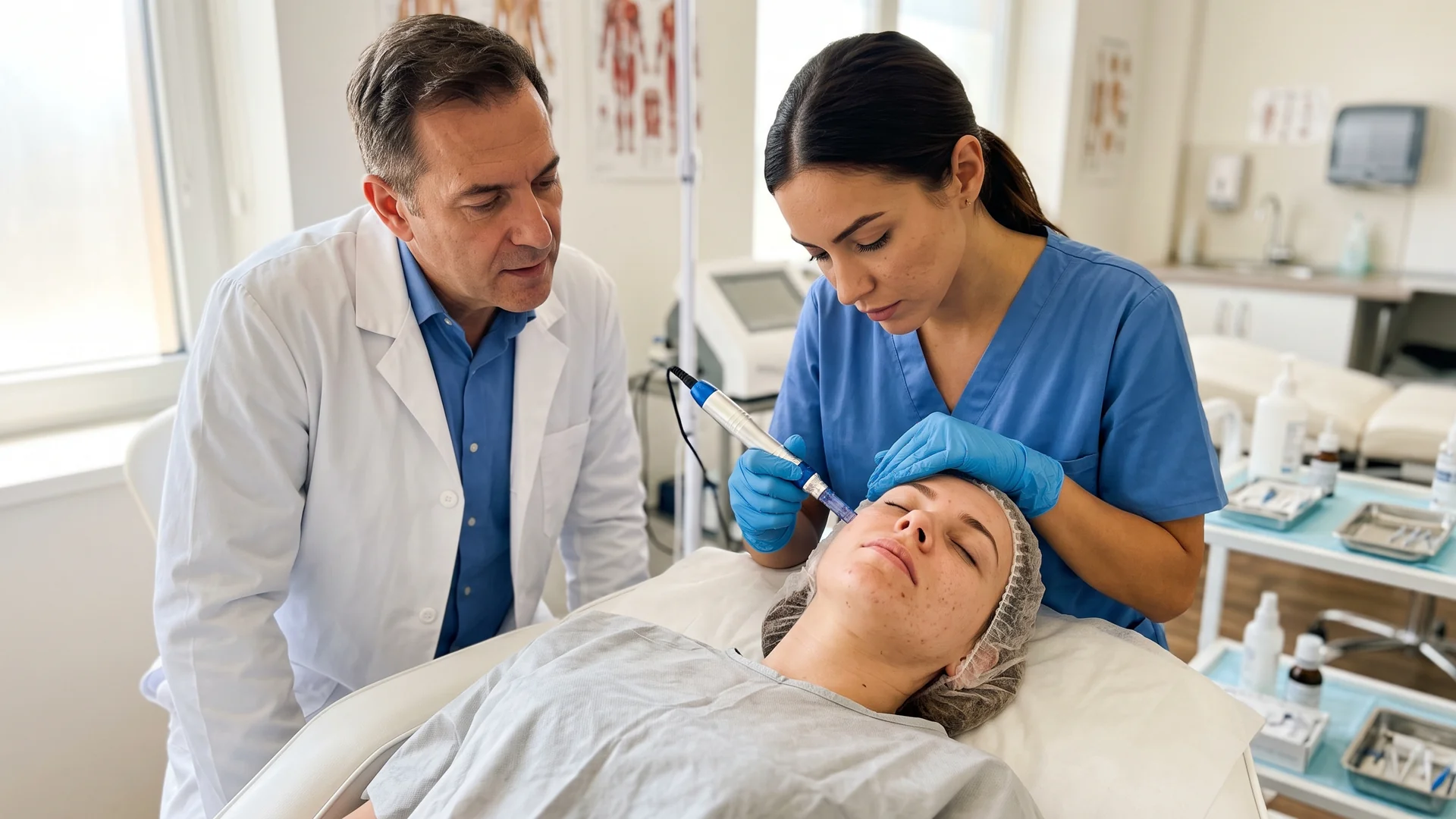
Is RF microneedling different?
Yes, and in one direction only: it is always medical. Radiofrequency microneedling devices such as Morpheus8 and Potenza deliver radiofrequency energy into the dermis through the needles themselves, which adds a second regulated element to a procedure that was already regulated. The needle designs differ: Morpheus8 uses coated needles that expose only the active distal tip, while Potenza offers both semi-insulated and non-insulated cartridges depending on whether the goal is to protect the epidermis or to coagulate the full needle track. Florida's bodily intrusion rule names radiofrequency and FDA-approved medical devices separately, so an RF pen fails the esthetics scope test twice. In practice RF microneedling in a med spa is performed by an RN, NP, PA or physician under protocols, and the training is device-specific and delivered by the manufacturer to the clinic's licensed staff. The supervision model Florida applies to laser hair removal, with direct physician oversight and a limit on how many technicians one physician may supervise, is a useful reference for how energy devices are treated, even though the laser rule sits in a different chapter.
What do med spa hiring managers actually check?
Three things, in this order. First, the license, verified on the state board website, because the license decides whether the clinic can legally schedule you on the device at all. Second, documented hands-on hours on the specific pen or platform the clinic runs, because every device has its own depth settings, cartridge system and pass technique. Third, who supervised you, because a candidate who can describe the supervising physician relationship at their last job is telling the clinic they will not create a compliance problem.
The certificate appears fourth, as a supporting document. Our guide to aesthetician jobs near you explains why postings that list microneedling under an esthetician title in Florida are describing work that needs a different legal basis than the registration, and a candidate who points that out in an interview tends to be remembered well. On the clinic side, Florida's med spa staff training requirements set out what the practice itself must document for every device it runs, which is the file your training log ends up in.
If you have seen "master esthetician" in a job post as the credential that unlocks microneedling, our explainer on the master esthetician title shows which states issue that second tier, what it allows there, and why Florida does not have one.
For nurses: the certificate is education, the protocol is the authority
A registered nurse in Florida may perform microneedling in a med spa. The authority does not come from the certificate; it comes from a physician's written protocol, a good faith exam before treatment, and the nurse's own scope under the Nurse Practice Act. The course is continuing education that makes the delegation defensible. What an aesthetic RN can and cannot do in Florida, including device-based treatments under protocol, is covered in our scope guide for registered nurses, and the good faith exam rules, who may perform the exam and what has to be in the chart before a treatment like microneedling begins, are in our good faith exam guide. Take the course, log the treatments, and make sure the protocol names microneedling specifically. A protocol that says "skin treatments" is not the same document.

Frequently asked questions
How do you become certified in microneedling?
Complete a course from a training provider or device manufacturer, usually 6 to 8 hours of theory plus a hands-on day with live models, and receive the provider's certificate. No state board issues or reviews it. Most courses admit only licensed estheticians, cosmetologists, nurses or physicians.
What qualifications do you need for microneedling?
A license that your state allows to puncture skin for cosmetic purposes, then device-specific training. In Florida that means a registered nurse, nurse practitioner, physician assistant or physician working under a physician's protocol. A facial specialist registration does not qualify in Florida, and working as a medical assistant does not change that.
How long does it take to get certified in microneedling?
One to two days for the course itself. Published programs run 6 to 8 hours of instruction, often with online pre-study. Becoming competent takes supervised repetition afterward, which is what employers actually count.
Who cannot do microneedling?
Anyone whose license does not cover skin puncture in their state, and anyone without a license at all. In Florida, Texas, Pennsylvania, Wisconsin, Tennessee and California that includes estheticians and cosmetologists working on their own license. RF microneedling is medical everywhere.
Can a basic esthetician do microneedling?
In most states, no. A few allow it with a depth limit, such as North Carolina at 1 mm with an FDA-approved device, or under physician supervision, and the exact rule lives on the state board website. Florida does not allow it on the facial specialist registration at any depth.
How much does microneedling certification cost?
Published prices run from $450 (Catherine Hinds Company, one day with live models) to $800 and up (Texas Laser Academy, 8 hours). Several providers publish no price and quote by phone. Device manufacturers may bundle training with a pen purchase.
Is there a free or fully online microneedling certification worth taking?
Free and online courses can teach theory and a manufacturer's device. They do not replace supervised hands-on hours, and they do not change your license. Use them as pre-study, not as a credential.
Does microneedling certification raise pay?
Only where the license allows you to perform the treatment. For nurses in Florida med spas, documented device hours add to what a clinic will pay and schedule. For a Florida esthetician the certificate does not change pay because it cannot change the treatment menu; our guide to esthetician continuing education explains what does.
Get the license question right, then get certified
A microneedling certification is worth having when the license underneath it can legally use it. Check your state's rule on the board website, not on a course page. In Florida that check ends the question for estheticians and starts it for nurses, whose authority comes from a physician's protocol and a good faith exam. Then choose a course with live-model hours, log every supervised treatment you perform, and bring the log, not just the certificate, to your next interview. If you are a licensed esthetician deciding where your training budget goes, our guide to esthetician continuing education separates the hours that renew your registration from the training that changes your job. When you are ready to put that training to work, 🎯 browse the South Florida med spa directory on Enhance.work to see which clinics are hiring providers for device-based treatments right now.