

Key Takeaways
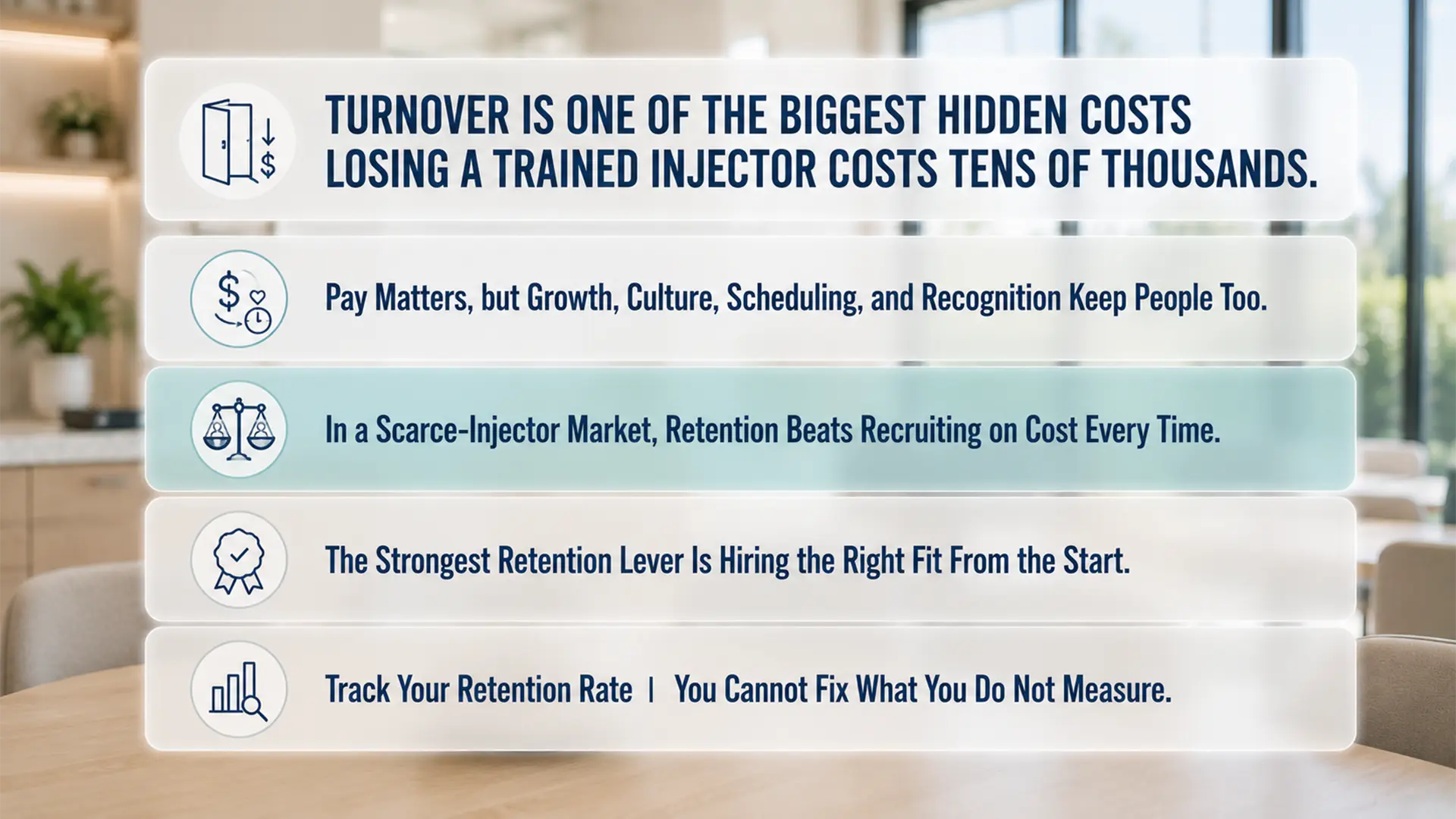
- How to reduce med spa turnover starts by pricing it: losing a trained injector costs tens of thousands in lost revenue and rehiring, and it is the biggest hidden cost most clinics carry.
- Pay matters, but growth, culture, scheduling, and recognition keep people as much as money does.
- In a scarce-injector market like South Florida, retention beats recruiting on cost every single time.
- The strongest retention lever is hiring the right fit in the first place.
- Track your retention rate; you cannot fix what you do not measure.
Low turnover is a competitive advantage: a stable, happy team is cheaper and better than constant rehiring.
How to reduce med spa turnover in Florida starts with pricing it. One departure costs a clinic between $6,600 and $22,200 depending on the role, once the unfilled schedule, the recruiting and the ramp are counted.
That number is larger than almost any retention lever you could fund, which is why retention is a budget decision before it is a culture one.
Every time an injector walks out, a South Florida med spa loses revenue, patients, and months of training, then pays all over again to replace them. In a market where experienced injectors are scarce, turnover is the quiet killer of margins. This is an owner's playbook for keeping your best people: the real reasons staff leave, the levers that keep them, and how to measure it. It is general guidance, not legal or HR advice.
Why is med spa turnover so expensive?
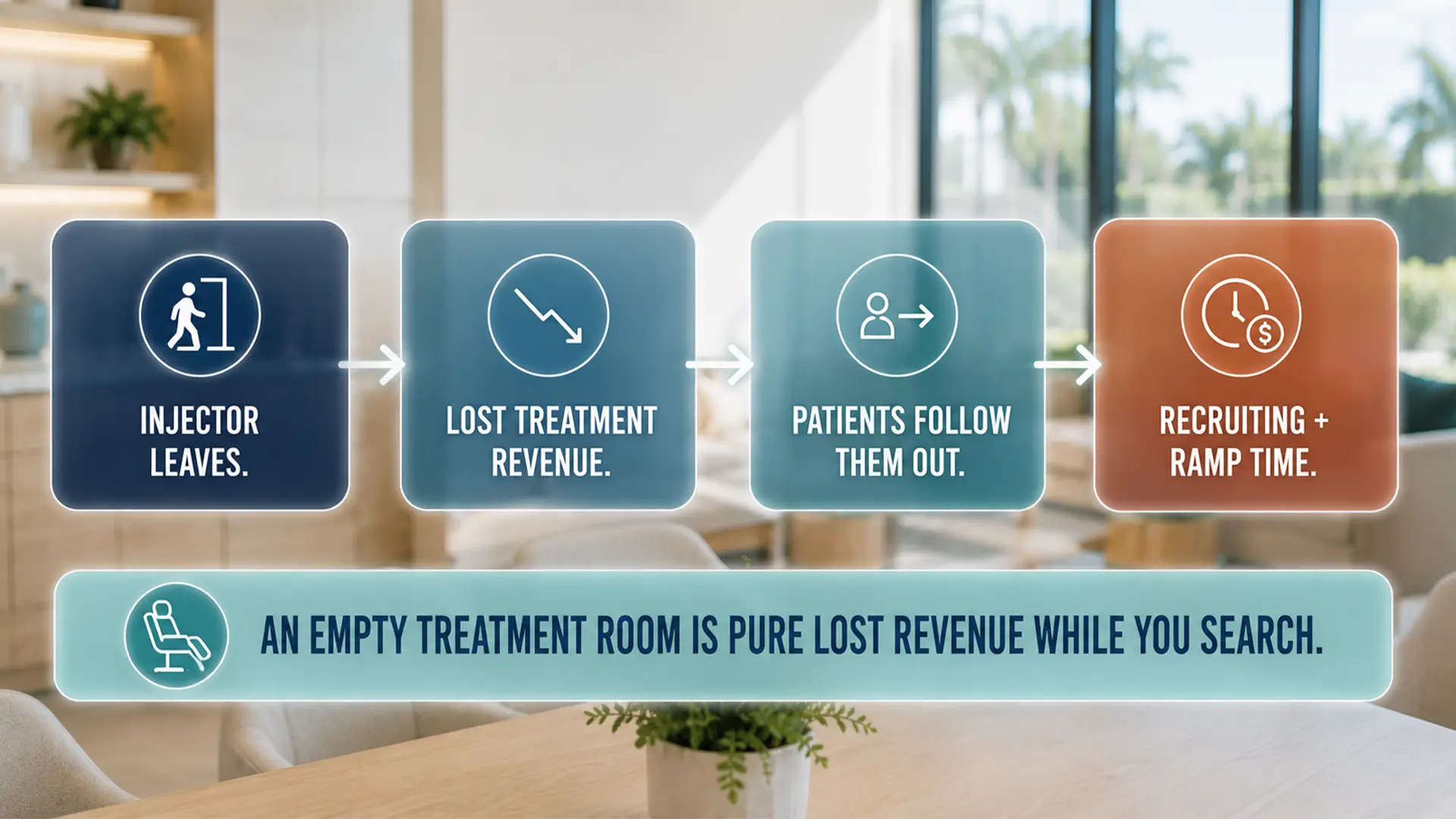
Losing a trained med spa injector can cost tens of thousands of dollars once you count lost treatment revenue, patients who follow the provider out the door, recruiting, and the ramp time of a replacement. Support roles cost less to replace, but the pattern is the same: turnover drains money and momentum. In South Florida, where experienced injectors are hard to find, an empty treatment room is pure lost revenue while you search.
The six levers that keep med spa staff: pay, growth, culture, scheduling, recognition, and the right hire.
What keeps med spa staff from leaving?
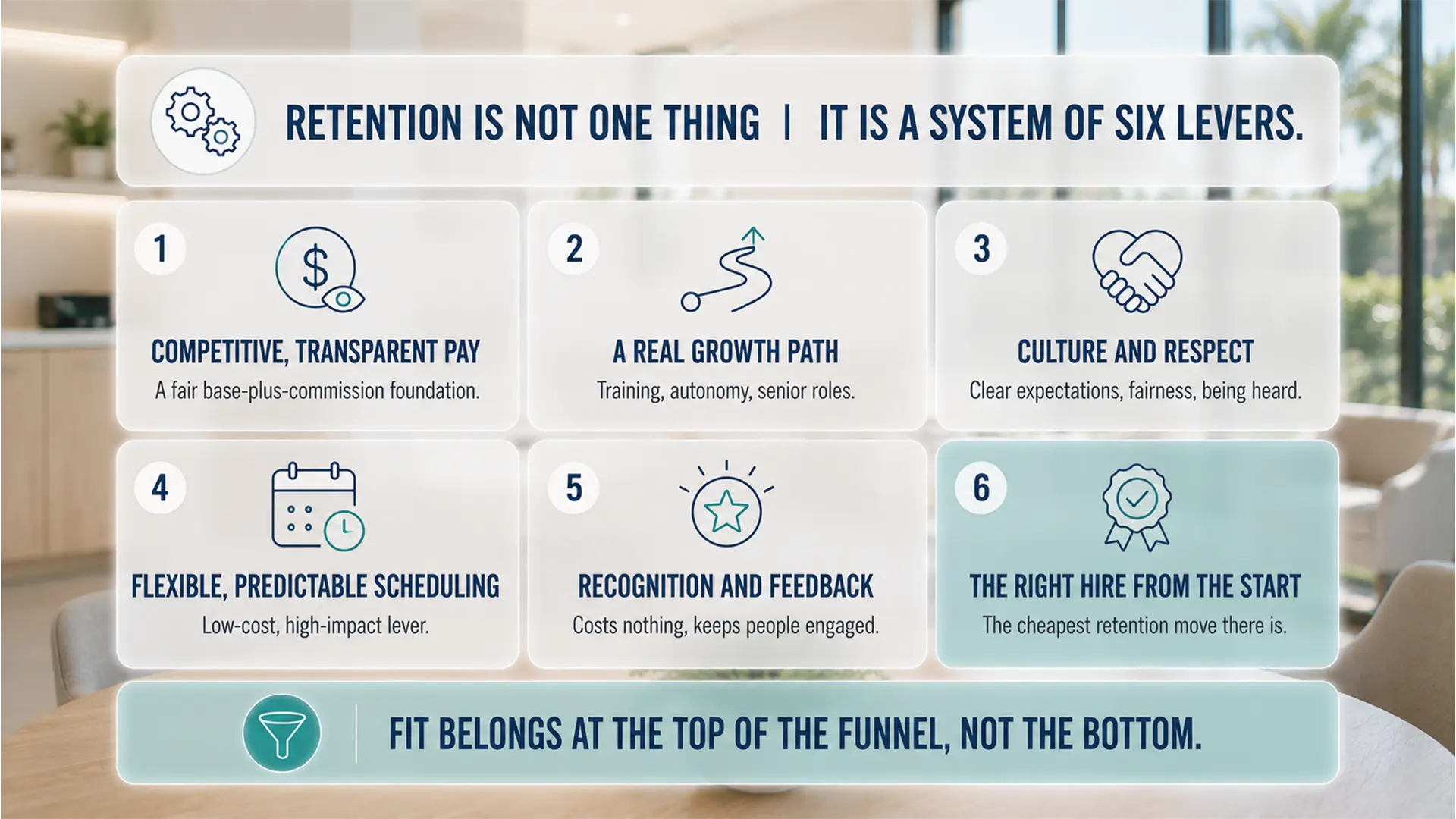
Retention is not one thing; it is a system, and the Society for Human Resource Management, which publishes research-backed best practices on keeping and engaging employees points to the same fundamentals. These six levers do most of the work:
1. Competitive, transparent pay
Money is not everything, but underpaying guarantees you lose people. A fair, clear base-plus-commission plan is the foundation. See our owner's guide on how to pay a med spa injector, since a fair base-plus-commission plan is the single biggest retention lever.
2. A real growth path
Top injectors leave when they stop growing. Offer advanced training, more autonomy, and a path to senior or lead roles so staying beats leaving.
3. Culture and respect
How people are treated day to day decides whether they stay. Clear expectations, fairness, and being heard matter, and a good handbook removes ambiguity. See our guide to the med spa employee handbook, which removes the ambiguity over expectations that quietly drives people out.
4. Flexible, predictable scheduling
Erratic schedules burn people out. Predictable hours and reasonable flexibility are a low-cost, high-impact retention lever in a demanding clinical setting.
5. Recognition and feedback
Regular, specific recognition and honest feedback cost nothing and keep good people engaged. Silence reads as being taken for granted.
6. The right hire from the start
You cannot retain a bad fit. Hiring for genuine fit is the cheapest retention move there is, which is why it belongs at the top of the funnel, not the bottom.
Recognition, growth, and respect keep injectors as much as pay does, and cost far less than replacing them.
Is it cheaper to retain or recruit med spa staff?
In South Florida, experienced injectors are the scarcest, most expensive hire, so the math is blunt: keeping the injector you already trained is far cheaper than competing to replace them. Our benchmarks make the case; see our South Florida Med Spa Hiring and Salary Report, which shows why keeping a trained injector is far cheaper than re-hiring in this scarce market. Retention is not a soft goal; it is a margin strategy. For building the team behind it, see our guide to med spa staffing in Florida, which covers building a team you can actually keep.
It starts with the right hire
The cheapest way to reduce turnover is to stop hiring people who were never going to stay. Fit, not just skill, is the strongest predictor of retention, so screen for it deliberately. Use our guide to the med spa interview questions that surface real fit, the strongest predictor of who will stay, and run the full process with our guide on how to hire a nurse injector in Florida, because retention truly starts with getting the right person in the first place.
Measure it: your retention rate
You cannot improve what you do not track. Calculate your retention rate as the share of employees who stay over a period (for example, staff retained over 12 months divided by staff at the start of the year). There is no universal benchmark for med spas, but rising turnover is an early warning, and a stable or improving rate signals a healthy clinic. Track it by role, since losing injectors hurts far more than losing a front-desk hire. For industry guidance, the American Med Spa Association publishes practical guidance on preventing employee turnover at medical spas.
Sources: Florida Board of Medicine.
What does one departure actually cost?
Build the number from wages you can verify rather than from a rule of thumb. Federal wage data gives the base: the Bureau of Labor Statistics puts the national median for skincare specialists at $45,330, registered nurses at $97,550 and nurse practitioners at $132,300 in the May 2025 survey. On top of the wage sit three costs that only appear when someone leaves: the schedule you cannot fill, the time and fees to recruit, and the weeks the replacement takes to reach full production.
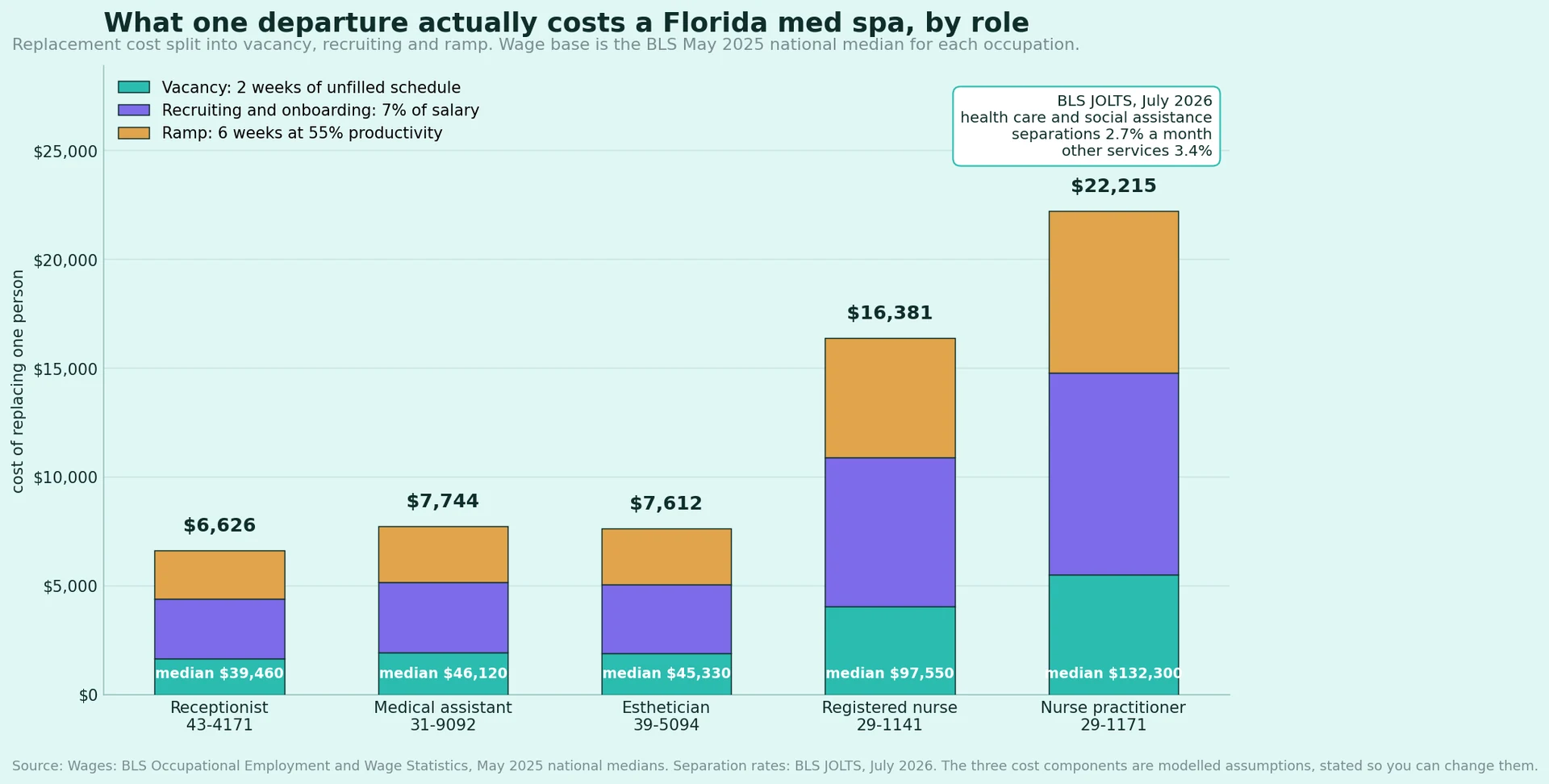
Replacement cost per departure by role. Wage base is the BLS May 2025 national median; the three components are stated assumptions you can change for your own clinic. Separation rates are BLS JOLTS, July 2026.
The gradient is the point. Losing a receptionist costs about $6,600 and losing a nurse practitioner about $22,200, so retention effort should not be spread evenly across the team. And the base rate is not low: the BLS Job Openings and Labor Turnover Survey put total separations in health care and social assistance at 2.7 percent a month in July 2026, and at 3.4 percent in other services, which is the bucket most spa employment sits in. At 3 percent a month a ten person clinic loses between three and four people a year without doing anything wrong.
Which retention levers are worth funding?
Compare each lever against the replacement cost it avoids rather than against the payroll line. A lever that costs less than one departure a year pays for itself the first time it works.
Note which column is empty most often. Three of the six levers cost nothing but management attention, and they are the ones clinics skip. Our breakdown of med spa commission structures shows which models quietly shift risk onto the provider and become a reason to leave, and our onboarding checklist covers the first ninety days, where the most expensive departures happen.
How do you measure retention properly?
Two numbers, tracked monthly, and neither is the one most owners quote. Annual turnover as a single percentage hides the pattern. Separate voluntary from involuntary departures, because they have different causes and different fixes, and track first year retention on its own, because a departure inside twelve months means the clinic never recovered the replacement cost from the previous one. Compare your voluntary rate against the JOLTS figure for health care rather than against a national all industry average, which runs much higher and will make a real problem look normal.
When do people actually leave, and what do you do in each window?
Departures cluster in three windows and each one has a different cause, so a single retention policy misses two of them. The first window is weeks one to twelve, where the departure is usually a mismatch between the job that was advertised and the job that exists. The second is months six to twelve, when the provider has the skills but not the book, and income volatility becomes intolerable. The third is year two onward, when the provider is fully productive and the only thing left to offer is a title or a new service.
The first window deserves the most attention because it is where the money is lost twice: the replacement cost of the person who left has not been recovered, and you are about to spend it again. The BLS Job Openings and Labor Turnover Survey publishes the monthly separations series to benchmark against, and our guide to med spa interview questions in Florida covers the questions that surface a mismatch before the offer rather than after the first month.
Sources
- Society for Human Resource Management, which publishes research-backed best practices on… (shrm.org)
- American Med Spa Association (americanmedspa.org)
- Licensing - Florida Board of Medicine (flboardofmedicine.gov)
- BLS Occupational Employment and Wage Statistics: Skincare Specialists (39-5094) (bls.gov)
- BLS Occupational Employment and Wage Statistics: Registered Nurses (29-1141) (bls.gov)
- BLS Occupational Employment and Wage Statistics: Nurse Practitioners (29-1171) (bls.gov)
- BLS Job Openings and Labor Turnover Survey (JOLTS) (bls.gov)
Frequently asked questions
What is the retention rate for a med spa?
There is no single benchmark; it varies by clinic, market, and role. What matters is tracking your own rate over time, because a falling rate is an early warning and a stable one signals a healthy team.
What is an acceptable employee retention rate?
It depends on the role and industry, and med spas have no universal standard. Rather than chase a number, watch your own trend and pay special attention to retaining scarce, high-value injectors.
Why do med spa employees leave?
Usually a mix: underpay relative to the market, no growth path, poor culture or scheduling, feeling unrecognized, or being a bad fit that was hired anyway. Rarely is it only about money.
How do you keep a good injector from leaving?
Pay fairly with base plus commission, give a real growth path and autonomy, recognize their work, offer predictable scheduling, and treat them well day to day. Scarcity means they have options.
Is retention cheaper than recruiting?
Almost always, especially for injectors. Replacing a trained injector costs lost revenue, lost patients, recruiting, and ramp time, which far exceeds the cost of keeping a good one.
How do you calculate med spa turnover rate?
Divide the number of employees who left during a period by the average number of employees in that period, then multiply by 100. Track it by role for a clearer picture.
How much does med spa turnover cost?
Between about $6,600 for a receptionist and $22,200 for a nurse practitioner per departure, using BLS May 2025 median wages plus two weeks of unfilled schedule, recruiting at 7 percent of salary and a six week ramp at reduced productivity. Change the assumptions and the ranking stays the same.
What is a normal turnover rate for a med spa?
Use the BLS JOLTS series rather than a rule of thumb. Health care and social assistance ran total separations of 2.7 percent a month in July 2026 and other services 3.4 percent. A ten person clinic losing three to four people a year is at the industry base rate.
Why do aesthetic injectors leave?
The reasons that show up repeatedly are income volatility from a commission model, no path to new services, and unpredictable scheduling. All three are cheaper to fix than to replace, which is the argument this page is built on.
Keep the team you worked to build
In South Florida's scarce-talent market, the clinics that win are not the ones that recruit hardest; they are the ones that keep their best people. Pay fairly, offer growth, build a real culture, hire for fit, and measure your retention. Every injector you keep is one you do not have to fight to replace.