
September 23, 2026 · 11 min read
This article is for general educational and career information only. It is not legal or medical advice. Scope-of-practice rules change and differ by state: confirm with your state board before you act.
Key Takeaways
- Hydrafacial certification is brand training from the device maker or a course certificate from a school; no state issues a Hydrafacial license.
- Your esthetics, nursing or medical license is what authorizes you to perform the treatment, not the certificate.
- The manufacturer trains through a two-day hands-on workshop, protocol videos and live sessions, plus a separate self-paced program called CONNECT.
- School certificates we verified cost $375 to $1,200 for 3 to 8 hours of training.
- The HydraFacial handpiece is an FDA-registered Class I device, exempt from 510(k) review: registered, not "FDA-approved".
A Hydrafacial certification is brand training, not a license. No state issues a Hydrafacial credential; your esthetics, nursing or medical license is what lets you perform the treatment. The maker trains the staff of clinics that use its device, while schools sell short certificates for $375 to $1,200. The HydraFacial handpiece is an FDA-registered Class I device, exempt from 510(k) review.
So should you pay for one before you apply to med spas? Sometimes, but usually not first. This guide separates the three things people call "Hydrafacial certification", shows what the courses cost, explains who may perform the treatment in four states (including a real gray area in Florida's rules), and covers what clinics check when they hire.
What is a Hydrafacial certification, exactly?
Three different things go by the same name.
- Manufacturer training for device accounts. Hydrafacial's professional resources page offers a "two-day, hands-on workshop to master your treatment pitch, protocol and personalization", plus protocol videos and live education sessions. Access runs through a login connected to a Hydrafacial representative, so it is aimed at clinics that already work with the brand and their staff.
- Hydrafacial CONNECT. A separate, three-level, self-paced certification program that the company launched in July 2020 and later expanded nationwide, according to trade press coverage in Practical Dermatology and American Spa. It combines online modules with coaching and in-person opportunities.
- School certificate courses. Short classes run by beauty and medical aesthetics schools. Some use the branded device; others teach "Hydrafacial-style" hydradermabrasion on generic machines. These are the courses with a published price.
A note on names. Hydrafacial itself describes "hydradermabrasion" as its own patented method and "hydrodermabrasion" as a general category of non-invasive facial treatment. When a course says "hydrafacial", ask which machine you will actually train on.
Do you need a certification to do Hydrafacials?
Legally, no state requires a Hydrafacial certificate. What you need is the license your state requires for the treatment and training on the device your clinic uses.
Estheticians discussing this on Reddit say the same thing in practice. One wrote that "Hydrafacial training is brand training and certification. It's not a legal requirement to have their training to perform the service." Another described the common path: the spa that owns the machine gives its staff training through the brand's representatives. Several also reported that Hydrafacial provides training when a clinic buys a device; the manufacturer's page we reviewed does not state that, so treat it as a common report, not a policy.
What employers care about is whether you can deliver the protocol safely and consistently on their machine.
Who can perform a Hydrafacial?
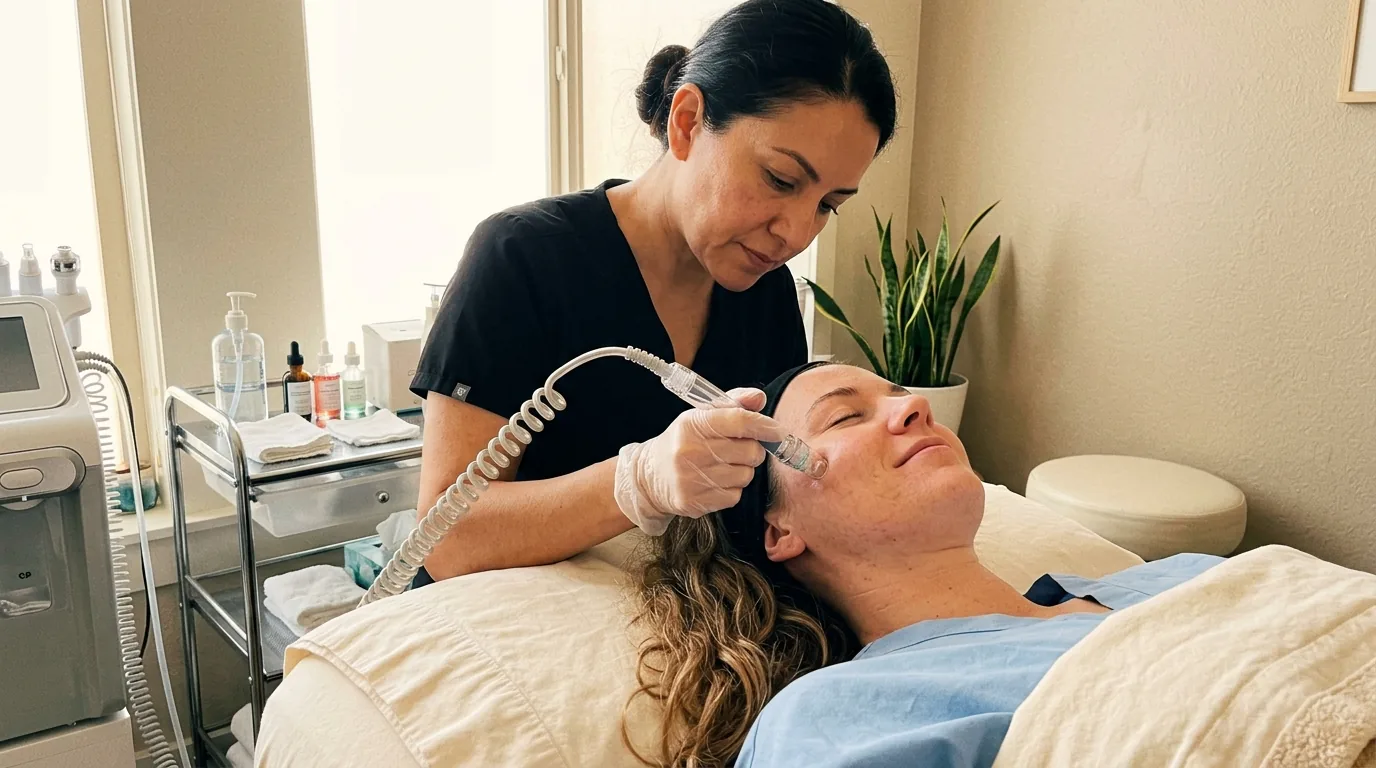
A licensed skin care professional acting within their state's scope, or a nurse or medical provider. The details vary by state, and Florida's rule leaves a question open.
Who may perform hydradermabrasion, what the rules say
| State | What the rule says | Reading |
|---|---|---|
| Florida | Rule 61G5-18.00015(2)(f) allows mechanical exfoliation by "brushing machines ... and microdermabrasion"; (1)(b) places "FDA approved medical devices" beyond the scope of a cosmetology license and facial specialist registration | Gray area: the rule never names hydradermabrasion, and the HydraFacial handpiece is FDA-registered, not approved. Confirm with the Florida Board of Cosmetology |
| California | Business and Professions Code 7316(c)(1): esthetic services by "hands, esthetic devices, cosmetic products" that "do not result in the ablation or destruction of the live tissue" | Surface treatments with esthetic devices fall within the esthetician license |
| New York | Department of State scope chart lists microdermabrasion within esthetics | Closely related exfoliation is within scope; no separate hydradermabrasion entry |
| Texas | The licensing agency's esthetician scope page includes face treatments "by hand or by using a device, apparatus or appliance" | Device facials are within scope; the rule text does not name hydradermabrasion |
The Florida question deserves a plain explanation. The same rule that allows "brushing machines" and microdermabrasion also says "FDA approved medical devices" are beyond the scope of a facial specialist. A HydraFacial handpiece is listed with the FDA as a Class I powered dermabrasion brush, which is neither "approved" (the label for high-risk devices) nor unregulated. The rule does not resolve which side it falls on. Until the board says more, a Florida facial specialist should ask the clinic for its written protocol and supervising provider, and anyone unsure should ask the board directly.
For a deeper look at what Florida's facial specialist registration covers, read what a licensed esthetician is, what the license covers, and why Florida registers facial specialists instead.
How much is Hydrafacial certification?
These are the school courses we could verify on the providers' own pages.
Hydrafacial training courses, prices as published
| Provider | Price | Length | Format | Device |
|---|---|---|---|---|
| Parisian Spa Institute (Jacksonville, FL) | $375 | 3 hours (evening) | In person | Not stated as affiliated |
| Empower Health and Aesthetic Institute (Dallas and Fort Worth, TX) | $500 | 4 hours | In person | Not affiliated |
| Florida Academy of Medical Aesthetics (Pembroke Pines, FL) | $850 | 1 day | In person | Teaches "HydraFacial-style" treatment |
| Texas Laser and Aesthetics Training Academy (Austin, TX) | $1,200 | 8 hours | Online plus in person | Says it partners with Hydrafacial (not verified) |
How to read the price:
- Hands-on minutes on the branded machine are the most valuable thing a course can sell you. Ask how many treatments you perform yourself.
- A certificate from a school does not transfer brand access. It will not give you the manufacturer's workshop or the device-account materials.
- Price does not track value. A three-hour class with supervised treatments can be worth more than a longer class of slides.
Can you get Hydrafacial certified online?
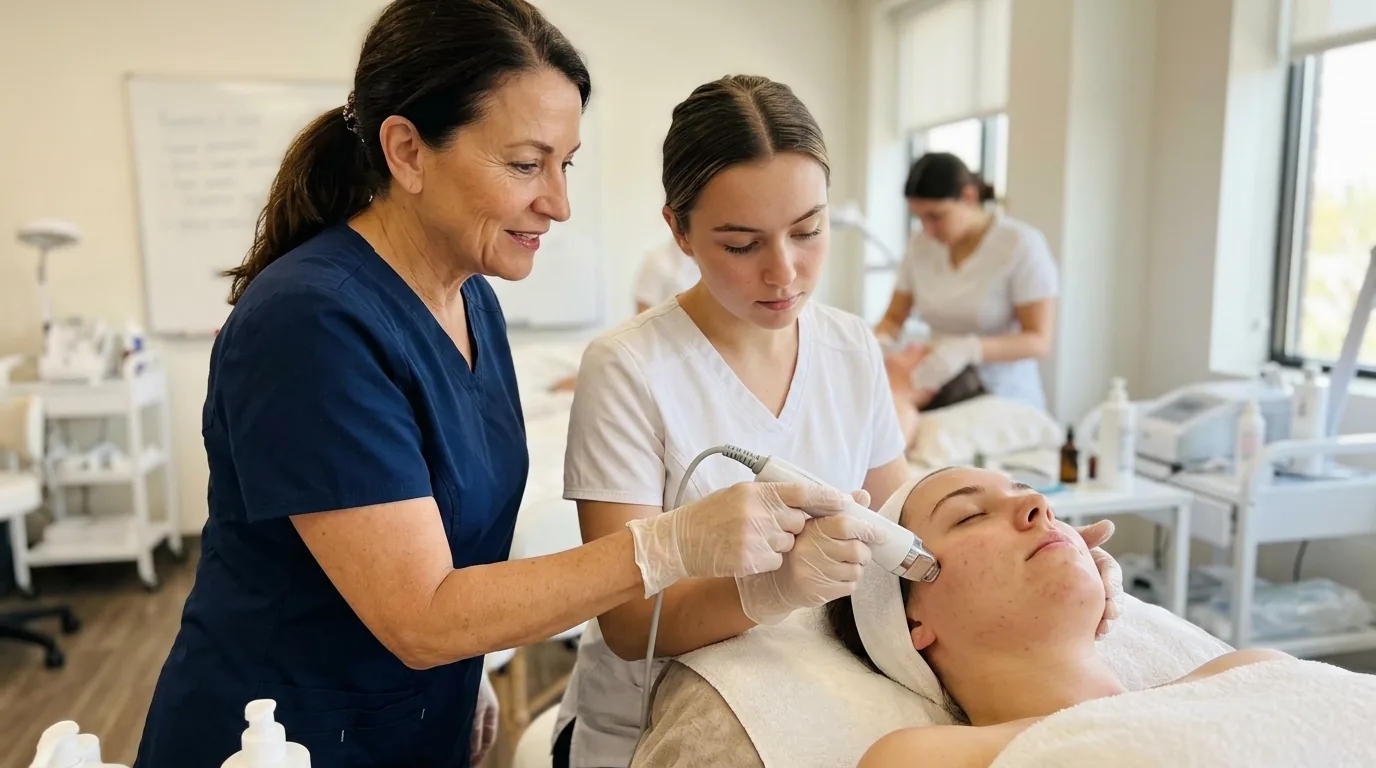
Partly. Hydrafacial training online exists in two forms: the manufacturer offers protocol videos and live online sessions, and CONNECT is described as self-paced online learning with coaching. Some schools sell hybrid courses that pair online theory with an in-person practical.
What Hydrafacial training online cannot give you is supervised practice with the handpiece: adjusting suction, working the tips around the nose and jaw, and reading how skin responds. If you learn online, plan to complete supervised treatments before you work alone.
Is the Hydrafacial device FDA approved?
No, and it does not need to be. FDA approval is the pathway for the highest-risk devices. HydraFacial LLC's handpiece is registered and listed with the FDA as a "Brush, Dermabrasion, Powered", a Class I device under 21 CFR 878.4820. That regulation places the device in Class I (general controls) and exempts it from premarket notification, the 510(k) process.
In plain terms: the device is registered with the FDA and subject to its general controls, but it was not "approved" and did not need a 510(k) clearance. Say "FDA-registered" in interviews and marketing, never "FDA-approved".
What does the research say the treatment does?
Less than the marketing, and all of it from small studies.
- Skin structure. A 2008 randomized study of 20 women compared six hydradermabrasion treatments with the same antioxidant serum applied by hand. The hydradermabrasion group showed thicker epidermis and papillary dermis, higher skin antioxidant levels and fewer visible fine lines and pores; the hand-applied group showed no change.
- Acne. A 2022 open-label study of 20 adults with mild to moderate acne found that the share rated clear or almost clear rose from 20% to 65% after six clarifying treatments, by investigator assessment. It had no control group, neither patients nor investigators were blinded, and one author is listed with The HydraFacial Company. Read it as a cosmetic result on the look of the skin, not as proof that the treatment treats acne, which is a medical condition that belongs with a dermatology provider.
- What happens in the skin. A 2024 imaging study of 8 volunteers, using a generic device and declaring no conflict of interest, saw the outer skin layer thin right after treatment (from 9.42 to 6.67 micrometers) and recover to 9.75 micrometers at two weeks. The upper dermis looked stretched after treatment and returned to baseline by two weeks, with no visible change in collagen.
The honest summary: the treatment is popular and the documented effects are superficial and short-term, from a handful of small studies. As a professional, describe results in terms of how skin looks and feels after treatment, not as a medical treatment or permanent remodeling.
What do med spas check when they hire for Hydrafacial?
Clinics usually want to know three things: that your license covers the treatment in their state, that you have performed it on their machine or can learn it quickly, and that you follow their protocol, including contraindications and aftercare.
If a clinic owns the device, expect it to give you Hydrafacial training on its protocol whether or not you hold a certificate, as part of the staff training every med spa owes its team; what training Florida med spas owe their staff, and how clinics document it for each role explains how that works on the employer side. A certificate helps most when you are new and competing for a first med spa role, as one of several add-ons you can list.
If you are still in school, how to choose a medical esthetician program in Florida, and which add-on certifications actually raise pay after the license shows how to sequence add-ons after licensing. Clinics that run Hydrafacial often also offer microneedling and body treatments; see what a microneedling certification proves, who can legally perform it, and what med spas check before hiring and which body contouring devices need a license, who may run them by state, and what courses cost.

Sources and how we checked them
- Manufacturer training: Hydrafacial's professional resources page for trained providers, with its workshop and online education and Hydrafacial's own explanation of its patented hydradermabrasion method versus generic hydrodermabrasion.
- CONNECT: Practical Dermatology's report on the expansion of the Hydrafacial CONNECT certification program and American Spa's report on the launch of the Hydrafacial CONNECT esthetician certification.
- FDA status: the FDA device registration and listing record for HydraFacial LLC, product code GFE, powered dermabrasion brush and the federal regulation 21 CFR 878.4820, which classifies the device and exempts it from 510(k).
- Florida: Florida Administrative Code Rule 61G5-18.00015, which defines medical purposes and mechanical exfoliation for cosmetology licensees.
- California: California Business and Professions Code section 7316, which defines the practice covered by an esthetician license.
- New York: the New York Department of State scope of practice determinations for appearance enhancement licensees.
- Texas: the Texas Department of Licensing and Regulation scope of practice page for estheticians.
- Courses: Parisian Spa Institute's three-hour Hydrafacial class in Jacksonville, Florida, with its published price, Empower Health and Aesthetic Institute's four-hour Hydrafacial course in Dallas and Fort Worth, Florida Academy of Medical Aesthetics' one-day hydrafacial and microdermabrasion course in Pembroke Pines and Texas Laser and Aesthetics Training Academy's eight-hour Hydrafacial training course in Austin, Texas, checked 2026-09-23.
- Research: the 2008 randomized study of hydradermabrasion with an antioxidant serum versus the serum applied by hand, the 2022 open-label study of HydraFacial clarifying treatments for acne, with a company co-author and the 2024 imaging study of microscopic skin changes after hydradermabrasion with a generic device.
Frequently asked questions
How much is Hydrafacial certification?
School courses we verified cost $375 to $1,200 for 3 to 8 hours. The manufacturer's own training for device accounts and its CONNECT program do not publish a price on the pages we reviewed.
How do you get Hydrafacial certified?
Either through the manufacturer, usually as staff of a clinic that works with the brand, through its CONNECT program, or through a school course. Whichever you choose, get supervised hands-on treatments on the device you will use.
Who can perform a Hydrafacial?
A licensed professional whose state scope covers device facials, such as an esthetician in many states, or a nurse or medical provider. In Florida the cosmetology rule leaves the question open, so confirm with the board and your clinic's protocol.
Can a basic esthetician do Hydrafacial?
In many states, yes, because hydradermabrasion is a surface exfoliation treatment within esthetics. Check your own state's rule; Florida's text is ambiguous for devices listed with the FDA.
Can I get a Hydrafacial certification online?
Hydrafacial training online covers the theory, through the manufacturer's education or hybrid school courses. You still need supervised practice on the handpiece before treating clients on your own.
Do I need a certification for the Hydrafacial machine?
No state requires one. Clinics that own the machine typically train their staff on it, and what matters to them is that your license covers the treatment and that you follow their protocol.
What is Hydrafacial CONNECT certification?
A three-level, self-paced certification program from the Hydrafacial company, launched in 2020 and later opened nationwide, combining online learning with coaching and in-person opportunities.
How do you become a Hydrafacial provider?
Clinics become providers by working with the company; individual professionals usually perform Hydrafacials as staff of those clinics. Get licensed, then look for clinics that offer the treatment and train on their device.
Get the license and the job, then the brand training follows
For most estheticians, a Hydrafacial certification is something the right employer gives you, not something you must buy to get hired. Secure your license, learn exactly what your state allows, and target clinics that already run the device. If you want an edge for your first med spa role, a short course with real hands-on time is a reasonable add-on; just do not mistake it for permission.