
September 23, 2026 · 13 min read
This article is for general educational and career information only. It is not legal or medical advice. Scope-of-practice rules change and differ by state: confirm with your state board before you act.
Key Takeaways
- A body contouring certification is a course certificate, not a license: it never expands what your state license already allows you to do.
- The main body contouring machines, including CoolSculpting, Emsculpt, truSculpt and SculpSure, are FDA-cleared medical devices, each with its own 510(k) record.
- Florida's cosmetology rule puts ultrasound, HIFU, laser and FDA medical devices outside a facial specialist's scope, and it bars massaging the torso.
- Texas treats body contouring at med spas as a medical treatment done under a physician's order and delegation.
- Fat freezing carries a documented risk, paradoxical adipose hyperplasia, which a 2025 meta-analysis put at about 1 in 455 patients.
A body contouring certification is a course certificate, not a license, so it never expands what your state license allows. Most body contouring machines are FDA-cleared medical devices. In Florida the cosmetology rule puts ultrasound, HIFU, laser and FDA medical devices outside a facial specialist's scope, and in Texas the regulator treats body contouring as a medical treatment done under a physician's delegation.
That matters before you pay for a course, because the most common advice online is wrong. Ask on Reddit and one of the top answers says it is "a loophole" and that you don't need your esthetics license for cryoskin or emsculpt. The rules we read say otherwise. This guide shows which devices are regulated, who may operate them in four states, what body sculpting certification courses actually cost, and what a med spa checks before it hands you the device.
What is a body contouring certification, and what does it not do?
A body contouring certification is proof that you completed body contouring training on one or more treatments: fat freezing, radiofrequency, ultrasound, electromagnetic muscle stimulation, or manual techniques such as wood therapy. Schools, device manufacturers and independent trainers all issue them.
What a certificate does:
- Shows an employer you have been trained on the physics, the protocol and the side effects of a specific modality.
- Satisfies the training part of what a supervising provider or a device manufacturer requires before you treat patients.
What a certificate does not do:
- It does not license you. No state issues a "body contouring license". Your authority to treat comes from the license you already hold: esthetics, massage, nursing, or a medical license.
- It does not override your scope. If your license does not cover a device, a course cannot add it. Several of the schools we reviewed say this themselves: Advanced Laser Institute's course page, for example, disclaims any equivalence with a state license.
Which body contouring devices are FDA-cleared, and what does clearance mean for the operator?
Most body contouring machines are regulated as medical devices and reach the market through the FDA's 510(k) clearance process. Clearance means the FDA found the device substantially equivalent to one already on the market for a stated use. It does not decide who may operate it: that is a state question, answered in the next section.
Common body contouring technologies and their FDA records
| Technology | Example device | FDA 510(k) | Regulation (21 CFR) | Decision date |
|---|---|---|---|---|
| Cryolipolysis (fat freezing) | CoolSculpting (Zeltiq) | K142491 | 878.4340 | 2015-01-26 |
| Radiofrequency | truSculpt (Cutera) | K180709 | 878.4400 | 2018-06-06 |
| High-intensity focused ultrasound (HIFU) | Liposonix (Medicis) | K100874 | 878.4590 | 2011-08-19 |
| Electromagnetic muscle stimulation (HIFEM) | Emsculpt, cleared as "BTL 799-2" (BTL Industries) | K180813 | 890.5850 | 2018-06-14 |
| Laser lipolysis (1060 nm) | SculpSure (Cynosure) | K150724 | 878.5400 | 2015-07-01 |
| Wood therapy, manual cupping | Hand tools | No FDA device record found | n/a | n/a |
Two details for your résumé and your interviews. First, "FDA-cleared" and "FDA-approved" are different things; body contouring devices are cleared, and saying "approved" signals you don't know the difference. Second, the Emsculpt regulation number is shared with non-aesthetic muscle stimulators, so always pair it with the device's own clearance number when you cite it.
Who can legally perform body contouring?
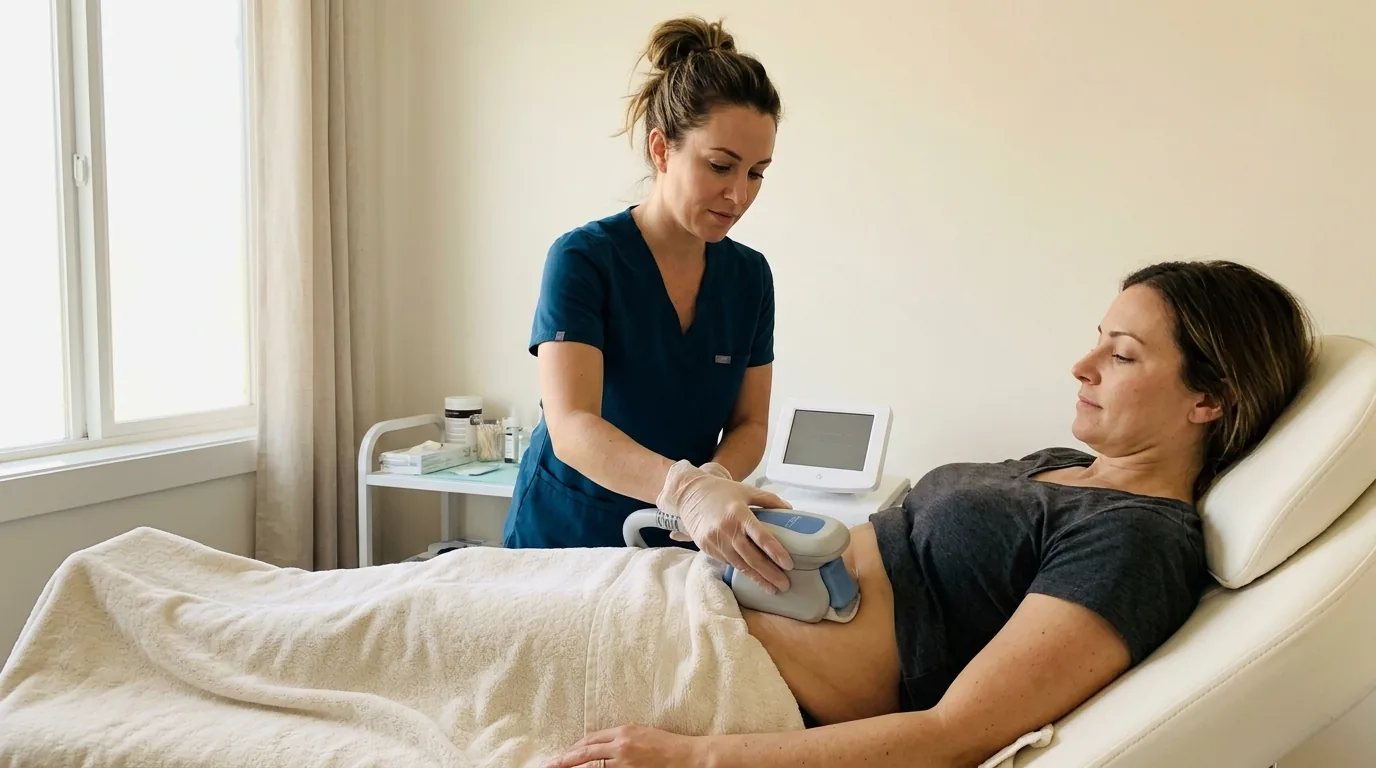
It depends on the state and on the device. Here is what the primary texts say in four states we checked; if yours is not listed, go to your state's cosmetology board and medical board before you enroll anywhere.
Who may perform device body contouring, by state
| State | What the rule says | What it means in practice |
|---|---|---|
| Florida | Rule 61G5-18.00015(1)(b) lists "laser and intense pulsed light (IPL) treatments, ultrasound and high intensity focused ultrasound (HIFU) treatments ... and FDA approved medical devices" as beyond the scope of a cosmetology license and facial specialist registration; (2)(e) puts "massaging the torso" outside that scope too | A Florida facial specialist cannot run device body contouring; it belongs under a medical license and its delegation rules |
| Texas | TDLR: "body cavitation and contouring ... fall under medical treatments that must be provided under the order and delegation of a licensed physician" | The esthetician license alone does not cover it; a physician's order and delegation are required |
| California | Medical Board: estheticians and cosmetologists may not use lasers or IPL devices | Laser-based contouring is off limits to estheticians; the board page does not address non-laser devices, so check before assuming either way |
| Arizona | A.R.S. 32-516 requires a laser technician certificate from the state for cosmetic laser use | Laser devices need the state certificate, not just a course |
So can estheticians do body contouring? Only where the state rule and the device allow it, and with devices that is rare. The pattern across states is consistent. Laser and energy devices sit in medicine, and the operator needs either a medical license or a delegation arrangement the state recognizes. The certificate is the training that makes delegation safe, not the permission itself. If laser work is where you want to go, our guide to becoming a laser technician in Florida, including which license lets you run laser and light devices walks through the Florida route step by step.
Can estheticians do body contouring in Florida?
Not with devices, on the rule as written. Florida's cosmetology rule defines "medical purposes" as "any form of bodily intrusion into the orifices, skin, muscles, or any other tissues of the body", and then names ultrasound, HIFU, laser, IPL and "FDA approved medical devices" as beyond the scope of a cosmetology license and full and facial registrations. A separate paragraph of the same rule says that massaging the torso is outside the scope of those licenses.
Florida's statute does let facial specialists provide "skin care services" to the body, but it defines them narrowly: applying or removing a preparation with a sponge, brush, cloth or similar device. That covers a body wrap or a scrub, not a fat-freezing applicator or an electromagnetic paddle.
What about manual body sculpting, such as wood therapy or lymphatic techniques on the abdomen and flanks? The same cosmetology rule places massaging the torso outside the facial specialist registration. Florida's Massage Practice Act defines "massage therapy" as "the manipulation of the soft tissues of the human body with the hand, foot, knee, arm, or elbow, regardless of whether such manipulation is aided by ... any electrical or mechanical device". Manual body contouring on the torso therefore falls under chapter 480, the licensed practice of massage therapy, not under a facial specialist registration. If this is the work you want, the credential to look at is a Florida massage therapy license, or a medical license for device work.
The same logic explains why Florida estheticians cannot do microneedling, covered in what a microneedling certification proves, who can legally perform it, and what med spas check before hiring.
How much does a body sculpting certification cost, and what do you get for it?
The body sculpting certification cost on a course page depends on format and on how much hands-on time is included. These are the courses we could verify on the providers' own pages.
Body contouring and body sculpting certification courses, prices as published
| Provider | Price | Hours | Format |
|---|---|---|---|
| Advanced Laser Institute | $850 | 6 hours | Online theory plus in-person hands-on |
| Contourology (Los Angeles) | $299 / $499 / $999 tiers | Varies by tier | Online, with in-person practicum options |
| Body Contouring Academy | Shown at checkout | Varies by course | 100% online |
| National Laser Institute | On request | On request | Online classroom plus in-person clinicals |
| Texas Laser Institute | On request | On request | Listed under medical-level aesthetician courses |
What separates a useful course from an expensive certificate:
- Supervised hands-on time on the device you will use. Theory videos alone do not prepare you to manage a treatment.
- Contraindications and side effects taught as a skill. You should leave able to screen patients and recognize a complication.
- Honesty about scope. A good course tells you which license the treatment requires in your state. A course that implies the certificate alone lets you treat is a red flag.
Is an online body contouring certification worth anything?
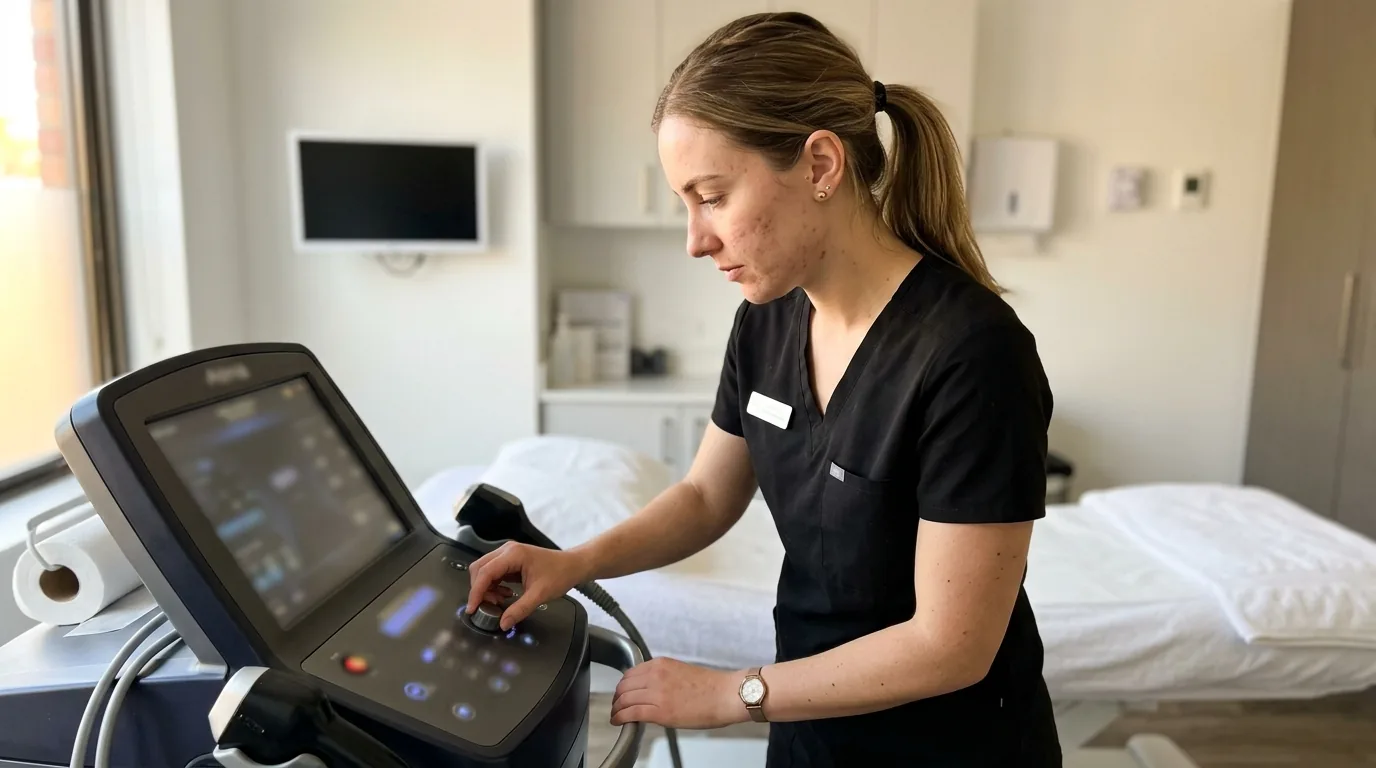
Online body contouring training is worth what the knowledge is worth: useful for theory, weak as proof that you can treat. Several providers sell fully online courses, and they can teach device physics, patient selection and aftercare well. None of them can teach you to place an applicator, read tissue response or manage a patient's discomfort through a screen.
If you take an online course, pair it with supervised treatments on the actual device, ideally at the clinic that will employ you: the clinic that owns the device decides how its operators are trained.
What risks must you be trained to recognize?
Body contouring is non-surgical, not risk-free, and the FDA is direct about expectations: non-invasive body contouring "does not treat obesity or improve your health. It will not result in weight loss". Patients who expect weight loss are poor candidates, and screening them out is part of your job.
The complication every fat-freezing operator must know is paradoxical adipose hyperplasia (PAH): the treated fat grows instead of shrinking. The FDA describes it as a raised, often rectangular bulge of hard, fatty tissue, reported two to five months after a fat-freezing treatment, and states that PAH "does not go away on its own and may require surgery to remove the visible bulge". The same FDA page notes reports of hernias in the treated area after fat freezing. A 2025 systematic review and meta-analysis of 28 studies and 13,078 patients estimated its incidence at 0.22%, about 1 in 455 patients, noting that the evidence is low-certainty and that the rate appears higher than manufacturer reports.
Other evidence worth knowing:
- A multi-location chart review of 3,262 patients treated with 18,203 CoolSculpting cycles found 180 adverse events in 87 patients, 2.05% of cycles, including paradoxical adipose hyperplasia in 2 patients. The authors put the PAH risk per cycle at 0.018% to 0.048%, depending on how it is calculated.
- A systematic review of 45 studies of high-intensity focused ultrasound reported body circumference reductions of 2.5 to 4.5 cm, with fewer than 5% of patients reporting transient redness, swelling or mild discomfort. The authors also note that treatment protocols and energy settings are not standardized across studies, and tape-measured circumference is a noisy outcome, so read those centimeters as a range, not a promise.
- A systematic review of 15 clinical studies of electromagnetic (HIFEM) treatment, mostly Emsculpt with follow-up of one to six months, reported average abdominal fat thickness reductions of 5.5 mm and muscle thickness gains of 2 mm, with no complications reported. It also found that two studies showed marginal or no benefit, and that several did not report patient characteristics or how missing data were handled, which limits how far the results can be generalized. Short follow-up also means these numbers say little about how long the changes last.
Every one of these devices also carries contraindications in its labeling, such as conditions or implants that rule a patient out. Screening against the labeling of the exact device you use is part of the operator's job, and it is one of the first things a good course and a good clinic teach.
You will not be the one diagnosing PAH, but you are often the person who sees the patient at follow-up. Knowing what it looks like, and escalating it to the supervising provider, is exactly what a good course and a good clinic teach.
What do med spas check before they hand you the device?
Expect four questions: which license you hold and what it lets you do in that state, which devices you have treated on and for how many supervised treatments, how you would recognize and escalate a complication during or after a session, and whether you have worked under a signed physician protocol before.
To prepare:
- Know your scope in writing. Be able to explain what your license covers in your state and where delegation is required.
- Document device hours. Log the device, the number of treatments and who supervised them.
- Ask about the protocol. A clinic running body contouring properly will have a written protocol signed by its supervising provider. If nobody can show it to you, that is a warning about the clinic.
If you are still choosing a school, how to choose a medical esthetician program in Florida, and which add-on certifications actually raise pay after the license shows which add-ons employers value. Clinics that run body devices often also offer facial device treatments, covered in what a Hydrafacial certification is, what it costs, and whether you need one to get hired.
Sources and how we checked them
- FDA device records: the FDA 510(k) database entry for the ZELTIQ CoolSculpting System, clearance K142491, cleared in 2015 and the matching records for K180709, K100874, K180813 and K150724, checked through openFDA on 2026-09-23.
- FDA guidance to patients: the FDA's consumer page on non-invasive body contouring technologies, including its description of paradoxical adipose hyperplasia.
- Florida: Florida Administrative Code Rule 61G5-18.00015, which defines medical purposes and the scope of cosmetology and facial specialists and Florida Statute 477.013, which defines cosmetology, specialty services and skin care services.
- Texas: the Texas Department of Licensing and Regulation page on medical spas and which services require physician delegation.
- California: the Medical Board of California answers on cosmetic treatments, lasers and who may perform them.
- Arizona: Arizona Revised Statute 32-516 on the state certificate required to use cosmetic lasers.
- Florida massage law: Florida Statute 480.033, which defines massage therapy as the manipulation of soft tissue, including with mechanical devices.
- Research: the 2025 meta-analysis of paradoxical adipose hyperplasia incidence after cryolipolysis, 28 studies and 13,078 patients; the real-world study of 3,262 patients treated with 18,203 cryolipolysis cycles and the adverse events reported; the systematic review of high-intensity focused electromagnetic energy for body contouring; the systematic review of high-intensity focused ultrasound for skin tightening and body contouring.
- Course prices: copied from each provider's page on 2026-09-23.
Frequently asked questions
What qualifications do you need to do body sculpting?
You need the license your state requires for the specific treatment, plus training on the device. For laser and energy devices that usually means a medical license or a delegation arrangement under one; for manual techniques it depends on whether your state treats them as massage.
Do you need a certification for body sculpting?
No state issues a body sculpting license, and a certificate is not legally required in most places. Employers and supervising providers, however, expect documented training on each device before you treat patients.
How much does it cost to get a body sculpting certification?
Body sculpting certification cost, in the courses we could verify, ranges from $299 for an online tier to $999 for an extended program, with a 6-hour hybrid course at $850. Several providers only give prices on request.
Can you do body sculpting without a license?
Not with regulated devices in the states we checked. Florida places ultrasound, HIFU, laser and FDA medical devices outside cosmetology licenses, and Texas requires a physician's order and delegation for body contouring at med spas.
Do I need a license to do body sculpting in Texas?
Texas's licensing agency says body cavitation and contouring at medspas are medical treatments that must be provided under the order and delegation of a licensed physician. An esthetician license alone does not cover them.
Is there a way to get certified in body sculpting online?
Yes, several schools sell fully online courses. They can teach theory well, but they cannot give you supervised hands-on time, which is what employers look for.
How long does it take to get certified in body sculpting?
Most body contouring training courses we reviewed run from a few hours to one or two days. The longer part is building supervised treatment hours on the device your employer uses.
Can estheticians do body contouring?
It depends on the state and the device. In Florida, device body contouring and torso massage fall outside the facial specialist registration; in Texas, it requires physician delegation; in California, estheticians may not use lasers.
Buy the training after you know what your license allows
A body contouring certification is worth buying once you know two things: which devices your license lets you operate, alone or under delegation, and which devices the clinics you want to work for actually own. Start with your state's rule, then choose the course, then build supervised hours. In that order, the certificate becomes a hiring advantage instead of an expensive piece of paper.