Key Takeaways
- Whether an LPN can inject Botox in Florida is not settled by the nursing statute. Florida Statute 464.003(18) defines practical nursing to include administering treatments and medications, but only under the direction of a registered nurse, physician, osteopathic physician, podiatrist, or dentist. Nothing in the practice act names Botox.
- The blanket claim that an LPN can never touch a syringe misreads the statute. What actually blocks cosmetic injection is the layer above the nursing act: who may accept delegation of a medical treatment, and who performed the good faith exam.
- Florida med spas overwhelmingly do not delegate cosmetic injection to LPNs. Even a registered nurse cannot inject as an independent provider here, which puts the practical nurse a full step further from the needle.
- LPNs are hired in Florida aesthetics, and the roles are real: intake and vitals, pre and post care, laser and device support where separately trained, and clinical coordination.
- The reliable route to injecting is the LPN to RN bridge, then aesthetic training. Most bridge programs run twelve to eighteen months, and that is the timeline worth planning around.
Whether an LPN can inject Botox in Florida is not answered by the nursing statute. The limit sits one layer above it.
Florida's practice act does not mention Botox once. The limit comes from a different place than most job seekers expect.
Can an LPN inject Botox in Florida? Ask that anywhere and you get a one word answer: no. The answer is directionally right and technically sloppy. The sloppiness matters, because it leaves out the part that tells you what to do next.
Florida's Nurse Practice Act does not contain a list of procedures with the word Botox next to a yes or a no. It defines what practical nursing is, in general terms, and then a separate body of medical practice rules decides who a physician may hand a cosmetic medical treatment to. The answer to can an LPN inject Botox in Florida lives in the gap between those two things.
Here is what the statute actually says, where the real limit sits, and what a Florida LPN can legitimately do in aesthetics today.
What does Florida law say a practical nurse can do?
Florida Statute 464.003(18), which defines the practice of practical nursing in the state's Nurse Practice Act calls it the performance of selected acts, expressly including the administration of treatments and medications. Then it attaches one condition. The work happens under the direction of a registered nurse, a physician, an osteopathic physician, a podiatrist, or a dentist.
Read that plainly and two things follow. Administering a medication sits inside the definition of practical nursing, not outside it. And an LPN never operates on independent judgment. The statute adds one more clause. A practical nurse is responsible for decisions based on their own education and experience. That sentence looks minor. In a scope dispute it does most of the work.
So the practice act does not ban an LPN from giving an injection as a category. An LPN gives injections in nursing homes, clinics, and hospitals across Florida every day. The question is never the needle. It is what is in the syringe, who ordered it, and on what basis.

Intake, history and vitals: the work Florida med spas hire practical nurses for, whatever the answer to can an LPN inject Botox in Florida.
So why can an LPN inject Botox in Florida almost nowhere in practice?
Because a cosmetic injection is not a routine medication administration. It is a medical treatment. It has to be ordered for a specific patient, after that patient has been evaluated. Florida takes that evaluation step seriously. We cover the requirement in detail in the good faith exam a Florida med spa must complete before injectables, lasers, and comparable treatments, which is what separates a legitimate medical act from a retail service.
Once a treatment is medical, the question becomes a delegation question, and delegation is governed on the physician side, not the nursing side. The supervising physician decides whether a task may be handed off, to whom, and under what protocol, and they carry the consequence if that judgment is wrong. In Florida aesthetics, that judgment has settled in a fairly consistent place.
The clearest evidence is what happens one rung up the ladder. As we set out in our breakdown of what an aesthetic registered nurse can and cannot legally do in Florida, an RN in this state cannot inject Botox or dermal filler as an independent provider. The RN injects under delegation, following a protocol, after the exam has been done by a physician, physician assistant, or advanced practice registered nurse. If the registered nurse is already dependent on delegation for that act, the practical nurse, whose entire scope is defined as working under the direction of that RN or physician, sits a full step further away.
That is the honest version of the answer. Not a statutory prohibition naming the drug, but a chain of authority that in practice does not reach the LPN.
| Question | LPN in Florida | Where it is decided |
|---|---|---|
| May administer treatments and medications? | Yes, under direction of an RN, MD, DO, DPM, or DDS | Fla. Stat. 464.003(18) |
| May exercise independent nursing judgment? | No. Acts are selected and directed | Fla. Stat. 464.003(18) |
| May perform the patient evaluation before injectables? | No | Good faith exam requirement |
| Is cosmetic injection typically delegated to an LPN? | No, and rarely offered | Physician delegation and clinic protocol |
| May an RN inject as an independent provider? | No, RNs also work under delegation | Florida scope for aesthetic RNs |
| Realistic route to injecting | LPN to RN bridge, then aesthetic training | Career path, not scope |
What can an LPN actually do in a Florida med spa?
This is the part the one word answer erases, and it is the part that pays rent. Florida med spas do hire practical nurses. The work is clinical support, and in a busy injectable practice it is the difference between a provider seeing eight patients a day and twelve.
- Intake, history, and vitals. Collecting the medical history, medication list, and allergy screen that the exam depends on. The provider still performs the evaluation, but the LPN builds the record it rests on.
- Pre and post treatment care. Cleansing, ice and pressure, aftercare instruction, and the follow up call that catches a complication early. Topical anesthetic is a narrower question than it looks. Compounded lidocaine, tetracaine and benzocaine formulations carry a real risk of local anesthetic systemic toxicity, whose presentation and management are set out in the StatPearls clinical reference and of methemoglobinemia when dose and surface area are not tightly controlled. Application belongs under a written protocol with defined limits, not with whoever is free.
- Assisting the injector. Room turnover, product reconstitution where the protocol and training permit, documentation, and photography for the before and after record.
- Device work where separately credentialed. Laser and light based treatment in Florida is its own regulatory question governed by the Electrolysis Council rules in Florida Administrative Code chapter 64B8-56, which govern laser and light device use, not by the nursing license, and it is covered in our guide to who can legally perform laser hair removal in Florida and what direct physician supervision requires, and a nursing license is not automatically the answer there either.
- Clinical coordination. Protocol adherence, supply and inventory of medical product, sterilization and infection control practice, and keeping the compliance file current.
None of that is filler. A practice that treats the LPN role as a waiting room rather than a real job loses the person within a year. That is expensive, for reasons we lay out in our analysis of why Florida med spa turnover costs so much and what actually keeps clinical staff in place.
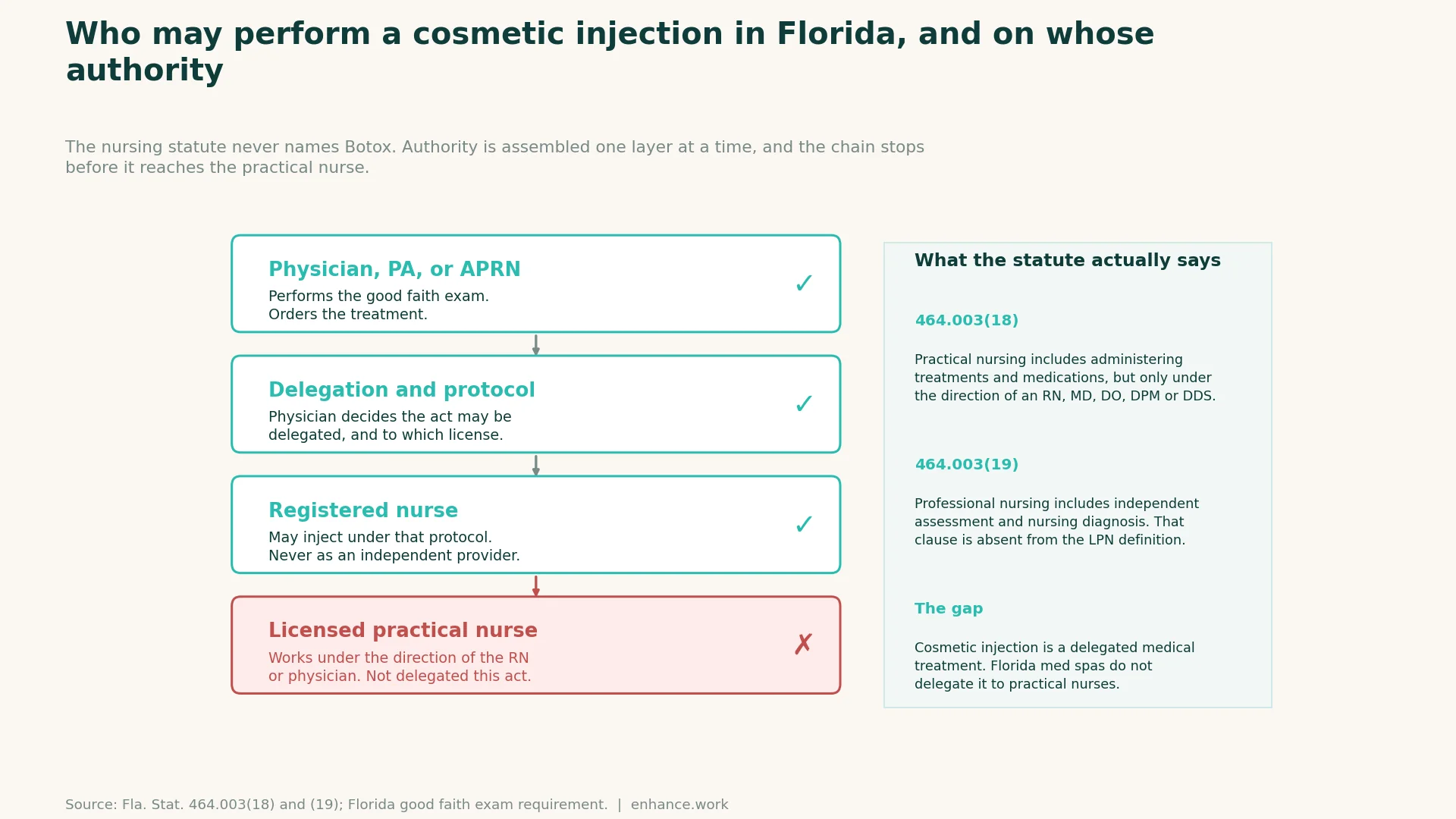
Authority is assembled one layer at a time, and the chain stops before it reaches the practical nurse.
How does an LPN become an injector in Florida?
Through the RN license, and there is no shortcut worth taking. The LPN to RN bridge is the standard route. It is an associate degree pathway that credits prior practical nursing coursework and clinical hours. Full time it runs twelve to eighteen months, and part time stretches longer. It ends with the NCLEX-RN.
After licensure, the aesthetic layer goes on top. That sequence, and what employers screen for at each step, is mapped in our step by step guide to becoming a nurse injector in Florida, from licensure through supervised training. If you are weighing whether the nursing route is the right one at all, our overview of how to get into aesthetic nursing and what your license actually allows is the better starting point.
One caution about training vendors. A weekend Botox course will sell a certificate to anyone who pays, including an LPN. The certificate does not expand your scope by a millimeter. Scope comes from the license and from what a physician may lawfully delegate to it, and no private curriculum changes either one.
What about the LPN who is already injecting somewhere?
It happens, and it is worth naming clearly rather than pretending otherwise. Some Florida practices operate loosely, and an LPN who is handed a syringe may reasonably assume the physician cleared it, because the physician is the one who is supposed to know.
The exposure is not symmetrical, though. The practice risks its medical direction and the physician risks their license, but the nurse risks their own. Practising beyond the scope of a license is listed among the grounds for discipline in section 464.018 of the Florida Statutes, which sets out the disciplinary grounds the Board of Nursing acts on, and a complaint follows the individual to every future employer in every state. If you are being asked to inject as an LPN, three questions settle it. Who performed the good faith exam? Is there a written protocol that names my license? Will the supervising physician put the delegation in writing?
If the answers are vague, that is the answer.

The LPN to RN bridge is the route that actually ends at the needle. Most run twelve to eighteen months.
Is the LPN license still worth it for aesthetics?
Yes, if you treat it as an entry point rather than a destination. It gets you inside a clinical environment, on payroll, learning injectable practice from the room instead of from a course, while you complete the bridge. Employers consistently prefer the internal candidate they already trust with their patients.
What it will not do is put you behind the needle on its own. Anyone telling you otherwise is either selling a certificate or has not read the practice act. If you want to see where the different aesthetic licenses land on pay and ceiling before committing to the bridge, our Florida aesthetic injector salary breakdown showing what each license type earns by setting and experience level is the comparison to run first.
Frequently asked questions
Can an LPN inject Botox in Florida?
In practice, no. Florida Statute 464.003(18) allows a practical nurse to administer treatments and medications under the direction of an RN or physician. But cosmetic injection is a delegated medical treatment, and it requires a good faith exam first. Florida med spas do not typically delegate it to LPNs. Even registered nurses here inject only under delegation and protocol, never independently.
Does Florida law specifically prohibit LPNs from injecting Botox?
No. The Nurse Practice Act does not name Botox or any cosmetic injectable. The limit comes from physician delegation rules and the good faith exam requirement, not from a prohibition written into the nursing statute. That is why the blanket claim that an LPN may never hold a syringe is inaccurate.
Can an LPN inject dermal filler in Florida?
The analysis is the same as for neurotoxin, and filler raises the stakes. Vascular occlusion, whether from intra-arterial embolization or extrinsic compression, requires emergency recognition and reversal on a defined ischemia protocol. Diagnosing and managing that event is a medical act and a physician responsibility. It sits outside independent RN practice too. That is exactly why filler is delegated under protocol with a physician reachable, and why the practical nursing scope is the wrong place to look for authority to perform it.
What can an LPN do in a med spa in Florida?
Patient intake, history and vitals, pre and post treatment care, assisting the injector, documentation and clinical photography, protocol and infection control support, and device work where the LPN holds the separate credential the device requires.
How long does it take an LPN to become an RN in Florida?
Most LPN to RN bridge programs run twelve to eighteen months full time, with part time tracks taking longer. The program credits prior practical nursing coursework and ends with the NCLEX-RN.
Is a weekend Botox certification enough for an LPN to inject?
No. Private certification does not expand a license. Scope is set by the practice act and by what a supervising physician may lawfully delegate, and a training certificate changes neither.
Get the license question right before the training question
The useful answer to can an LPN inject Botox in Florida is not a yes or a no. It is that the statute permits directed administration, the delegation chain does not reach the practical nurse for cosmetic work, and the fix is the RN license rather than another certificate.
Florida clinics are hiring practical nurses into real clinical support roles right now, and those roles are the best possible place to be while you finish the bridge. Browse Florida med spa and aesthetic practice openings on the Enhance.work directory to see which clinics are hiring clinical support and start where the license you hold today already fits.