To become a nurse injector in Florida you need an active Florida RN or APRN licence from the Board of Nursing, hands-on injectable training, and a physician relationship on paper: a delegation protocol if you stay an RN, or a supervisory or autonomous-practice arrangement if you complete an APRN programme. The RN route takes months.
The APRN route takes two to four years and removes the income ceiling.
Key Takeaways
- How to become a nurse injector in Florida starts with the supervision rule: an RN can inject in Florida, but only under a physician. The Board of Nursing has confirmed that a physician may delegate neurotoxin administration to an RN, provided the physician is physically present and watching. An APRN cannot supervise an RN injector. The APRN license is what lets you assess, order and inject without a physician standing over you.
- Realistic timeline is 2.5 to 4 years: Two years minimum just for the master's degree. Anyone selling you a faster path is selling a course, not a career.
- Training runs $5,000 to $15,000, not $30,000: Neurotoxin and filler courses run $1,500 to $6,500 each and cadaver labs $1,750 to $3,500. Budget for repetition and mentorship rather than certificates, because no practice will pay you a senior rate and train you at the same time.
- New injectors do not earn NP wages: if you cannot inject yet, you are not worth $50 to $70 an hour to a South Florida practice. Expect $30 to $40 an hour while you are learning. That number climbs fast as your skills grow.
- Protect your before and afters before you sign anything: Your patient photo portfolio is your career. If your contract does not give you the right to use those photos after you leave, you walk away with nothing to show.

How to become a nurse injector in Florida comes down to two decisions. You either stay an RN and inject under physician delegation, or you complete an APRN programme and assess, order and inject yourself. The first route is quicker and narrower. The second takes two to four years and removes the ceiling. Everything below prices both.
This is one of the questions we field most often from RNs and APRNs looking to move across from hospital or clinical nursing into aesthetic medicine. Our honest breakdown of how to become a botox injector explains why no weekend course makes you skilled. It also covers the volume needed to reach skill, and the training deals that produce injectors in South Florida.
New to aesthetics entirely? Start with the full Florida path to becoming an aesthetic nurse. It covers whether to take the RN or the NP route first. This guide zeroes in on the nurse injector role specifically: the credential that gets you hired, the timeline, and the first job.
What does becoming a nurse injector in Florida actually require?
Let us start with what actually matters and what does not.
You want to assess a patient, order the product and inject it with no physician in the room. For that you need an Advanced Practice Registered Nurse (APRN) license issued by the Florida Board of Nursing, as a nurse practitioner with prescriptive authority. That is the bar for working as an injector in the way most job postings mean. A registered nurse is not shut out of injecting. But an RN may only give what a physician has examined the patient for, ordered and delegated. And only with that physician in the room. There is no lower-bar certification that substitutes for either license.
Beyond the APRN license, there is no Florida-specific certification for aesthetic injections. No state board exam for Botox. No required course hours for fillers. No government-recognized credential that signals to a practice you are qualified. Aesthetic training in Florida is private, unpoliced and wildly uneven in quality. The real answer to how to become a nurse injector in florida rests on three things. Your current license. A training spend in the $5,000 to $15,000 range. And whether you can land a work-for-training deal.
What practices actually evaluate when hiring: how many patients you have injected, what results you can show, and whether your hands are steady. A $3,000 Botox certificate from a weekend course will not change a hiring decision. A portfolio of 200 patients with documented results will. Most people researching how to become a nurse injector in florida get the timeline wrong. Expect 2.5 to 4 years from APRN licensure to fully independent practice.
This matters before you spend a dollar on training.

Demonstrated injection technique at scale is what South Florida med spas evaluate when hiring nurse injectors, not paper alone. The job is about separating the legal rules from the practical market reality in South Florida.
Can an RN work as an aesthetic injector in Florida?
Yes, but under conditions that most Florida med spas do not actually meet. This is the single most misreported point in aesthetic nursing, and getting it wrong has cost nurses their licenses.
The "practice of professional nursing" is defined in Florida Statute 464.003. It covers giving medications and treatments as ordered by a duly licensed practitioner. Botox is a prescription drug. An RN may administer it when a physician has examined the patient, ordered the treatment, and delegated the task.
The Florida Board of Nursing has said so directly. The Cremeans declaratory statement, Final Order DOH-24-0637, came out in May 2024. In it the Board confirmed that a physician licensed under Chapter 458 or 459 can delegate Botox Cosmetic to an RN. It also set out what "direct supervision" means, and this is where practices get caught:
- The physician must be physically present and visually observing the injection. Remote availability, phone access or being elsewhere in the building does not satisfy the standard.
- An APRN cannot serve as the supervising practitioner. The delegation and the direct supervision must both come from a physician. A nurse practitioner overseeing an RN injector does not make the arrangement lawful.
- The RN's involvement must be disclosed in the patient's informed consent.
- Declaratory statements are fact-specific. A statement issued to another nurse confers no protection on you. The American Med Spa Association tracks each of these Florida board rulings one nurse at a time. Its coverage also explains why the Board keeps answering them that way.
In practice, few aesthetic clinics keep a physician in the treatment room watching every syringe. That is the real reason RN injector roles are scarce here, not a statutory ban. Say a Florida practice offers you an RN injecting job. Ask who delegates, who will be in the room, and whether the consent form names you. If the answers are vague, the compliance exposure lands on your license as much as theirs.
Under the Florida Nurse Practice Act, Chapter 464 of the Florida Statutes, which defines advanced nursing practice, APRNs with prescriptive authority work under a physician protocol. They can assess, plan and treat with no physician present. That is the real route into an injector role.
One caveat that surprises senior APRNs: autonomous registration does not cover this work. Florida Statute 464.0123 limits autonomous APRN practice to primary care, naming family medicine, general pediatrics and general internal medicine. Aesthetic medicine is not primary care. So an aesthetic APRN still needs a supervising physician and a written protocol, however many clinical hours they have logged.
Which of the two training paths should you take?
Once you have your APRN license, you face the decision every new nurse injector in Florida faces: pay for training, or work for it.
Path 1: Pay for private training courses
Private training programs exist across the country. The Allergan Medical Institute injectable training program is one of the more solid options from a big product company. It runs hands-on cadaver labs and supervised injection practice for licensed nurse practitioners. The other neurotoxin and filler makers run similar tracks. Independent training programs and cadaver courses give you more hands-on time.
The honest cost to build a real foundation across neurotoxins, dermal fillers and related injectables is $5,000 to $15,000 for most nurses. Core neurotoxin and filler courses run $1,500 to $6,500. The spread depends on length and on whether patient models are included. Bundled injector tracks sit around $3,300 to $5,700. A facial anatomy cadaver lab adds $1,750 to $3,500. Add products, travel and the advanced modules you will want in year two, and the total climbs. But figures near $30,000 usually cover several years of training. They are not the cost of getting started.
The problem with this path is not just the cost. You graduate with certificates and no real clinical volume. Practices know the difference between someone trained in a classroom and someone who has injected real patients under real pressure. The certificate alone does not close that gap.
Path 2: Work for training
For most new nurse injectors in South Florida, the smarter path is a practice that will train you for a lower starting salary. This is how the majority of successful injectors in this market actually learned.
You come in as a clinical nurse at $30 to $40 an hour. You earn your keep through IV therapy, laser work and patient coordination. The medical director brings you into injectables as your skills grow. You get trained. They get a committed nurse at a rate that honestly reflects your current skill level.
No practice will pay competitive NP injector wages and invest significant time training you simultaneously. The math does not work for them. You either pay for the education yourself, or you price yourself honestly while you receive it on the job.
Mentorship arrangements, where a new APRN works alongside an experienced injector for reduced pay in exchange for supervised training, also exist in this market. They take longer to find but can accelerate development far when the mentor is serious and patient volume is high.
The six steps, in order
Here is the whole route in one block. Each step is unpacked in the sections below.
- Hold an active Florida RN license. Start from an RN license in good standing with the Florida Board of Nursing. An RN may inject only by delegation, with the physician in the room.
- Finish an MSN or DNP and get APRN licensure. Two years at least for the degree. Then 30 to 90 days for board processing, credentialing and the collaborative agreement.
- Take hands-on injectable training. Core modules run $1,500 to $6,500. Put facial anatomy, pharmacology and complication management ahead of certificate count.
- Log documented supervised cases. Build a written record of real cases done under supervision. No Florida rule sets a case count, so this is a hiring signal, not a legal one.
- Check the practice complication protocol before you accept. Ask if hyaluronidase is stocked and in date, if a written vascular occlusion protocol exists, and which eye emergency service they call.
- Negotiate a protected base first. New injectors in South Florida start near $30 to $40 an hour. Take a base while you build a book, and read the photo ownership clause.
How long does it take to become a nurse injector in Florida?
- Master of Science in Nursing (MSN) or DNP program: 2 years minimum from enrollment, assuming you are already an RN. Accelerated programs exist but do not change clinical hour requirements significantly.
- APRN licensure in Florida after graduation: 30 to 90 days for board processing, credentialing, and collaborative practice agreement setup.
- Aesthetic training and first clinical reps: 6 to 18 months before you are independently managing a patient injection book with consistent results. Private courses compress initial technique but not clinical confidence.
Total from "I am an RN today" to "I am a good, employed nurse injector": 2.5 years if everything moves fast. Three to four years is more typical. The school path this career rests on is confirmed by both the Bureau of Labor Statistics occupational outlook for nurse practitioners and nurse anesthetists and the American Association of Nurse Practitioners, the national body that tracks NP scope of practice by state.
Anyone advertising a "become a nurse injector in 6 months" program is describing the certificate timeline, not the career timeline.
What do South Florida practices look for when hiring?
New or small practices hiring their first injector
A practice opening its first injector job usually has a rough hiring process. The owner or medical director has not judged injection candidates before. They know they need someone who can inject and they want confidence and a real portfolio.
New practices usually do not have the capital for a full base salary. The most common deal for a first injector hire is a revenue split. Expect 30 to 50 percent of treatment revenue, with little or no base. That can pay well once volume builds. In the early months, though, your income rides on how fast the practice grows its patient base. Get clarity on their current patient flow before you agree to anything.
Established practices with existing injection volume
Established South Florida practices hire at all experience levels and are more likely to offer a base hourly rate. They have existing patients, an experienced medical director, and a clear sense of what they need. They can evaluate your skill level accurately and structure pay accordingly.
These practices will develop junior injectors if the fit is right, but not at market NP wages. Expect the same dynamic: lower starting rate while you build skill, with a clear path for how pay increases as your clinical volume develops.
Minimum viable experience before applying
Say you have your APRN but no injection experience. The floor for being useful is simple: be solid at IV vitamin infusions and intramuscular shots. This keeps you clinically valuable while you are not yet injecting aesthetics. Laser certifications add further value. Practices are more willing to invest in training someone who already generates revenue in other service lines. See our guide to what the aesthetic RN role looks like in Florida. It covers which licenses qualify for independent work, and why APRNs hold the edge over RNs here.
How much does a new nurse injector earn in Florida?
The salary data circulating on job sites reflects experienced injectors with established patient books. It does not reflect where you start.
ZipRecruiter aggregated salary data for nurse injector job postings advertised in Florida and Glassdoor's Florida nurse injector salary data both put median pay at $70,000 to $90,000 a year. The two sources show the full range, from training-level rates to senior earnings. That is the midpoint for working injectors, not day-one candidates.
- New APRN, no injection experience: $30 to $40 an hour in a clinical support role while training.
- Some injection experience, 6 to 18 months in: $40 to $55 an hour, or a revenue split that pays meaningfully as volume builds.
- Established injector with a real patient book: $55 to $75 an hour base. Top injectors at high-volume Miami practices earn above $100,000 annually with commission.
The nurses who walk into interviews expecting $60 to $70 an hour without an established injection book reliably do not get hired. The salary reflects your injection skill, not your credential alone. An APRN who cannot yet inject does not command the same rate as one who can. The progression is real and moves relatively fast once you are injecting regularly.
Which contract detail burns new injectors?
Most new injectors focus on salary and schedule when reviewing their first contract. The detail that matters most is often overlooked: ownership of patient before and after photos.
Your before and after portfolio is your career asset. When you leave a practice, that portfolio is what gets you hired at the next one. With no visual record of your results, every new job search starts you off as an unknown. It does not matter how much experience you built.
Many employment agreements either claim ownership of all patient photos or are silent on the issue, which means the employer controls them. Negotiate this before you sign, and understand what you are negotiating. Clinical photographs are protected health information, and a face is rarely de-identified in any meaningful sense. To use them in a portfolio you need a written HIPAA authorization under 45 CFR 164.508. It has to name marketing and portfolio use. The patient has to sign it. A general consent to treat is not enough. The images also sit inside the medical record, and that record is governed by Florida Statute 456.057, which makes the practitioner who creates the record its owner unless the employment contract designates the employer as records owner. What you are asking for is a contractual right to retain a copy of images you are separately authorized to use. Most practices will agree if asked directly. Almost none will volunteer it, and almost none have the authorization language on file already.
This is the single contract detail we most reliably see new injectors in South Florida fail to address before their first hire. It is a five-minute conversation that protects years of clinical documentation.
How do you find your first nurse injector role in South Florida?
Most nurse injector openings in Miami, Fort Lauderdale, and Boca Raton are not posted publicly. Practices fill these roles through networks and direct outreach before anything reaches a job board. The positions that make it to Indeed went unfilled everywhere else first.
- Target bigger practices with an experienced medical director: They can evaluate and develop an injector. New practices figuring it out alongside you create a different set of challenges early in your career.
- Be direct about the trade-off: say you will start at a lower rate for supervised training and a clear path up. That works better than pushing for a high base you have not earned yet.
- Build device and IV skills first: laser work, HydraFacial and IV therapy make you useful on day one. They give a practice a reason to hire you before you inject on your own.
Connect directly through Enhance.work: Most positions are filled before they reach general job boards. See our guide to what nurse injectors in Miami are earning by experience level. It breaks down how pay structures differ across South Florida practices.
What does nobody tell you before your first syringe?
Everything above is about getting hired. This section is about not harming someone once you are. It is the part the certificate mills skip, and it is the reason the training market rewards anatomy repetitions over course counts.
The catastrophic complication in filler work is intravascular injection. Product enters a facial artery, travels against the flow, and occludes vessels downstream. The consequences range from skin necrosis to permanent blindness when material reaches the ophthalmic artery through the angular, supratrochlear or supraorbital branches. A 2024 review in Aesthetic Surgery Journal covers a century of published blindness cases from filler. It sets out the prognostic factors and the management approaches that follow an occlusion. An earlier review in the same journal set out the high-risk zones behind most reported cases. They are the glabella, the nasal dorsum, the nasolabial fold and the forehead.
What competent training actually gives you, and what you should ask any program to show before you pay:
- Facial arterial anatomy by layer, not by landmark. Depth and plane matter more than surface marks, which is why cadaver dissection is worth its cost while a slide deck is not.
- Risk-mitigation technique, and its real limits. Four habits lower the chance of an accidental puncture into a vessel. Pick the right tool for the region, needle or cannula. Inject at low pressure. Deposit minimal boluses. Keep the instrument moving. Not one of the four removes the risk. Aspiration is the clearest illustration of that ceiling. With viscoelastic hyaluronic acid gels the test carries a high false negative rate. The product itself resists flow inside the cone of the needle, and the walls of small vessels collapse under suction. A Dermatologic Surgery study tested whether blood can be drawn back into a syringe already primed with hyaluronic acid and concluded that a plunger pull showing no blood does not rule out intravascular placement. A negative aspirate must never be read as a guarantee of safety before you deposit a static bolus. Cannula gauge behaves the same way. Ex vivo force measurements published in Ophthalmic Plastic and Reconstructive Surgery, taken on facial arteries dissected from fresh frozen cadavers, found that blunt microcannulas of 27G need only 0.23 to 0.32 kg to perforate the arterial wall, while 25G needs 0.43 to 0.54 kg and 18G and 22G cannulas could not penetrate the vessel at all. Read that for what it is. It is a benchtop measurement on dissected tissue, not a clinical trial in living faces. It tells you a fine 27G cannula pierces a facial artery with almost the same ease as a needle, and that larger gauges resist far more. It does not tell you a 25G cannula is safe. Vascular tortuosity, scarring from previous treatment, tissue tethering that stops a vessel sliding away, and the pressure you put on the plunger all move the real threshold, which is why occlusions have been documented with 25G cannulas in live practice. Gentle displacement, slow injection and retrograde microdosing stay mandatory whatever instrument is in your hand.
- Recognising an occlusion in the chair. Disproportionate pain, immediate blanching, dusky mottling, and any visual change or ocular pain, which is an emergency and not a follow-up call.
- A written hyaluronidase protocol and the drug on the shelf. A 2025 review in the Journal of Clinical Medicine covers hyaluronidase formulations, dosing and safety in aesthetic practice. Ask where the vials are kept and when they expire. If a practice cannot answer during your interview, that answer tells you what kind of employer it is.
- An escalation pathway, and the tissue survival time behind it. The protocol has to name the eye emergency service or hospital you call. It has to say how the patient gets there. The window to save the retina is counted in minutes. The central retinal artery is an end artery. Classic experiments in Experimental Eye Research clamped the central retinal artery in rhesus monkeys and placed retinal survival at about 97 minutes, and that 97 minute figure still gets quoted in courses as though it were an operating window. It is not one. In humans it is far faster. Filler that embolizes into branches of the ophthalmic artery causes permanent ischemic injury well before that. A review in BMC Ophthalmology that re-examined the evidence on retinal survival time concluded that infarction of the inner retina most likely occurs after only 12 to 15 minutes of complete occlusion, and injector experience with filler cases puts irreversible damage commonly inside the first 15 to 30 minutes. The outcomes confirm how little slack there is. among the published filler blindness cases that reported a visual outcome, only 6.0 percent of patients achieved complete recovery of vision and 68.2 percent recovered none. At the least hint of visual trouble or sudden eye pain, you activate at once. You never wait on the false idea of a long window.
None of this is a reason to avoid the career. It is why the good practices in South Florida take a year to make you independent. It is also why documented hands on time beats a stack of theory certificates at hiring. Diplomas from classroom courses are not what bigger practices screen for. They screen for three things: real supervised time with patients, a three dimensional grasp of the facial planes, and confident handling of complications. Florida hiring managers like to see a documented log of real cases done under supervision before you work alone. Numbers in the low hundreds do get quoted in interviews. Treat any such figure as a description of how the dexterity and safety curve builds through tutored repetition. It is not as a formalized medical standard, and not as a regulatory requirement. No Florida rule sets a case count for injectables.
What has to be true before an RN injects in Florida?
Four things, at the same time. Clinics that skip one of them are not offering you a shortcut. They are handing you the licence risk.
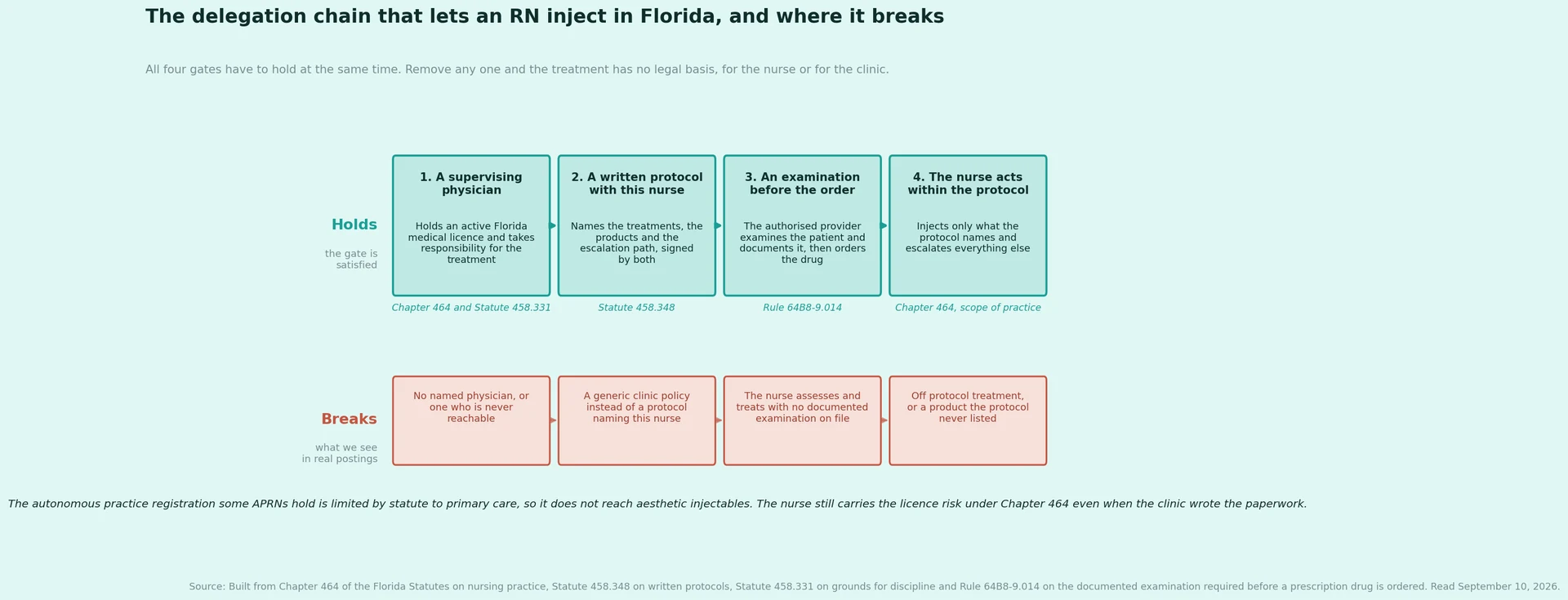
The four gates behind delegated injecting in Florida, and what breaks each one. Built from Chapter 464 of the Florida Statutes and Statute 458.348, read 10 September 2026. (Note: older articles cite Rule 64B8-9.014 for the pre-prescription exam; that rule governed telemedicine prescribing and was repealed with effect from 26 October 2014 -- see the body text below for the statutes that actually govern this duty.)
Two of those gates get skipped most often. Statute 458.348 puts a written protocol between the physician and each person they supervise. It is per nurse, not a clinic wide policy. And A prescription drug must be ordered in the course of a genuine professional relationship with the patient, and the chart has to show it -- Florida Statute 458.331(1)(q) makes prescribing outside the course of the physician's professional practice a ground for discipline, and 458.331(1)(t) reaches conduct that falls below the standard of care. The industry calls the visit behind that order the good faith examination. If nobody examined the patient, the treatment has no order behind it.
Ask for both documents on day one. A clinic that cannot produce a protocol with your name on it is not ready to have you inject, whatever the job advert said.
This is the one question every candidate gets wrong. So here is the whole chain in one place. No other page on the first page of Google lays it out this way. Take this version into your interview.
Read the table against the job advert in front of you. Say an advert offers an RN a solo injector role. Or offers an esthetician an injectables role at all. Then the practice is either writing the job loosely or running it wrong. Either answer tells you something before you sign.
What does the route cost, and how long does it take?
Price it before you commit. The two routes differ by years and by tens of thousands of dollars. The income gap at the end is why people pick the longer one.
The gap between those two wage lines is the whole argument. The BLS Florida median is $84,190 for registered nurses and $129,510 for nurse practitioners, across 229,940 and 21,790 people employed in the state. That is a difference of $45,320 a year, every year, for a degree that takes two of them.
One caveat on the shorter route. Delegated injecting depends on a physician who is willing to supervise you and stay involved. If that person leaves, your ability to inject leaves with them. The APRN route is slower precisely because it does not have that single point of failure.
Sources and how we checked them
Every figure above is tied to one of these sources. Some costs and timelines are our own read of the South Florida market, not a published figure. The table caption says so when that is the case.
- Nurse pay in Florida. the BLS Florida state state profile. Its May 2025 estimates give an $84,190 median for registered nurses and a $129,510 median for nurse practitioners. Read on 10 September 2026.
- National comparison. See the BLS national occupational profile for registered nurses, SOC 29-1141, with a $97,550 median annual wage. See also the BLS national occupational profile for nurse practitioners, SOC 29-1171, with a $132,300 median annual wage. Read on 10 September 2026.
- Delegation and protocols. Florida Statute 458.348 on the written protocol required between a physician and each person supervised. See also Florida Statute 458.331(1)(q) and (1)(t), on prescribing within the course of the physician's professional practice and to the standard of care. Read on 10 September 2026.
- Nursing scope and licensure. Florida Statute 464.012 on advanced practice registered nurse certification and autonomous practice. See also the Florida Board of Nursing, which is where scope questions get answered and licences get renewed. Read on 10 September 2026.
- Complication safety evidence. Carey and Weinkle in Dermatologic Surgery on why aspiration through a hyaluronic acid primed needle returns false negatives.
- Ugradar and Hoenig in Ophthalmic Plastic and Reconstructive Surgery measuring the force each cannula gauge needs to perforate the facial artery.
- Hayreh and colleagues in Experimental Eye Research on retinal survival time after experimental central retinal artery occlusion in primates.
- Tobalem and colleagues in BMC Ophthalmology rethinking that survival time down to 12 to 15 minutes.
- Doyon and colleagues in Aesthetic Surgery Journal reporting visual outcomes across a century of published filler blindness cases. Read on 15 September 2026.
How we checked this, and what we sell
Enhance.work is a job marketplace for aesthetic careers in South Florida. We do not sell injector training. We take no fee from any school. We have no commercial tie to any program named on this page. That matters here, because most pages ranking for this search are published by companies that sell the courses they recommend.
Every legal claim above is tied to a Florida statute, a board rule or a board order. Each one is linked, so you can read it yourself. Every clinical claim is tied to a named, peer reviewed paper in PubMed. Pay and cost figures come from the Bureau of Labor Statistics or from named salary sources. Where a number is our own read of the South Florida market, the caption says so. This page was written by a practising aesthetic APRN and last reviewed on 15 September 2026.
Frequently asked questions
How do I become a nurse injector in Florida?
For a solo injector role you need three things. An active APRN license with prescriptive authority. Formal training in neurotoxins and dermal fillers. And a written protocol with a supervising physician. A registered nurse can inject only under four conditions at once. A physician examined the patient, ordered the treatment, delegated the task, and is in the room.
Can an RN become a nurse injector in Florida?
An RN can inject, but not on your own. Under Florida Statute 464.003 a nurse gives medications ordered by a licensed practitioner. The Board of Nursing went further in Final Order DOH-24-0637. A physician may delegate Botox to an RN, but only while present and watching. Few clinics staff that way. So most RNs who want a full injector role go back for a master's in nursing and an APRN license with prescriptive authority granted by the Florida Board of Nursing under Chapter 464. That takes two and a half years at least.
Can an APRN supervise an RN injector in Florida?
No. Final Order DOH-24-0637 states that the delegation and the direct supervision must both come from a physician licensed under Chapter 458 or 459. A setup where a nurse practitioner oversees an RN who injects does not meet the standard. It is one of the most common compliance gaps in Florida med spas.
Do you need a certification to become a nurse injector in Florida?
No formal certification beyond your nursing license is required or recognized by Florida law. Private training courses teach technique, but South Florida practices evaluate hands-on experience and documented results, not certificates. A weekend course does not substitute for having injected real patients.
How much does it cost to become a nurse injector in Florida?
Building real injectable skills through private courses costs $5,000 to $15,000 for most nurses, not including the NP program. Individual neurotoxin and filler courses run $1,500 to $6,500 and cadaver labs add $1,750 to $3,500. The other option is a below-market rate at a practice that trains you. You trade cash up front for a lower salary while you learn.
How long does it take to become a nurse injector in Florida?
Realistically, 2.5 to 4 years from starting an NP program. The master's degree takes a minimum of 2 years. Add 3 to 6 months for licensure, then 6 to 18 months of clinical training before independently managing an injection book with consistent results.
What does a new nurse injector earn in Florida?
New nurse injectors without an established patient book earn $30 to $40 an hour at South Florida practices. Experienced injectors with real clinical volume earn $55 to $75 an hour base, with total pay far higher where commission applies.
What is the difference between a nurse injector and a medical injector?
In Florida, a nurse injector is usually an APRN, most commonly a nurse practitioner, who performs injectable aesthetic treatments. The term medical injector is broader and can include physicians, PAs and NPs. In practice at South Florida med spas, nurse injectors and PA injectors hold the same scope of practice and earn equivalent rates.
Should I pay for a training program or find a practice to train me?
For most new injectors in South Florida, finding a practice willing to train in exchange for a lower starting salary is the better path. Private programs produce technique knowledge without real clinical volume. Working for training produces both, while keeping you employed and building actual patient outcomes.
Completing formal injectable training before applying to aesthetic positions is the most reliable way to enter the Florida market at a competitive starting rate.
Can I use a multistate nursing licence to work as an injector in Florida?
Florida is in the Nurse Licensure Compact. A multistate licence from another compact state lets you work in Florida. You do not apply for a second licence. Two warnings before you move. A compact licence follows your home state. Once Florida is your home state, you have to move the licence over. The compact also covers RN and LPN licences only. It does not cover APRN status, and that is the credential an injector job turns on. Check your status with the Florida Board of Nursing. That office confirms compact status and handles advanced practice registered nurse certification here.
Does my malpractice insurance cover aesthetic injections?
Not on its own. This is the clause new injectors skip. A standard nursing liability policy is written around bedside nursing. Cosmetic injectables under a protocol are often carved out, or priced on their own. Before your first syringe, get three answers in writing. Does the policy name aesthetic injectables? Does it cover you in the exact supervision setup you work under? And does the practice policy cover you, or only the practice? An employer who will not put that in writing has told you where the risk sits.
What continuing education does Florida require to keep the licence you inject under?
Florida RN renewal runs on a two year cycle of 24 hours. The Board of Nursing splits it up. You need 16 general hours. On top of that you need three set courses: 2 hours on prevention of medical errors, 2 hours on Florida laws and rules, and 2 hours on human trafficking. Add 2 hours on impairment in the workplace every other renewal. Add one hour on HIV and AIDS before your first renewal. Add 2 hours on domestic violence every third cycle, on top of the 24. None of it is about aesthetics. That is the point. Florida asks nothing of you on injectables, so the safety training is on you and on the practice that hires you.

The Real Path Is Slower Than the Marketing Says
How to become a nurse injector in Florida has a real answer. It is not the answer most training programs want you to hear. Two years minimum for the master's degree. Another six months to a year to complete injectable-specific training. A first role that pays less than you expected while you build speed and patient rapport. By year three or four, the numbers start to look very different.
The providers at the top of the South Florida pay range did not find the fastest path. They are the ones who learned the credential rules before spending on training. They read their first contract closely. They built a patient book step by step. The timeline is real. The income ceiling is real too. Enhance.work connects qualified APRNs with practices in South Florida that are hiring now.
One last thing to weigh before you sign anywhere. Every injection you give is placed under your own licence, and in Florida it is the Board of Nursing that decides what can be delegated to you and what cannot. Supervision is not a formality. It is a written protocol with a named physician, a defined scope and standing orders you should be able to read before your first shift. A practice that cannot produce that document, or cannot tell you where the hyaluronidase is kept and who gets called when a patient goes pale in the chair, is asking you to carry its risk on your licence. Prioritise employers that offer supervised mentorship on real patients and a written occlusion management protocol. Patient safety and licence protection are the same decision.