
September 25, 2026 · 11 min read
This article is for general educational and career information only. It is not legal or medical advice. Scope-of-practice rules change and differ by state: confirm with your state board before you act.
Key Takeaways
- Botox and filler training is a private course that ends in a certificate of completion, not a state license to inject.
- Prices for the courses we checked run $1,500 to $4,250; National Laser Institute's "NOW $8,750" figure prices a broader multi-day program, not this course alone.
- None of the 8 schools we checked publishes a minimum number of live models or injections a student must complete.
- Published contact hours run 8 to 20 among schools that state a single number; two schools describe training in days or tiers instead.
- Dermal fillers are FDA Class III devices and BOTOX carries a boxed warning for distant spread of toxin effect; a course teaches technique; it does not change a product's FDA-approved indications.
Botox and filler training is a private course. A school sells it, not the government. It ends in a certificate of completion. Your state license, not the course, is what legally lets you inject. This guide prices 8 national courses by contact hours. It checks who each course will enroll. It also tests something else. Does the curriculum teach you to manage a complication, not just a syringe?
Most search results here are single-school sales pages. They never mention a competitor's price. This one compares 8, not just one school. It uses only what each school publishes on its own page. It was checked 2026-09-25, and it also draws on FDA records and complication research. You may not have mapped the license route yet. If so, start here: how to become a nurse injector, from a base nursing license through training and hiring.
What does "Botox and filler certification" actually certify?
A completion certificate is what a course gives you. It is not anything a state issues. Derma Institute USA says this of its own course. "Completing the course does not replace professional licensure or state rules." The American Academy of Cosmetic Medicine (AACM) certifies graduates after a written exam. Graduates earn its own "FAACM" title, a private membership credential, not a state or FDA certification. No school page here claims a government-recognized license.
What allows injecting is the license you already hold: physician, dentist, nurse practitioner, physician assistant, or registered nurse. Some states also allow an LVN or LPN under supervision. Your state's scope-of-practice rules apply on top of that license. A course adds skill. At accredited schools, it also adds CE credit. It does not add legal power the license does not grant.
Who can enroll in a Botox and filler course?
Seven of the 8 schools in this audit limit enrollment to an existing license: physician, dentist, nurse practitioner, physician assistant, or registered nurse. Some also accept an LVN or LPN under supervision. National Laser Institute is the exception. It markets its training to "Aestheticians and career changers!" Yet no state covered in this research lets an esthetician inject Botox or filler on an esthetics license alone.
Before you pay, confirm whether estheticians can legally perform Botox or filler injections under their existing license. A school may accept your payment. That is not proof your state will let you use what it teaches.
Does Florida change who can enroll?
Florida layers its own licensing statute on top of what a school will accept. Read Florida's own rules on Botox and filler training and who the state actually allows to inject. It gives the state-specific breakdown and price data this national audit does not track.
How much does Botox and filler training cost?
Below is what each school publishes. It lists price, format, contact hours, accreditation, and whether it states a live-model count.
Botox and filler course audit, 2026
| School | Price | Format | Contact hours | CME / CE credits | Live models? | Eligible licenses | Site |
|---|---|---|---|---|---|---|---|
| American Academy of Facial Esthetics (AAFE) | $1,797 to $4,997 (separate at $1,797 each, or bundled at $3,297) | In person, live patients | 20 combined (10 per course) | 20 AMA, ANCC, AAPA; 10 ADA CERP | No, bring your own | MD/DO, DDS/DMD, NP, RN, PA | facialesthetics.org |
| Empire Medical Training | $1,799 in person, or $799 livestream; $200 off booking both same trip | In person, or livestream | 8 per course (Botox AM, Fillers PM same day) | 8.0 AMA, ANCC, AAPA | Yes, live volunteer models | MD/DO, DDS/DMD, NP, RN, PA | empiremedicaltraining.com |
| Derma Institute USA | $4,250 combined Level I and II | 2 days in person, 1 day online | Not stated in hours | "CME-accredited"; credit count not stated | Yes, over 50% hands-on | Physicians, dentists, nurses, PAs | dermainstitute.us |
| MedAesthetics Training | $1,745 | One day, 8 AM to 5:30 PM | About 9.5, from posted hours | Up to 9.75 AAFP; PACE dental CE | Yes, capped at 8 students | MD, DO, PA, NP/APRN, RN; some states DDS, LPN/LVN | medaestheticstraining.com |
| American Academy of Osteopathic Procedural Medicine (AAOPM) | $1,799, payment plans | Online modules plus seminar | Not verified | 8.0 AMA, ACCME-accredited | Yes, small group breakouts | MD/DO, DDS/DMD, NP, PA, RN | aaopm.com |
| Texas Laser Institute | $1,500 tuition | Hybrid, online plus in person | 8 | Not stated | Bring your own, count unspecified | Physician, PA, NP, RN, or LVN; unlicensed only under supervision | texaslasers.com |
| AACM | Not published | In person (10 or 20 hour) or online (8.5 hour) | 10, 20, or 8.5, by tier | 8.5 credits, AMA/ACCME/ACPE/ANCC/ADA | Yes, 3 to 5 shadow days | RN/NP, PA, physician/dentist | cosmeticinjectors.org |
| National Laser Institute | "NOW $8,750" | In person or online, 8/11/14-day options | Not broken into one total | Not stated | Yes, recruits paying patients | Aestheticians and career changers; no license required | nationallaserinstitute.com |
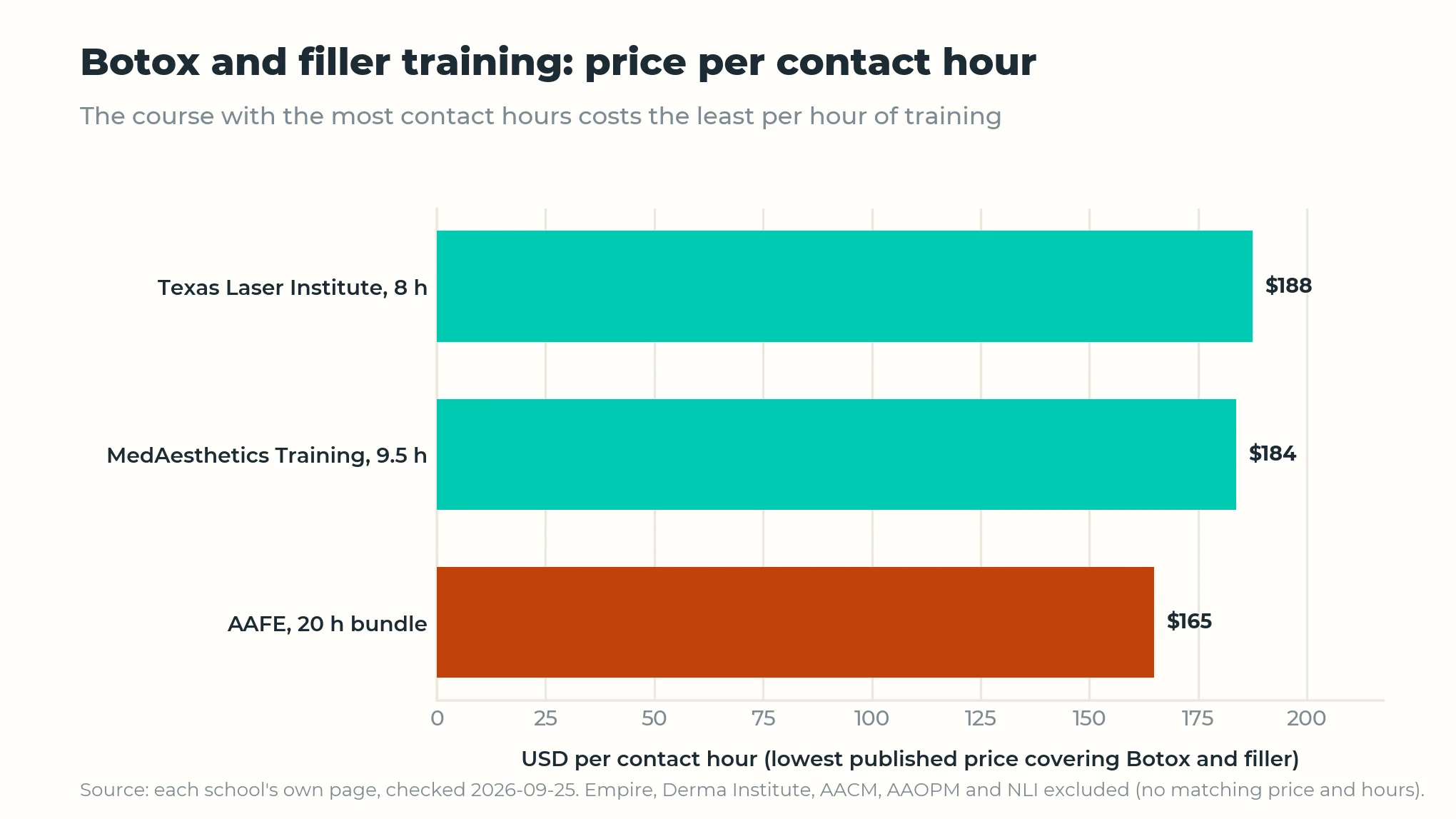
AAOPM excluded, its page states "8am-12pm (8 hours total)," an inconsistency needing a fresh check. National Laser Institute excluded, its "$8,750" prices a broader program. Price used = the lowest listed in-person price that covers both Botox and filler (AAFE: the $3,297 bundle, since $1,797 buys one 10-hour course), checked 2026-09-25.
Figcaption: Price per contact hour, the 3 schools with a published Botox plus filler price and a verified hour total.
Combined course or separate Botox and filler courses?
Some schools price Botox and filler training as one package. Others sell each half separately. AAFE lists Level I Botox and Level I Fillers as two 10-hour courses, at $1,797 each or bundled at $3,297. Empire runs Botulinum Toxin in the morning and Dermal Fillers in the afternoon. Students who book both the same trip get a $200 discount rather than one flat rate. MedAesthetics folds both into a single one-day course at one price.
Ask what share of a combined day is Botox versus filler. A single day covering both gives less time per topic. Two separate courses give more.
How many live models should a course give you?
None of the 8 schools publishes a minimum number of live models or injections a student must complete. Some schools supply the models. MedAesthetics "provides models, products, and supplies". National Laser Institute recruits "paying patients for students to practice on". Other schools require the student to bring their own model. AAFE "does not provide model patients". Texas Laser Institute says the student must bring "a model". No page states how many injections a student performs.
There is no published model-to-student ratio. Without it, hands-on time can be diluted across a large class. Ask a school, in writing: how many models per student, who supplies them, and who supervises the injection.
Does the course teach you to handle a complication?
This is the real quality test, and harder to market than a certificate. A 2019 literature review (Beleznay et al., PMID 30805636) found 48 new published cases of vision loss from filler injection. The vision loss was partial or complete. Cases were reported between 2015 and 2018 worldwide. Hyaluronic acid filler caused 81.3% of cases. The nasal region (56.3%) and glabella (27.1%) were the highest-risk sites. Only 20.8% of patients recovered vision completely.
A 2021 consensus paper (Walker et al., PMID 35096260) found "no internationally accepted consensus" on managing filler-induced vision loss. The paper concluded that current evidence does not support one treatment for reversing vision loss. That treatment is retrobulbar or peribulbar hyaluronidase, meaning injections deep into the eye socket. It called that approach unproven and possibly riskier for clinicians without ophthalmology training.
That warning is only about injections into the orbit. It is not a statement about hyaluronidase in general. A 2024 survey of 16 specialists (Nikolis et al., PMID 39161297) shows where practice agrees and where it does not. In the survey, 93% favor a shared adverse-event database. Also, 93% use a cannula for some injections. Only 43% use ultrasound.

Ask any school two things. Is a hyaluronidase protocol taught hands-on? Does the course run an emergency-kit drill for a vascular occlusion? A course that answers only with a certificate is not testing the part of the job that matters most.
What does the FDA say about Botox and dermal fillers?
BOTOX Cosmetic (onabotulinumtoxinA) carries an FDA boxed warning. The DailyMed prescribing label for BOTOX Cosmetic, current since November 2023, including its boxed warning on distant spread of toxin effect states this. Effects "may spread from the area of injection". The warning covers breathing and swallowing difficulty that "can be life threatening", including reports of death.
Dermal fillers sit in a higher device-risk tier than most trainees expect. The FDA's own device classification record showing dermal fillers are Class III medical devices under product code LMH confirms this. Product code LMH, "Implant, Dermal, For Aesthetic Use", is Class III, the highest device-risk class.
It requires Premarket Approval. JUVEDERM holds PMA P050047. RESTYLANE and PERLANE hold PMA P040024. A weekend course cannot change what a product is approved to do. Licensed prescribers may use approved products off-label under their own clinical judgment. Advanced courses often teach such techniques. So a good course states which parts of its curriculum are labeled indications and which are not.
Is online Botox and filler training enough to get hired?
Partly, and only the didactic half. Empire's Livestream Virtual course and AACM's 8.5-hour online tier cover injection theory and dosing without an in-person day. No school page in this research claims an online format replaces supervised hands-on injecting.
Employers check for that hands-on record, not a certificate. An online module does not count. Was your course fully online? Then get a separate in-person practicum first. Only after that, list this training as job-ready.
Advanced and refresher courses: when are they worth it?
An advanced course earns its price once your base training has a gap a beginner course will not fill. That gap might be a new technique, a new injection site, or a product you were not trained on before.
A refresher earns its cost in two cases. Your CE may have lapsed. Or you have not injected in months and want supervised practice before a live patient again. Either way, it is not a substitute for the hands-on record employers want.
Some injectors add a related, regulated skill instead of a second round of Botox training. See How platelet-rich plasma training works as a follow-on skill for injectors who already have a Botox and filler base. It covers the draw, process, and inject steps PRP adds. It also covers which of those your license allows you to perform.
Sources and how we checked them
- FDA label: the DailyMed prescribing label for BOTOX Cosmetic, in effect since November 2023, with its boxed warning.
- FDA device records: openFDA's device classification record for product code LMH, the dermal filler implant category, openFDA's PMA approval record for JUVEDERM gel implants, PMA number P050047, applicant Allergan, and openFDA's PMA approval record for RESTYLANE and PERLANE injectable gels, PMA number P040024.
- Research: the 2019 literature update on 48 new cases of vision loss from filler injection, PMID 30805636, the 2021 consensus paper on managing soft tissue filler induced vision loss, PMID 35096260, and the 2024 global Safety Task Force survey of 16 experts on filler adverse events, PMID 39161297.
- Courses: American Academy of Facial Esthetics' combined Level 1 Botulinum Toxin and Dermal Fillers course page, Empire Medical Training's complete Botulinum Toxin and Dermal Fillers training course page, Derma Institute USA's combined Level I and Level II Botox and dermal filler course page, MedAesthetics Training's one-day Botulinum Toxin and Dermal Filler training course page, the American Academy of Osteopathic Procedural Medicine's comprehensive Botox training course page, Texas Laser Institute's hybrid Botox and Facial Fillers professional training course page, the American Academy of Cosmetic Medicine's Botox and filler course page at cosmeticinjectors.org, and National Laser Institute's Botox and filler training program page for career changers, all checked 2026-09-25.
Frequently asked questions
How much is Botox and filler training?
Published prices among the schools we checked run $1,500 to $4,250 for a standalone course. National Laser Institute's "NOW $8,750" figure prices a broader multi-day program, not a like-for-like comparison.
How long is a Botox and filler course?
Contact hours run 8 to 20 among schools that publish a single number. Derma Institute and AACM describe training in days or tiers instead.
How do you get certified for Botox and fillers?
You complete a school's course and, at most schools, pass a written exam for a certificate of completion. That certificate documents training; your existing license is what legally authorizes you to inject.
What qualifications do you need to do Botox and fillers?
At every licensed-injector school in this audit, you need an existing license: physician, dentist, nurse practitioner, physician assistant, or registered nurse, with some accepting an LVN or LPN under supervision. No course substitutes for that license.
Can you do Botox and filler training online?
The didactic portion, yes: Empire's Livestream Virtual option and AACM's online tier teach dosing and technique remotely. Neither claims this replaces supervised, in-person hands-on injecting.
Is Botox and filler training worth it for nurses?
An RN license qualifies for enrollment at all 7 licensed-injector schools checked. Whether it pays off depends on your state's supervision and scope-of-practice rules for RN injectors, so confirm with your board first.
Can non-medical people take Botox and filler training?
Not at 7 of the 8 schools checked, all of which require an existing medical, nursing, dental, or PA license. National Laser Institute is the exception, marketing to "aestheticians and career changers."
What should a Botox and filler course include?
Real hands-on time with live models, an accreditation body such as ACCME, ANCC, AAPA, AAFP, or ADA CERP behind its credits, and a rehearsed protocol for a vascular complication, not just routine injection technique.
Pay for hours with a needle in your hand, not for the certificate
Every school here sells a certificate. None sells a license. Price the course by contact hours. Ask in writing how many live models you get. Confirm your existing license is enough in your state. Start with the Florida and esthetician-scope links above if either applies.