Key Takeaways
- Growing as an aesthetic provider in Miami starts with accepting that knowing how to inject is the entry ticket, not the career. Providers who only develop injection skills become commoditized - there will always be someone offering the same thing for less.
- Sales is the highest-leverage skill a Miami aesthetic provider can develop. This is a cash-based, out-of-pocket industry. Knowing how to sell ethically and effectively is what separates growing providers from stagnant ones.
- Miami is a bilingual market. Every patient touchpoint - consultations, social media, follow-ups - needs to work in English and Spanish to reach the full audience.
- You cannot compete on price in Miami. Latin America is always a cheaper option. Differentiation through brand, communication, and patient experience is the only sustainable competitive strategy.
- Personal brand on Instagram and TikTok is not optional in Miami. The biggest accounts are not the best injectors - they are the best marketers. If you cannot be found, your clinical skill is irrelevant.
- Independence is only for providers who have already built skills outside clinical work - marketing, sales, operations, and leadership. Going independent to work less is not a viable plan.
- Miami is one of the largest aesthetic markets in the country. For any aesthetic provider in Miami with an abundance mindset and the right skill set, the market share available here is larger than almost anywhere else in Florida.

Miami is one of the largest and most competitive aesthetic markets in the United States. Growing here requires more than clinical skill - it requires a deliberate strategy.
Growing as an aesthetic provider in Miami depends less on injection skill, which is the entry ticket, than on three things: selling ethically in a cash pay market, working fluently in English and Spanish, and building a reputation patients choose over a cheaper competitor. Providers who only develop injection skills end up competing on price.
Most aesthetic providers enter Miami with a version of the same plan: get trained, get hired, inject patients, build a reputation. That plan works well enough for the first year or two. But providers who are still running that same playbook at year four are usually wondering why their income has plateaued, why their schedule has gaps, and why newer providers seem to be building faster than they did.
The answer is almost always the same. They stopped developing. They got good at injecting and assumed that was enough. In Miami, it is not. This guide covers what it actually takes to grow as an aesthetic provider in Miami - from the skills that matter most to the mindset shift that separates top earners from everyone else.
What is the commoditization trap for aesthetic providers in Miami?
Injectable technique is teachable. Anyone with the right credentials and a few thousand dollars can take a weekend course, learn the basics of neurotoxins and dermal fillers, and emerge calling themselves an aesthetic injector. That reality has a direct consequence for your career: when your only differentiator is the ability to inject, you are competing in the most crowded lane in the market.
For any aesthetic provider in Miami, commoditized labor gets commoditized pricing. If you offer the same thing as the provider down the street and the provider across town, the only lever left is price. In Miami, that is a race you cannot win, because the floor is set by clinics in Colombia, Brazil, and Mexico that operate at cost structures you will never match. Patients with price as their only criterion are not your market. Trying to capture them by lowering your rate is a path to burning out at $35 an hour.
The providers who grow in Miami are the ones who make themselves genuinely difficult to replace. That requires building a stack of skills that goes far beyond what any training course teaches. Clinical excellence is the baseline. Everything built on top of it is what determines your trajectory.

The Miami aesthetic provider growth roadmap: clinical foundation first, then layering sales, brand, and business skills at each stage. Each layer compounds the one before it.
Why is sales the most important skill for aesthetic providers in Miami?
Aesthetic medicine in Miami is a cash-based, out-of-pocket industry. Patients are not coming to you because their insurance covers it. They are making a discretionary spending decision, often in a consultation room, with you across from them. Whether they book a treatment, which treatment they book, whether they commit to a plan or walk out and think about it - all of that is a sales conversation, whether you call it that or not.
Most providers coming from clinical backgrounds have never been trained to sell. In a hospital or traditional medical setting, the patient comes to you with a defined problem and a referral. In an aesthetic practice, you are the entire value proposition. You have to understand what the patient actually wants, which is often different from what they ask for. You have to translate that into a treatment recommendation they can say yes to. And you have to do it in a way that feels like expert guidance, not a transaction.
Providers who develop genuine sales skills - the ability to listen, diagnose the real concern, present a plan with confidence, and handle objections without pressure - build patient books that compound. Those patients return. They refer people in their network. They upgrade their treatments over time. That compounding is what the income ceiling actually looks like at the senior level. Providers who avoid the sales side of the role because it feels uncomfortable are capping their own growth.
The practical starting point is not a sales course. It is honest self-assessment of every consultation. What did the patient actually want? Did you address it directly? Did they leave with a plan or without one? What question or concern came up that you did not handle well? Treating every consultation as a feedback loop is how the skill develops. For a broader look at how sales proficiency directly affects compensation at every experience level, this breakdown of aesthetic NP salary in Florida shows exactly how the gap between mid-range and top earners maps to business development skills, not clinical credentials.
Every aesthetic consultation is a sales conversation. Providers who develop this skill ethically and consistently build patient books that grow through retention and referrals.
Miami Is a Bilingual Market - and Most Providers Ignore Half of It
Miami is not a typical American city when it comes to language. A significant portion of the population is Spanish-dominant or prefers to receive medical and beauty information in Spanish. That applies to consultations, to follow-up communication, to social media content, and to any marketing material you produce. A provider who operates only in English in Miami is functionally invisible to a large segment of the market.
This is not about translation. Translated content tends to feel mechanical and misses the cultural register that actually builds trust with a Spanish-speaking Miami patient, who is often Colombian, Venezuelan, Cuban, or Brazilian, each with their own aesthetic preferences and communication styles. The providers who grow fastest in Miami's Spanish-speaking market are the ones who communicate authentically in the language, not just technically correctly.
According to US Census data for Miami-Dade County, over 70% of residents speak a language other than English at home, with Spanish being the dominant second language. If you are not bilingual, the practical response is to build your team and your content strategy to fill that gap. A patient coordinator or front desk staff member who handles Spanish-language consultations and communication is not a nice-to-have in Miami. It is a market access decision. The practices that have solved this problem consistently outperform those that have not, because they are accessible to the full patient population rather than half of it.
Why You Cannot Compete on Price in Miami - and What to Do Instead
The Miami aesthetic market has a structural pricing problem that does not exist in the same way in Tampa, Orlando, or most other Florida cities. Miami patients have a genuine alternative to local providers: aesthetic clinics in Latin America. Colombia, Brazil, and Mexico have well-developed medical tourism infrastructure for cosmetic procedures, with price points that no Miami provider operating legally under Florida overhead can match.
Trying to compete on price in Miami is not a strategy. It is a slow exit from the market. Every time you lower your rate to win a price-sensitive patient, you attract more price-sensitive patients, erode your margin, and devalue the perception of your work. You end up busier and poorer, chasing a patient segment that will leave the moment someone offers $5 less per unit.
The sustainable alternative is differentiation on everything that cannot be priced: your communication, your patient experience, your aesthetic eye, your results, your brand, and the relationship you build with patients who return because they trust you specifically. In Tampa or Orlando, being competent and reasonably priced is often enough to hold a patient. In Miami, competent and reasonably priced is just the entry point. What retains a Miami patient is the feeling that no one else in the market gives them what you give them.
That differentiation is not built in the treatment room alone. It is built in every touchpoint - how they find you, how they are greeted, how the consultation feels, how their results are documented, how you follow up. Providers who engineer that experience deliberately grow in Miami. Providers who focus only on what happens between injection and aftercare instructions plateau. For context on how this plays out in the hiring market, this overview of medical spa jobs in South Florida covers what high-performing practices look for when they hire, which reflects exactly the skill set that drives growth at the provider level.
Personal Brand Is Not Optional in Miami Aesthetics
The largest aesthetic accounts on Instagram and TikTok in Miami are not held by the most technically skilled injectors. They are held by the providers who are best at communicating their value, showing their work, and building an audience that trusts them before a patient ever contacts the practice. That is not a coincidence. Personal brand in Miami aesthetics is a direct revenue driver, not a vanity project.
Consider what a strong personal brand does in practical terms. A patient who has followed you for six months, watched your before-and-after content, seen how you explain procedures, and developed a sense of your aesthetic and personality arrives at a consultation already decided. They are not comparison shopping. They are not price-checking. They came specifically for you. That consultation closes at a higher rate, retains at a higher rate, and refers more because the relationship started before you ever met in person.
Building that brand is essential for any aesthetic provider in Miami - it requires two things above everything else: consistency and authenticity. Posting three times and stopping does not build a following. Showing up regularly with content that actually demonstrates your expertise - patient transformations with proper consent, procedure explainers, honest answers to common questions, behind-the-scenes of your practice - builds the trust that converts viewers into patients. Spanish-language content, or bilingual content that reaches both audiences, doubles the addressable market for every post you publish.
According to Statista data on social media usage in the US, Instagram and TikTok reach the highest concentration of users in the 18-44 age demographic, which maps almost exactly to the core aesthetic patient population in Miami. If you are not building an audience there, you are leaving patient acquisition on the table every day.

Documenting results consistently and building an authentic content presence is one of the highest-return activities an provider in this market can invest time in.
When should an aesthetic provider go independent in Miami?
Independence is a word that comes up early in most aesthetic providers' thinking. The idea of owning your schedule, your patient relationships, and your income is genuinely appealing. But the providers who go independent before they are ready usually discover that independence without preparation is not freedom - it is just a different kind of stress with more financial exposure.
The signal that you are ready to go independent in Miami aesthetics is not a number of years of experience. It is a set of capabilities. You need to know how to market your practice - not just have an Instagram account, but understand how to consistently generate new patient inquiries. You need to know how to sell - convert those inquiries into booked appointments at your target rate. You need to understand the operational side of running a practice: scheduling, compliance, supplier relationships, staffing if you are growing. And you need to be genuinely willing to work the hours that building a practice demands, which in the early stages is not 40 hours a week.
Providers who go independent because they want to escape the employment structure - fewer rules, more flexibility, less accountability - tend to struggle. The discipline that a structured practice environment provides does not disappear when you go independent. You have to generate it yourself. The most successful independent providers in Miami went into it with a clear plan, existing patient relationships they could bring, and the business skills to execute without a practice owner supporting the infrastructure.
If the goal is independence, the right move is to start building those non-clinical skills now, while employed. Learn marketing deliberately. Develop your sales approach in every consultation. Build your personal brand. Save capital. Understand your state's requirements for practice structure and medical direction. Going independent from that position is a calculated move. Going independent before that groundwork is laid is a gamble. This breakdown of the NP injector role in Florida covers the medical director requirement and collaborative agreement structure that any provider opening a practice in Florida needs to navigate.
The Miami Advantage: Why Growing Here Compounds Faster
Miami is genuinely one of the largest and most active aesthetic markets in the United States. The concentration of wealth, the cultural emphasis on appearance, the international client base, and the density of high-spending demographics create a patient pool that simply does not exist at the same scale in most other Florida markets or most American cities.
What that means practically is that the upside available to a provider who executes well in Miami is larger than almost anywhere else. A provider who builds a strong personal brand, develops real sales skills, communicates bilingually, and delivers consistent results in Miami is not competing for a small share of a limited market. They are competing for a share of one of the deepest aesthetic markets in the country. The ocean, as it were, is biggest here.
The flip side of that opportunity is that the competition is also real. Miami attracts ambitious providers from across the country and from Latin America. The practices are sophisticated. The patients are educated and have often already had treatments elsewhere. The standard for what qualifies as a good result is higher here than in most markets. Growing in Miami is harder than growing in a mid-size Florida city - and it pays more, teaches more, and produces providers who can operate at a level most markets never demand of them.
For providers who are ready to engage with that challenge, Miami is the right market to be in. For providers who want to grow steadily without the intensity of South Florida's competition, other Florida markets offer a legitimate path. The decision is a values and lifestyle question as much as a career one. But if the goal is to reach the ceiling of what this career can produce, Miami is where that ceiling is highest. The salary data for aesthetic NPs in South Florida reflects exactly that premium - providers at the senior level here earn materially more than comparable providers in the rest of the state.
The Growth Blueprint: Practical Steps by Career Stage
Growing as an Aesthetic Provider in Miami: The Straight Assessment
The providers who grow fastest in Miami are not the ones who inject best. They are the ones who understand that clinical skill is the cost of entry and everything else is the business. Sales converts inquiries into revenue. Brand attracts patients before they ever contact you. Bilingual communication opens the full market. Patient experience creates retention and referrals that compound over years. Independence, when pursued with the right preparation, unlocks a ceiling that employment cannot reach.
None of those skills come from a medical training program. They are built deliberately, through intentional practice, honest self-assessment, and a willingness to be uncomfortable in the non-clinical parts of the job. The providers who treat that discomfort as optional tend to plateau. The ones who treat it as the actual work tend to build something.
Miami will reward that work more generously than almost any other market in the country. The market is large enough, the spending is real enough, and the ceiling is high enough that a provider who puts in the full effort here can build a career that most markets do not make possible. The question is not whether Miami has room for providers who do the full job. It does. The question is whether you are willing to develop everything the full job requires.
Growing as an Aesthetic Provider in Miami Requires Playing the Long Game
Growing as an aesthetic provider in Miami is not a sprint. The providers who build the strongest practices and the highest compensation over time are the ones who invested in their skills before they needed to, built referral networks before they were essential, and stayed in practices long enough to develop loyal patient followings.
The Miami market rewards providers who are good at their craft and good at relationships. Both are learnable. The career path from first injection role to senior injector with an independent book takes three to five years when done well. Enhance.work is built to help aesthetic providers at every stage connect with the right next opportunity in South Florida.
How to grow your income and reputation as an aesthetic provider in Miami
Growing as an aesthetic provider in Miami means deepening your treatment skills, building a loyal patient base, and choosing clinics that reward volume with commission. Advanced training plus retention beats chasing a slightly higher base rate.
How do I grow my aesthetics career or business in Miami?
Focus on three levers: master advanced injectables and devices, build reviews and referrals, and position yourself at a high volume Miami clinic that pays commission. Reputation and retention compound faster than a small pay bump somewhere else.
How much do aesthetic providers make in Miami?
Miami is one of Florida's top paying markets because treatment prices and patient volume are high. Providers who add advanced services and hold a loyal panel earn the most, well above smaller inland markets.
Sources: American Med Spa Association, Florida DBPR.
What actually moves your income, beyond injecting well?
Five levers, and clinical skill is the price of entry rather than one of them. Two providers with the same hands and the same clinic can end a year tens of thousands apart, and the gap comes from the list below rather than from technique.
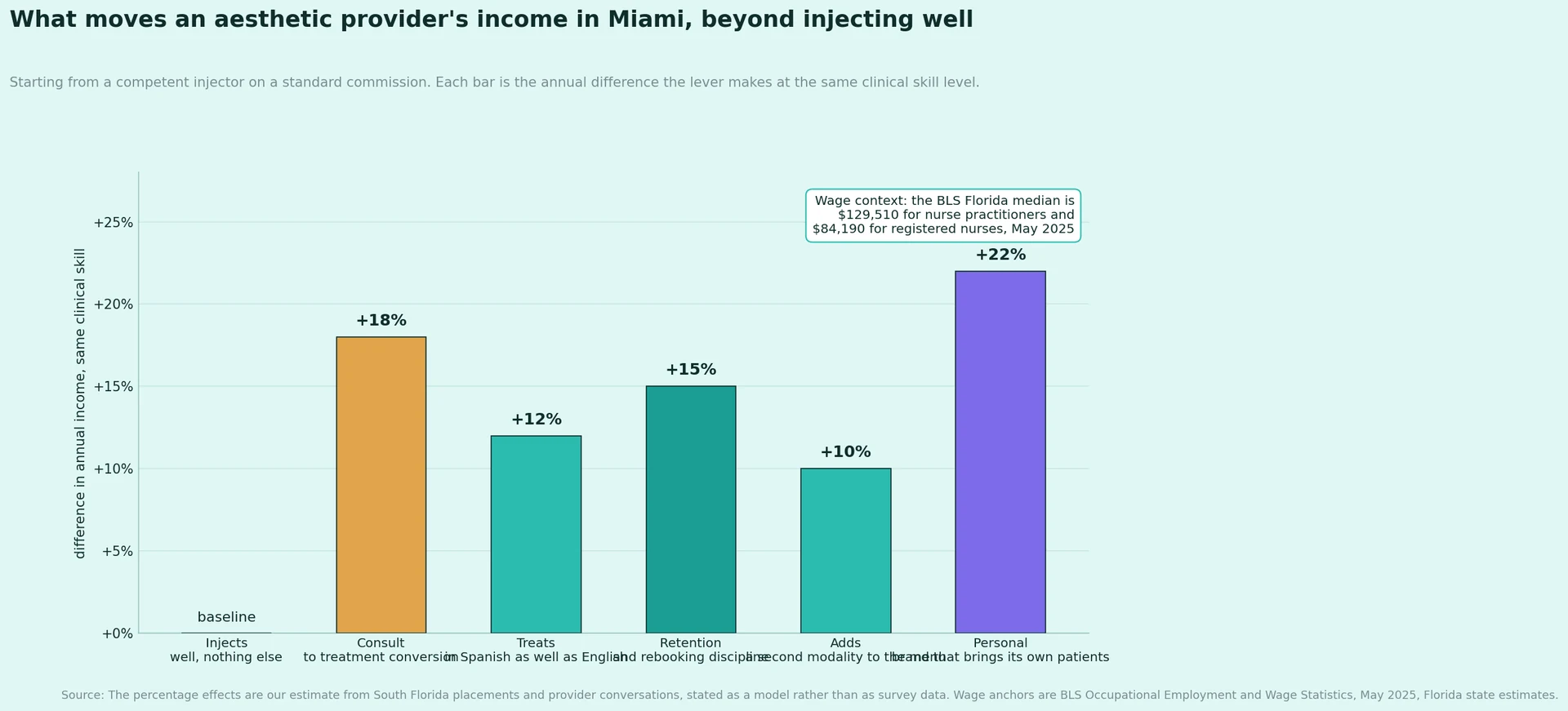
The annual income difference each lever makes at the same clinical skill. Percentages are our estimate from South Florida placements, stated as a model rather than as survey data. Wage anchors are BLS May 2025 Florida medians.
Rank them by durability and the answer changes. Conversion pays fastest. The personal brand pays longest, because it is the only asset on the list that is yours rather than the clinic's.
What does the Miami market actually pay?
Anchor the ambition to the federal numbers before you set a target. The BLS Florida median for nurse practitioners is $129,510 and for registered nurses $84,190, across 21,790 and 229,940 people employed in the state. Those are all employers, not aesthetics, so an aesthetic role should clear them rather than sit under them. What the levers above do is move you from clearing the median to being paid well above it, at the same level of clinical skill.
The pool size is the other half of the leverage. With 21,790 nurse practitioners in the whole of Florida and a small aesthetic subset, a provider who converts consultations and holds a book is not easily replaced. Our South Florida med spa salary report breaks the bands down by role and by whether the position injects.
Sources and how we checked them
Wage and scope figures are federal or statutory and dated. The lever estimates are ours and are labelled.
- The $129,510 and $84,190 Florida medians and the 21,790 and 229,940 Florida employment counts: BLS Occupational Employment and Wage Statistics, Florida state estimates, May 2025, pulled 10 September 2026.
- The authority a provider injects under, which decides whether they can hold their own book: Chapter 464 of the Florida Statutes, Statute 458.347 for physician assistants and Statute 458.348 for written protocols.
- The percentage effect of each lever is our estimate from South Florida placements and provider conversations. It is a model, stated as such on the chart, and not survey data.
Frequently Asked Questions
What is the most important skill for an aesthetic provider to develop in Miami?
Sales, above everything else. Miami is a cash-based, out-of-pocket market where patients are making discretionary spending decisions. Providers who know how to conduct a genuine consultation, address patient concerns, and guide them toward a treatment plan ethically and confidently build patient books that grow through retention and referrals. No other single skill has more direct impact on income trajectory in this market.
How important is speaking Spanish for an aesthetic provider in Miami?
It is a significant competitive advantage. Miami is a bilingual market where a large portion of the patient base is Spanish-dominant or prefers to receive aesthetic information in Spanish. Providers who communicate authentically in both languages access the full market. Those who operate only in English are functionally invisible to a substantial segment of potential patients.
Can an aesthetic provider in Miami compete on price?
Not sustainably. Miami patients have access to aesthetic clinics in Latin America at price points no Florida provider can match within legal operating costs. Competing on price attracts price-sensitive patients who will leave for a cheaper option the moment one appears. The sustainable strategy is differentiation through brand, patient experience, communication quality, and results consistency.
How important is Instagram or TikTok for providers in this market?
Extremely important. Personal brand on social media is a direct patient acquisition channel in Miami's aesthetic market. The highest-performing providers are not necessarily the most technically skilled - they are the ones who have built audiences that trust them. A patient who follows you for months before booking arrives at a consultation already decided, which produces higher conversion, higher retention, and more referrals.
When is an aesthetic provider ready to go independent in Miami?
When they have developed skills outside clinical work: marketing, sales, operations, and the discipline to manage all of it simultaneously while working the hours a startup practice demands. Going independent to escape structure or work less is rarely a strong enough foundation. Going independent with an existing patient base, a clear marketing plan, and the business skills to execute is a calculated move with a realistic path to growth.
How does Miami compare to other Florida markets for aesthetic providers?
Miami offers the largest earning ceiling and the most competitive environment simultaneously. South Florida consistently outpays Orlando, Tampa, and other Florida markets at the senior level. The patient base is larger, the spending is higher, and the international client base adds depth that other markets do not have. The trade-off is that the competition is also significantly more intense and price differentiation is harder due to competition with Latin American providers.
What advanced training investments are worth it for aesthetic providers in Miami?
Techniques that justify premium pricing and cannot be easily learned over a weekend: advanced filler placement, thread lifting, combination treatment planning, and any modality with high patient demand and limited provider supply in the market. The training worth investing in is the kind that adds a service your current practice does not offer and that your target patient demographic is actively seeking. Generic injectable refresher courses, by contrast, rarely move the needle on a provider's market position in a sophisticated market like Miami.